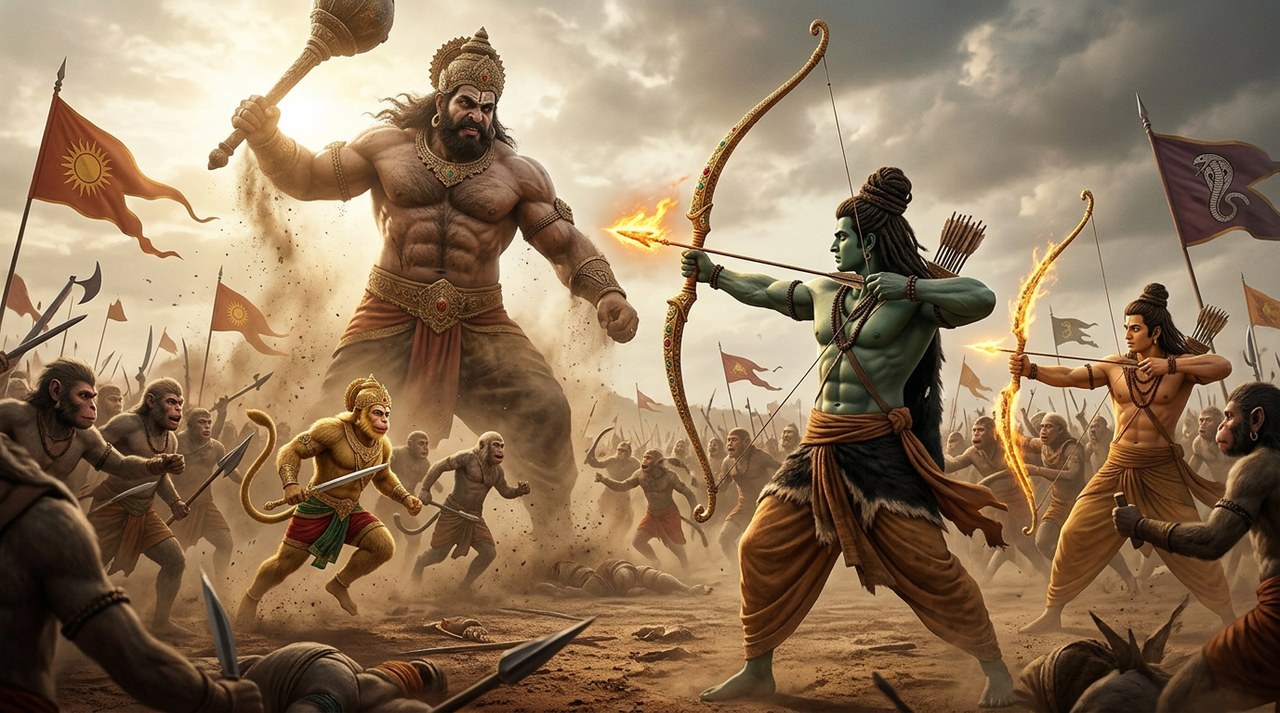
Twenty-two illustrated scenes tracing the epic from the fire sacrifice that called Rāma into the world to the first singing of the poem itself. Every panel names its kāṇḍa and sarga so you can read the original alongside it.
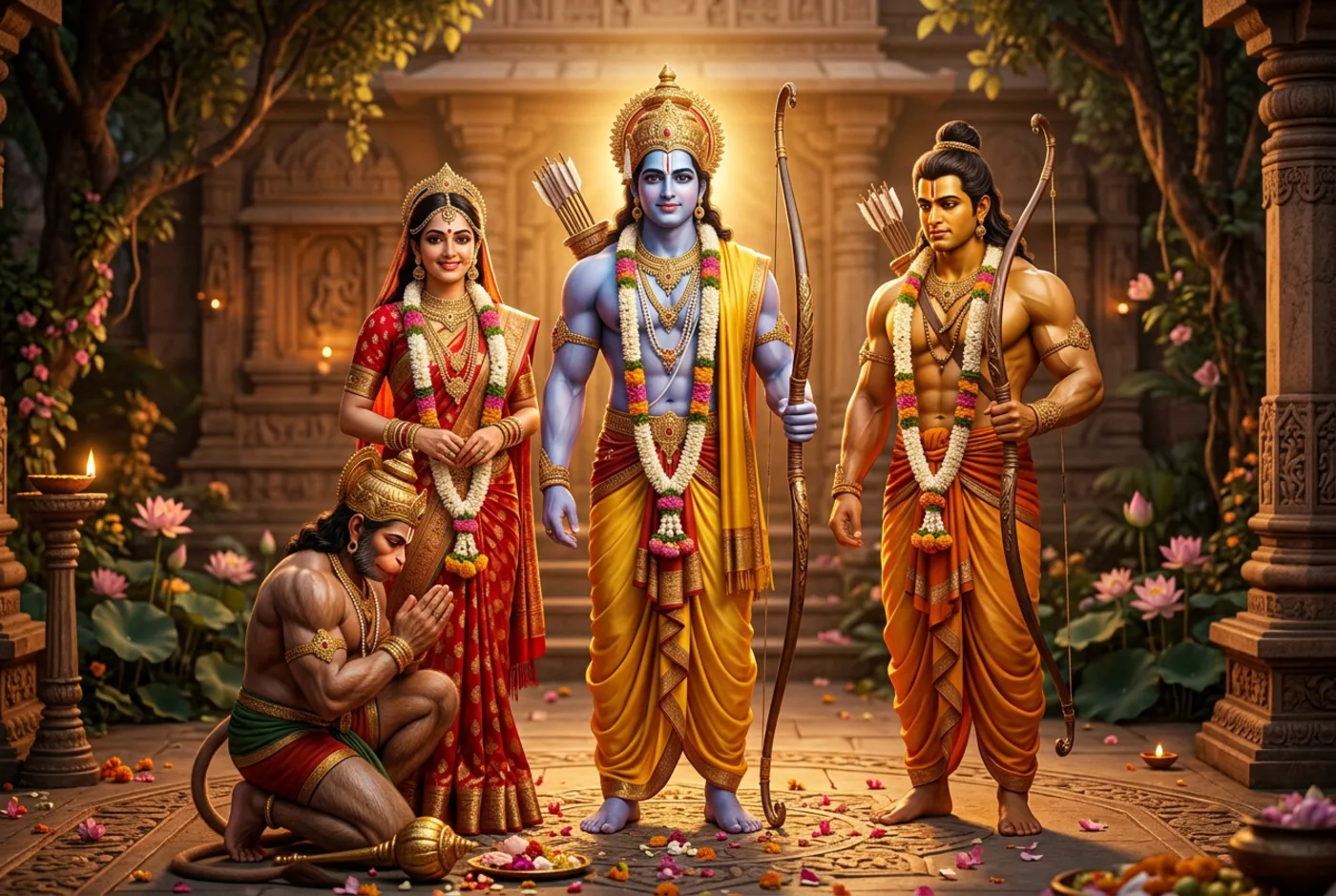
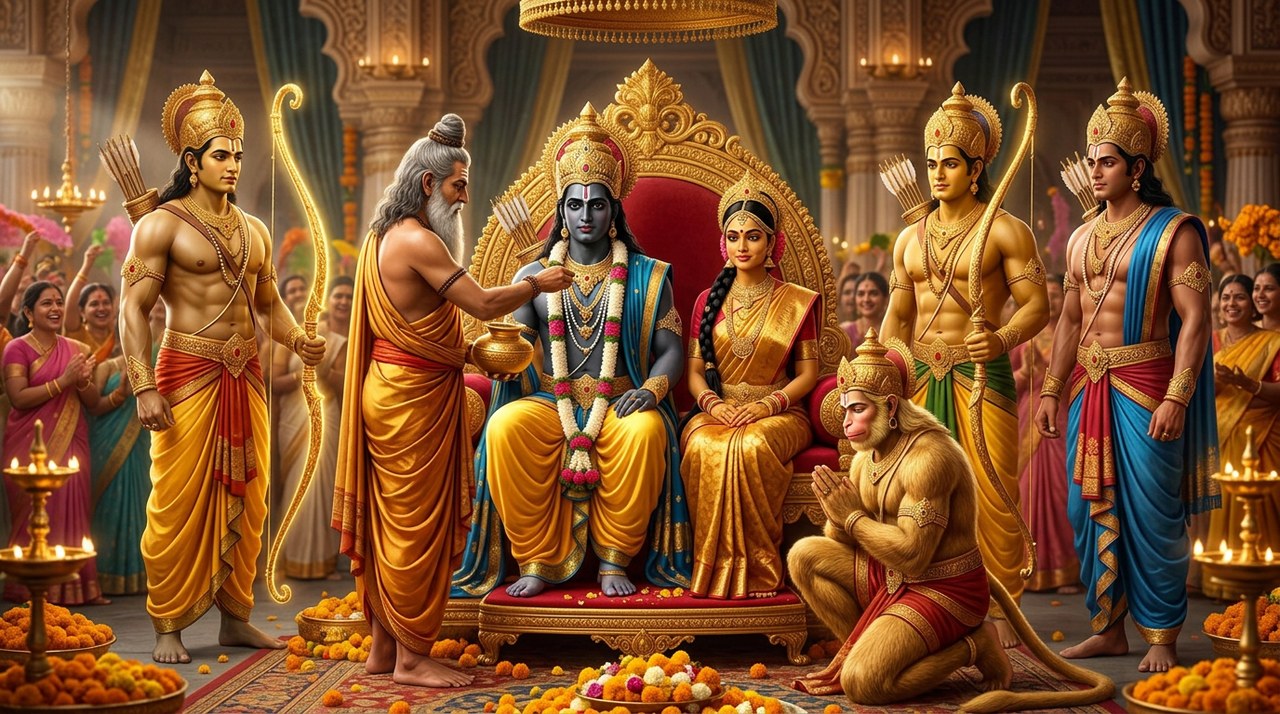
Sītā and Rāma together in the Rāma Darbār, with Lakṣmaṇa at his side and Hanumān kneeling at their feet. Depictions follow Vālmīki: Rāma is ājānubāhu and of cloud-dark hue; Lakṣmaṇa is gaura, golden-fair, of the same height and build; Sītā is tapta-hema-varṇā, of molten gold, in fine silk and royal ornaments.
बालकाण्ड · The Book of Childhood
Bāla Kāṇḍa
The birth of Rāma from Daśaratha's putrakāmeṣṭi sacrifice, his training under Viśvāmitra, and his marriage to Sītā after breaking the bow of Śiva.
1
Scene 1 · Bāla Kāṇḍa, sargas 14–18
The Sacrifice that Called Down God
पुत्रकामेष्टि यज्ञ
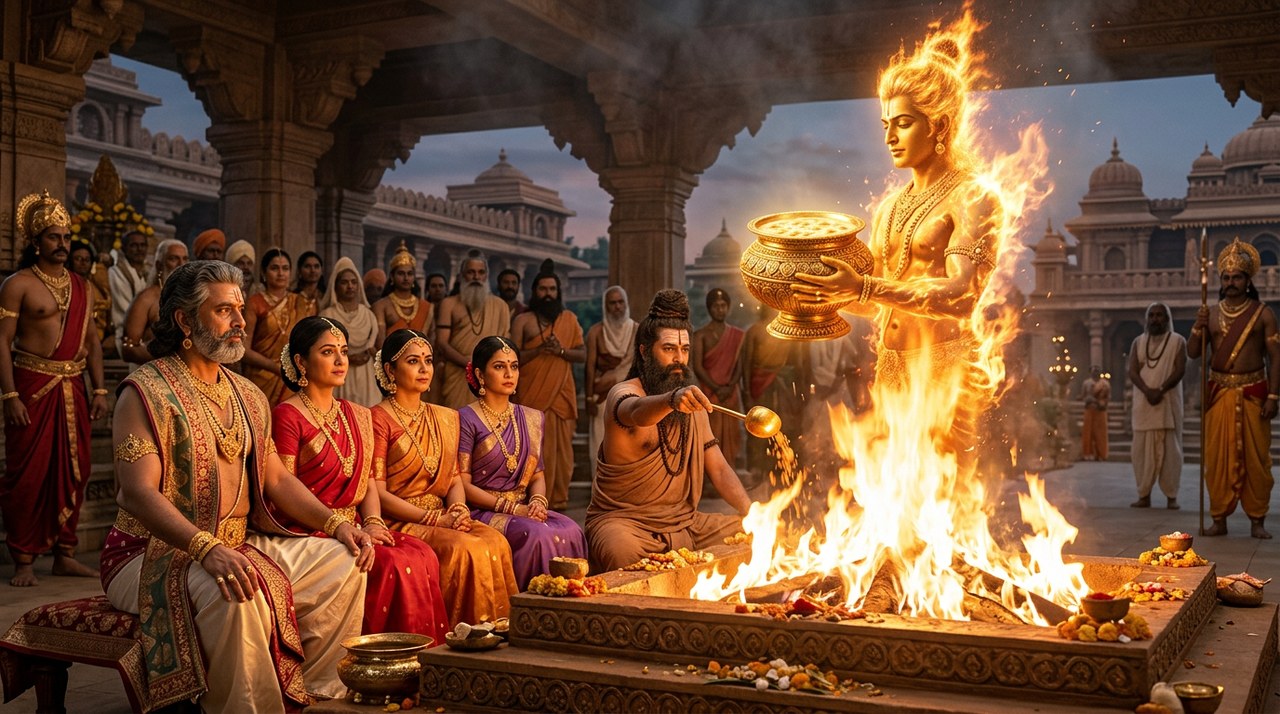
Daśaratha, emperor of Kosala, is childless. On the counsel of Vasiṣṭha he invites the sage Ṛṣyaśṛṅga to conduct the aśvamedha followed by the putrakāmeṣṭi — the rite performed in desire of sons.
From the sacrificial fire rises a being of blazing splendour bearing a golden vessel of divine pāyasa. Divided among Kausalyā, Kaikeyī and Sumitrā, it brings forth Rāma, Bharata, and the twins Lakṣmaṇa and Śatrughna — Viṣṇu descending in four portions to end the tyranny of Rāvaṇa, who had been made invulnerable to gods and demons but had disdained to ask protection from men.
2
Scene 2 · Bāla Kāṇḍa, sargas 19–49
Viśvāmitra Claims the Princes
विश्वामित्रागमन
The sage Viśvāmitra arrives at court and asks for Rāma — a boy of fifteen — to guard his sacrifice from the rākṣasas. Daśaratha resists; Vasiṣṭha persuades him.
In the forest Rāma slays Tāṭakā, receives the divine astras bala and atibalā, destroys Subāhu and hurls Mārīca far across the ocean. Entering Gautama's hermitage, his very presence frees Ahalyā from her unseen state of penance. The exile of a prince begins here as an apprenticeship in dharma.
3
Scene 3 · Bāla Kāṇḍa, sargas 66–76
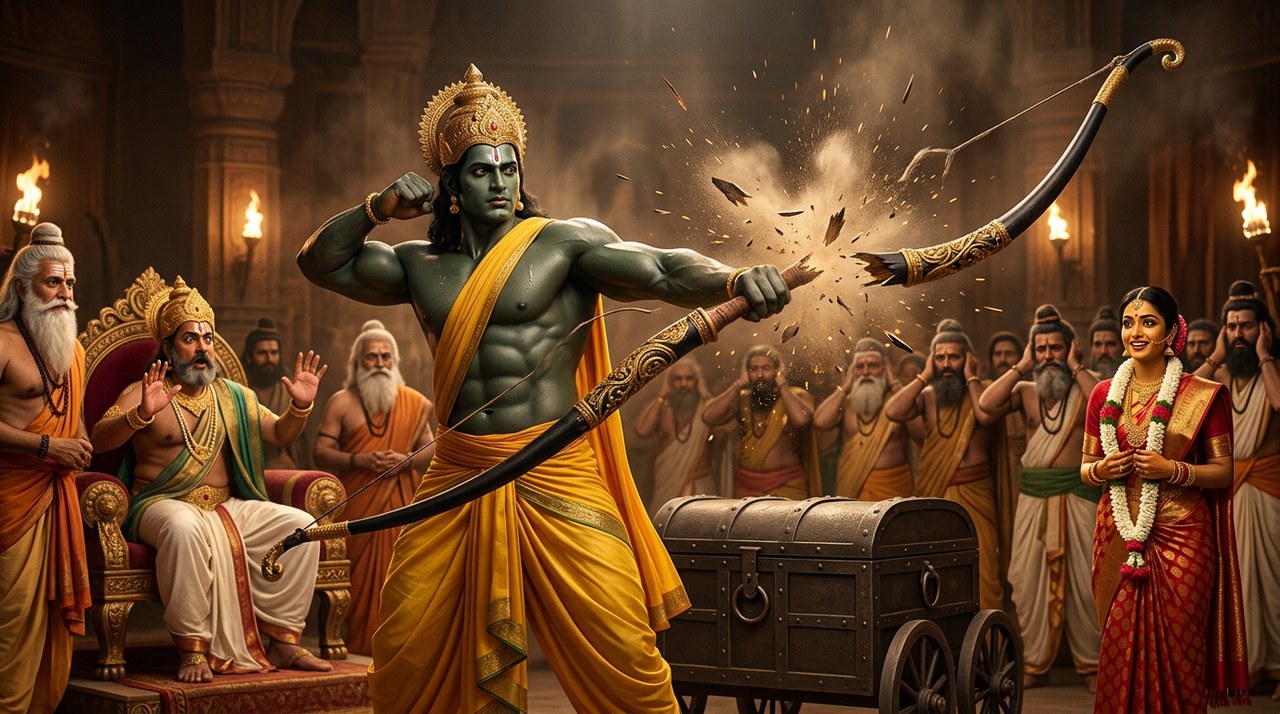
The Breaking of Śiva's Bow
शिवधनुर्भङ्ग
In Mithilā, King Janaka has vowed his daughter Sītā — found in the furrow of the earth — to whoever can string the colossal bow of Śiva. Kings have failed even to stir it.
Rāma lifts it, bends it, and snaps it with a sound like thunder, and Janaka joyfully offers Sītā in marriage. Four brothers are wedded to four princesses; on the return road Paraśurāma challenges Rāma and yields to him, transferring the Vaiṣṇava bow.
अयोध्याकाण्ड · The Book of Ayodhyā
Ayodhyā Kāṇḍa
Kaikeyī's two boons, the fourteen-year exile, Daśaratha's death, and Bharata's refusal of the throne in favour of Rāma's sandals.
4
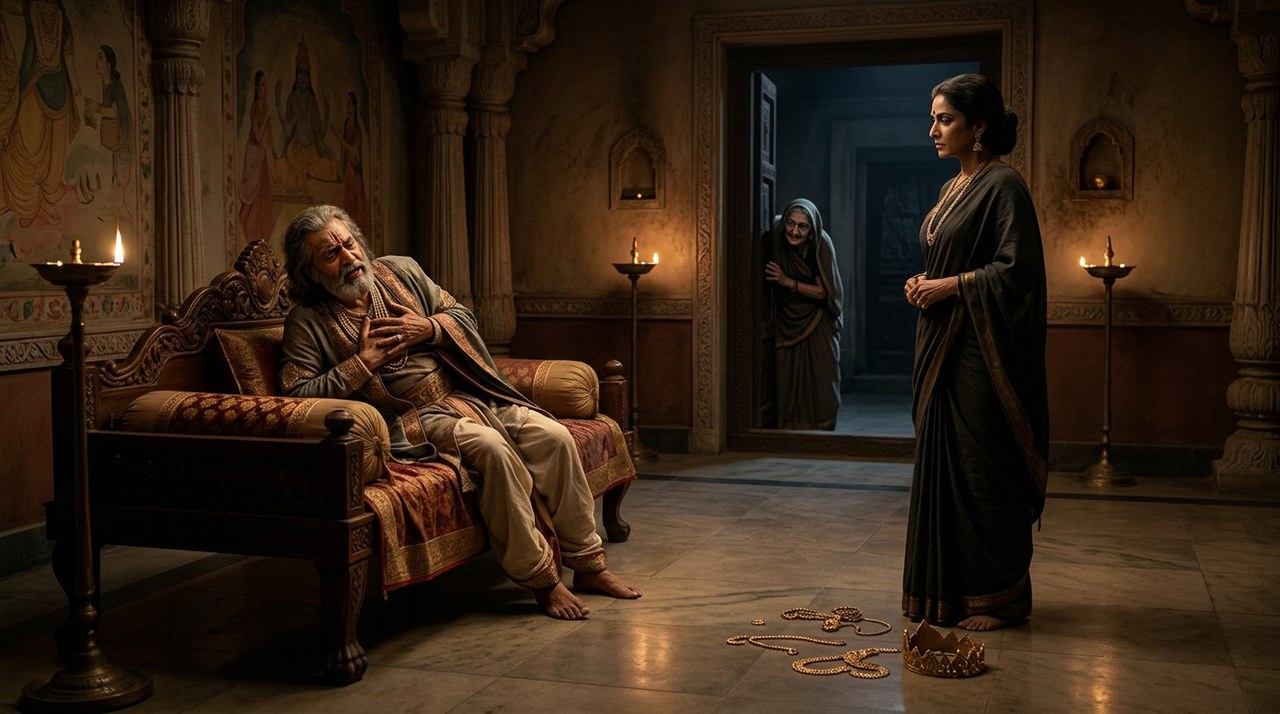
Scene 4 · Ayodhyā Kāṇḍa, sargas 9–19
Two Boons, Fourteen Years
कैकेयीवरदान
On the eve of Rāma's coronation, Mantharā poisons Kaikeyī's mind. She invokes two boons long ago granted by Daśaratha: the throne for Bharata, and fourteen years of forest exile for Rāma.
The king collapses; Rāma accepts without a tremor, holding his father's word to be higher than a kingdom. Sītā refuses to remain behind, and Lakṣmaṇa refuses to be parted from his brother.
रामो द्विर्नाभिभाषते
rāmo dvirnābhibhāṣate
“Rāma never speaks a thing twice — his word, once given, is final.”
— Ayodhyā Kāṇḍa 18.30
5
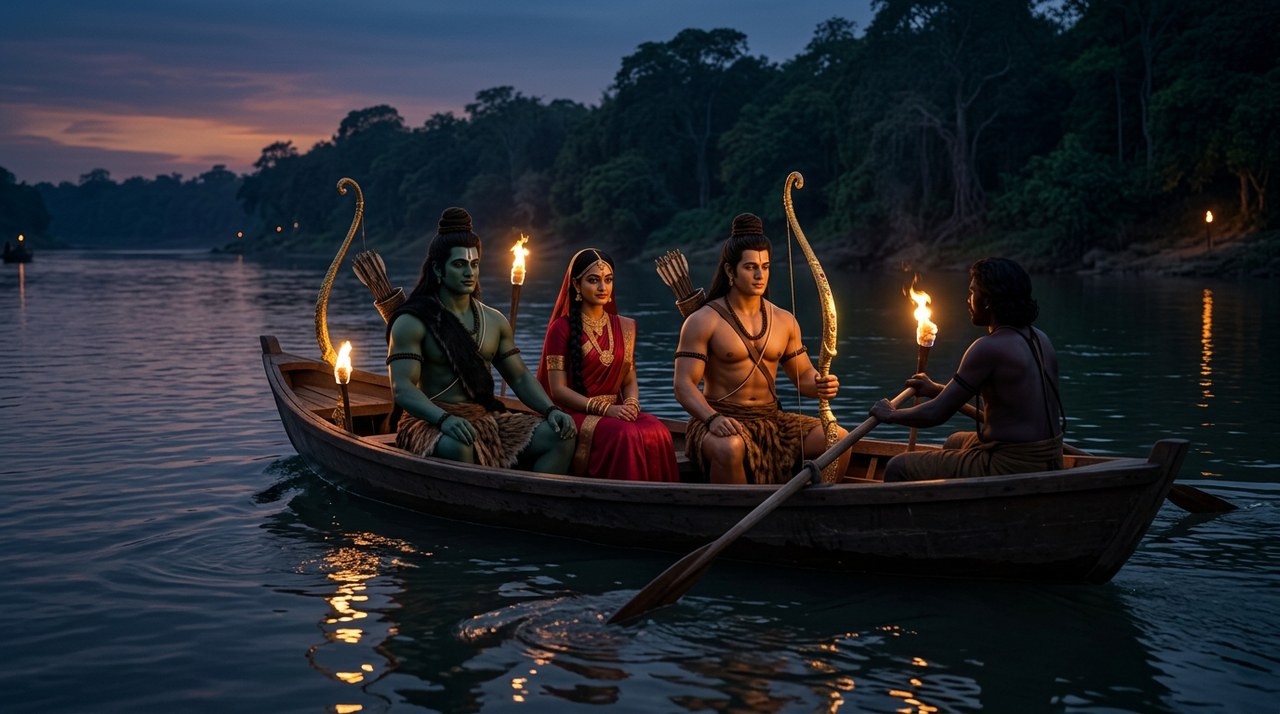
Scene 5 · Ayodhyā Kāṇḍa, sargas 50–52
Crossing the Gaṅgā
गङ्गावतरण — गुहसंवाद
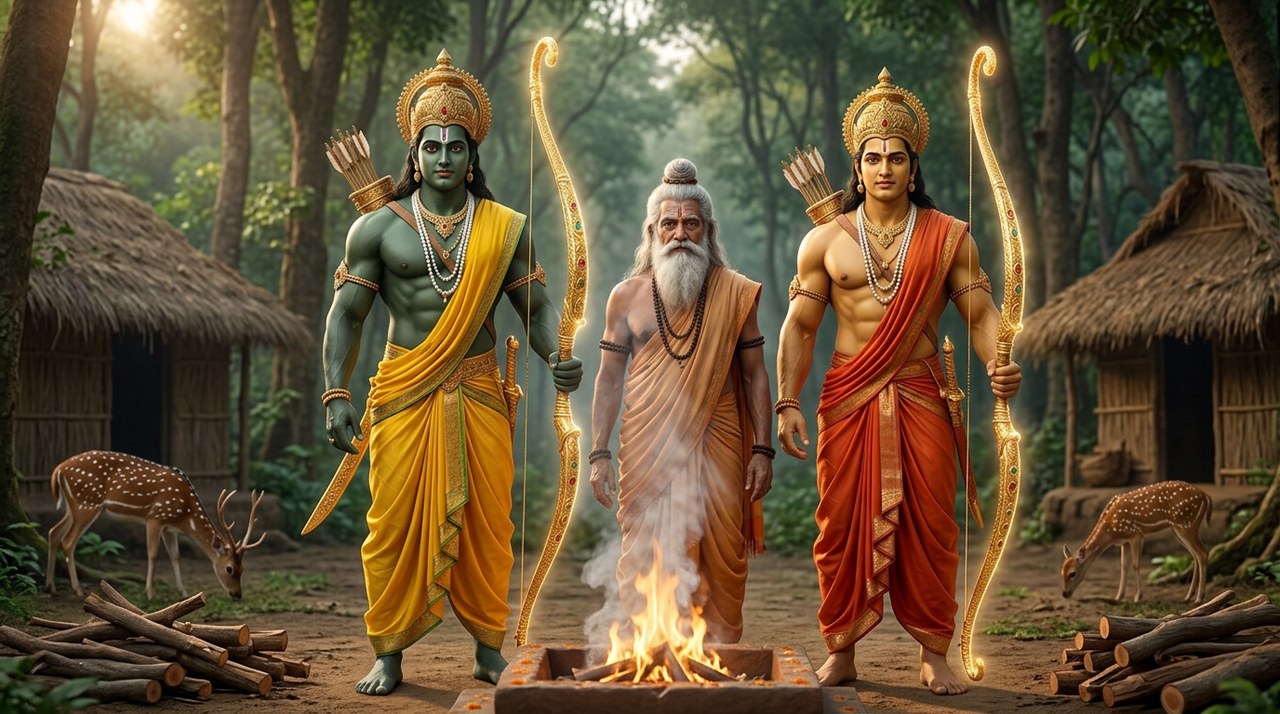
Guha, chief of the Niṣādas, receives the exiles with the love of a brother and ferries them across the Gaṅgā. Rāma and Lakṣmaṇa have already matted their hair into jaṭā and exchanged silk for valkala bark-cloth.
Sītā alone remains as she was — a queen in fine silk and gold ornaments in the middle of the wilderness, for her vow is to her husband, not to asceticism.
6
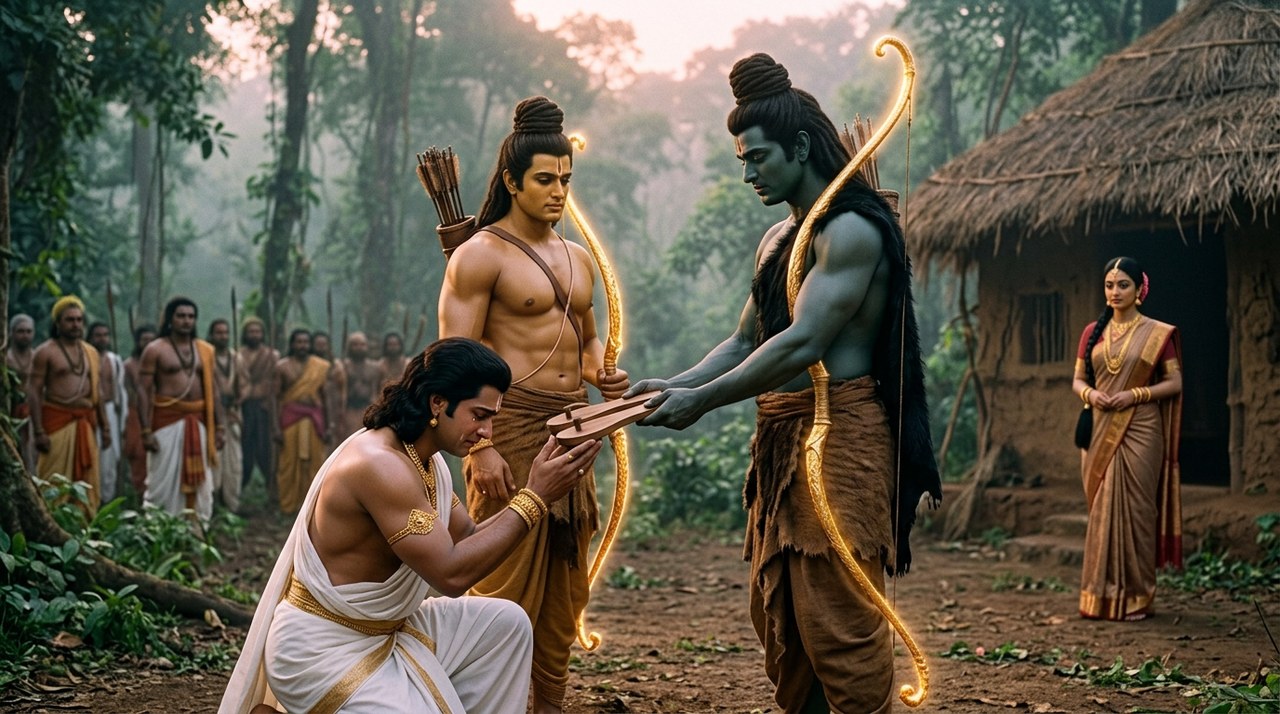
Scene 6 · Ayodhyā Kāṇḍa, sargas 99–115
The Sandals on the Throne
पादुकाप्रदान
Daśaratha dies of grief. Bharata, returning to find himself king by his mother's contrivance, marches to Citrakūṭa with the whole army — not to rule but to beg Rāma home.
Rāma will not break his father's word. Bharata carries back his wooden pādukā, places them on the throne, and governs from Nandigrāma as regent for fourteen years, living himself as an ascetic.
अरण्यकाण्ड · The Book of the Forest
Araṇya Kāṇḍa
Life at Pañcavaṭī, Śūrpaṇakhā's humiliation, the golden deer, the abduction of Sītā, and the fall of Jaṭāyu.
7
Scene 7 · Araṇya Kāṇḍa, sargas 12–30
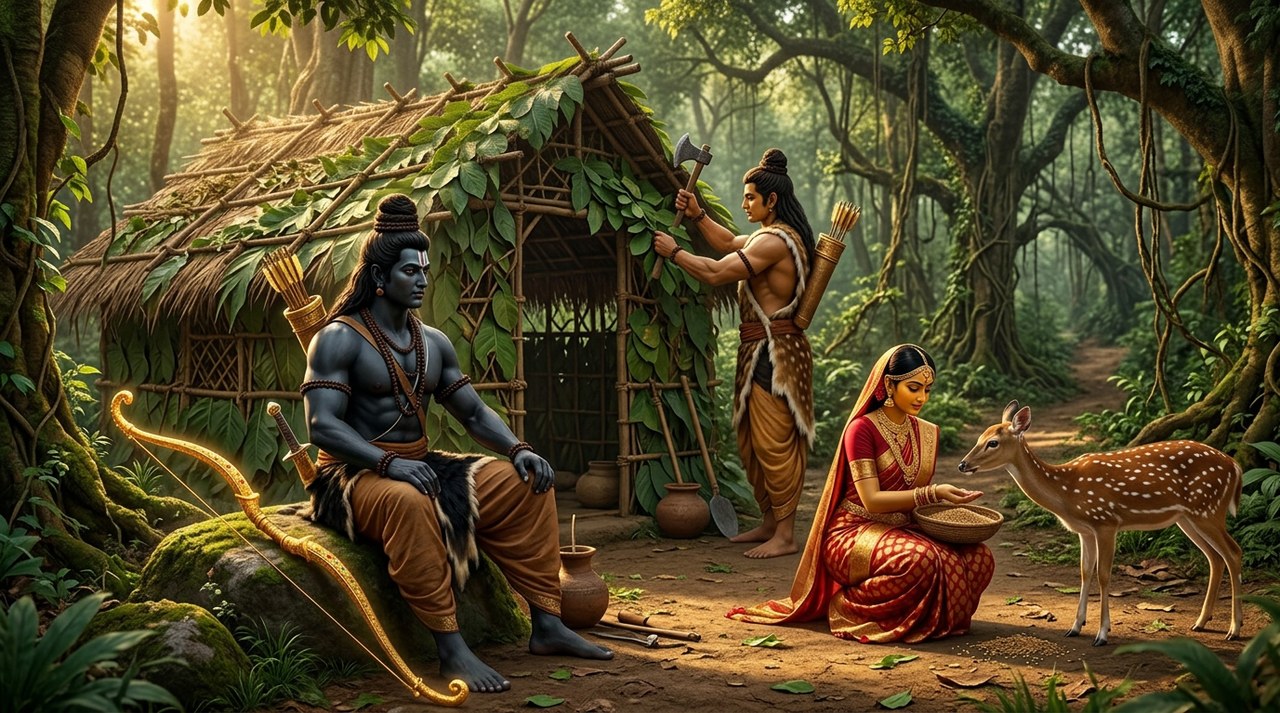
The Hut at Pañcavaṭī
पञ्चवटी निवास
On Agastya's advice they settle at Pañcavaṭī on the Godāvarī. Lakṣmaṇa raises a hut of leaves and bamboo; the years pass in study, hospitality to sages, and the protection of the forest hermitages.
Śūrpaṇakhā, Rāvaṇa's sister, desires Rāma, is refused, attacks Sītā, and is disfigured by Lakṣmaṇa. Khara and Dūṣaṇa come with fourteen thousand rākṣasas; Rāma destroys them alone. The war with Laṅkā has begun.
8
Scene 8 · Araṇya Kāṇḍa, sargas 42–45
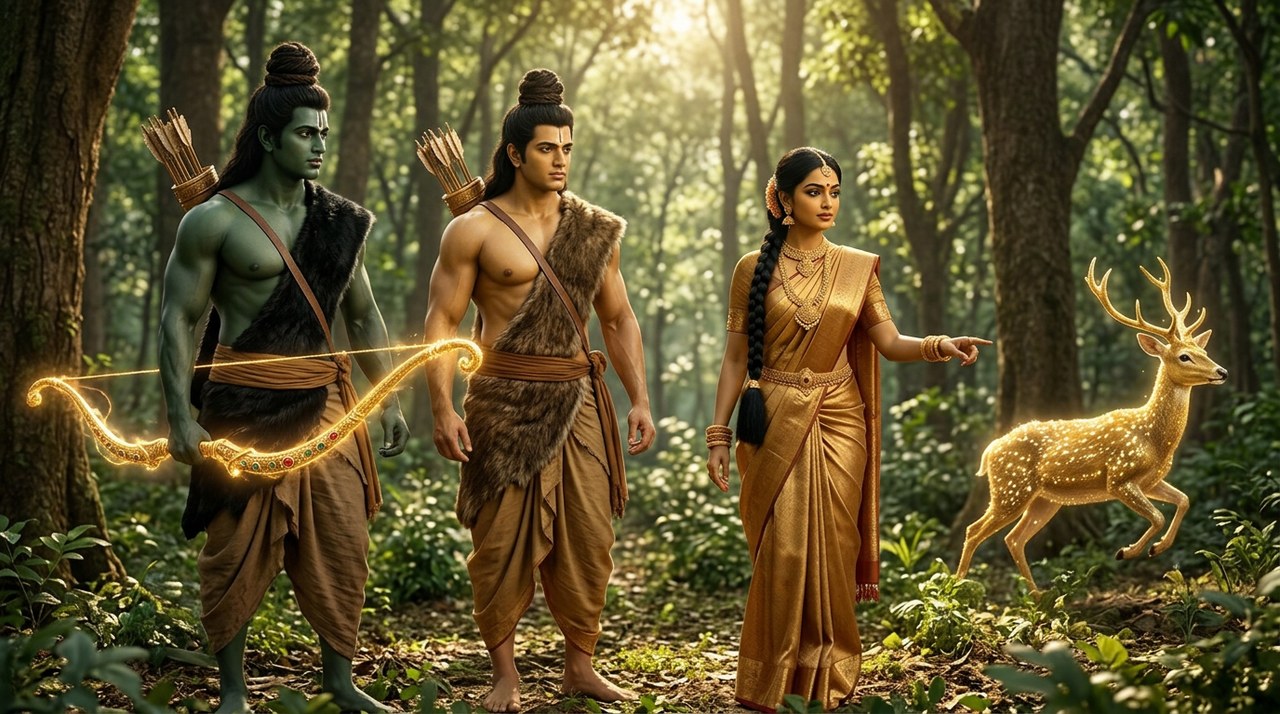
The Golden Deer
मारीच मृग
Mārīca, forced by Rāvaṇa, becomes a deer of gold and gems. Sītā longs for it; Rāma pursues and pierces it, and the dying demon cries out in Rāma's own voice: 'Hā Sītā! Hā Lakṣmaṇa!'
Sītā, in terror, drives Lakṣmaṇa away with words he cannot bear. Reluctantly he walks away to seek his brother, leaving the hut empty of protectors — which was the entire purpose of the illusion.
9
Scene 9 · Araṇya Kāṇḍa, sargas 47–68
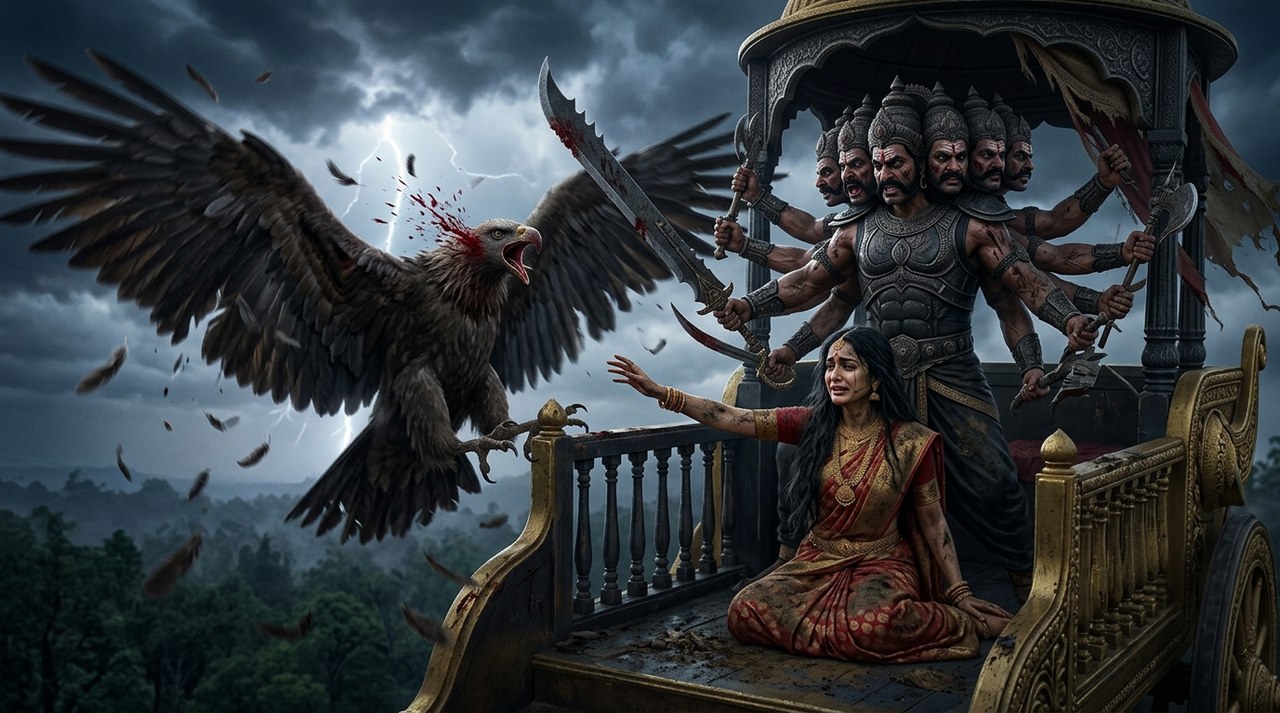
The Abduction and Jaṭāyu's Last Flight
सीताहरण — जटायुवध
Rāvaṇa comes disguised as a mendicant, seizes Sītā and rises into the sky. She scatters her ornaments to the vānaras on the hills below — the only trail she can leave.
The aged vulture king Jaṭāyu, friend of Daśaratha, hurls himself at the chariot, shatters it and is cut down. He lives only long enough to tell Rāma the direction of the south, and dies in his arms receiving the funeral rites of a father.
किष्किन्धाकाण्ड · The Book of Kiṣkindhā
Kiṣkindhā Kāṇḍa
The meeting with Hanumān and Sugrīva, the alliance of the vānaras, and the search for Sītā in all directions.
10
Scene 10 · Kiṣkindhā Kāṇḍa, sargas 1–26
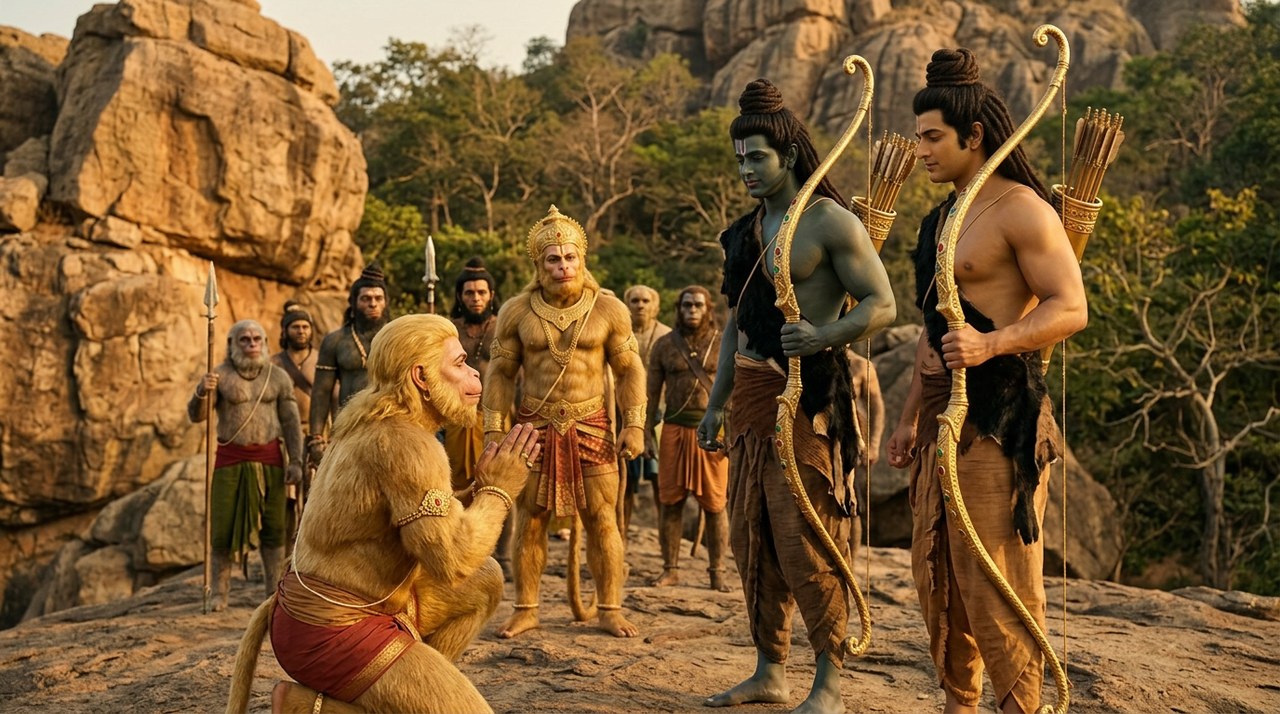
Hanumān Finds His Lord
हनुमद्दर्शन — सुग्रीवसख्य
On Ṛṣyamūka, Hanumān approaches in the guise of a brahmacārin and speaks so faultlessly that Rāma remarks no one ignorant of the whole Veda could speak thus. He carries the brothers on his shoulders to Sugrīva.
Fire is witness to the alliance: Rāma will destroy Vālin, Sugrīva will find Sītā. Sītā's dropped ornaments, kept by the vānaras, are the first proof that she lives. Search parties go out to all four quarters.
सुन्दरकाण्ड · The Beautiful Book
Sundara Kāṇḍa
Hanumān's leap across the ocean, his meeting with Sītā in the Aśoka grove, and the burning of Laṅkā.
11
Scene 11 · Sundara Kāṇḍa, sargas 1–3
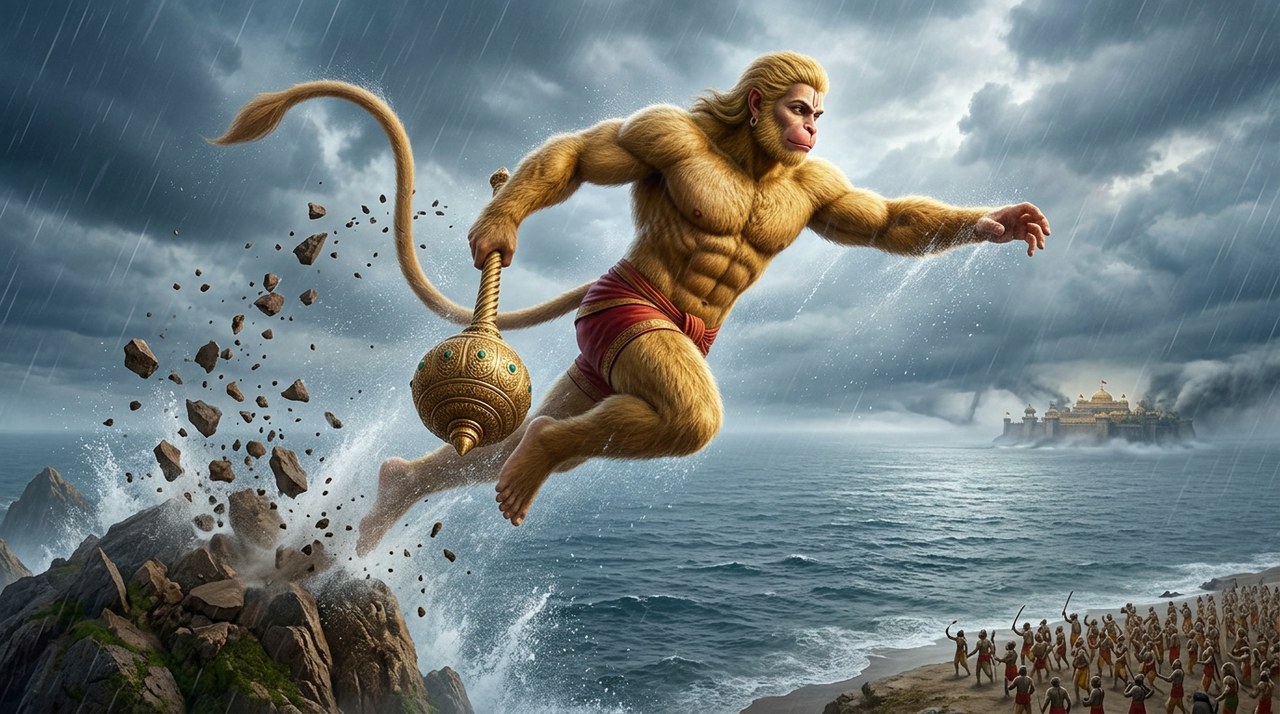
The Leap Across the Ocean
समुद्रलङ्घन
Jāmbavān reminds Hanumān of the strength he had forgotten under a sage's curse. He swells to mountain size and springs from Mahendra hill; the peak sinks beneath his feet.
He passes Maināka's offered rest, tears through Surasā by wit, and destroys Siṃhikā by force — a hundred yojanas of ocean crossed by a single devotee's will. This glorious sequence gives the Sundara Kāṇḍa its name.
12
Scene 12 · Sundara Kāṇḍa, sargas 14–38
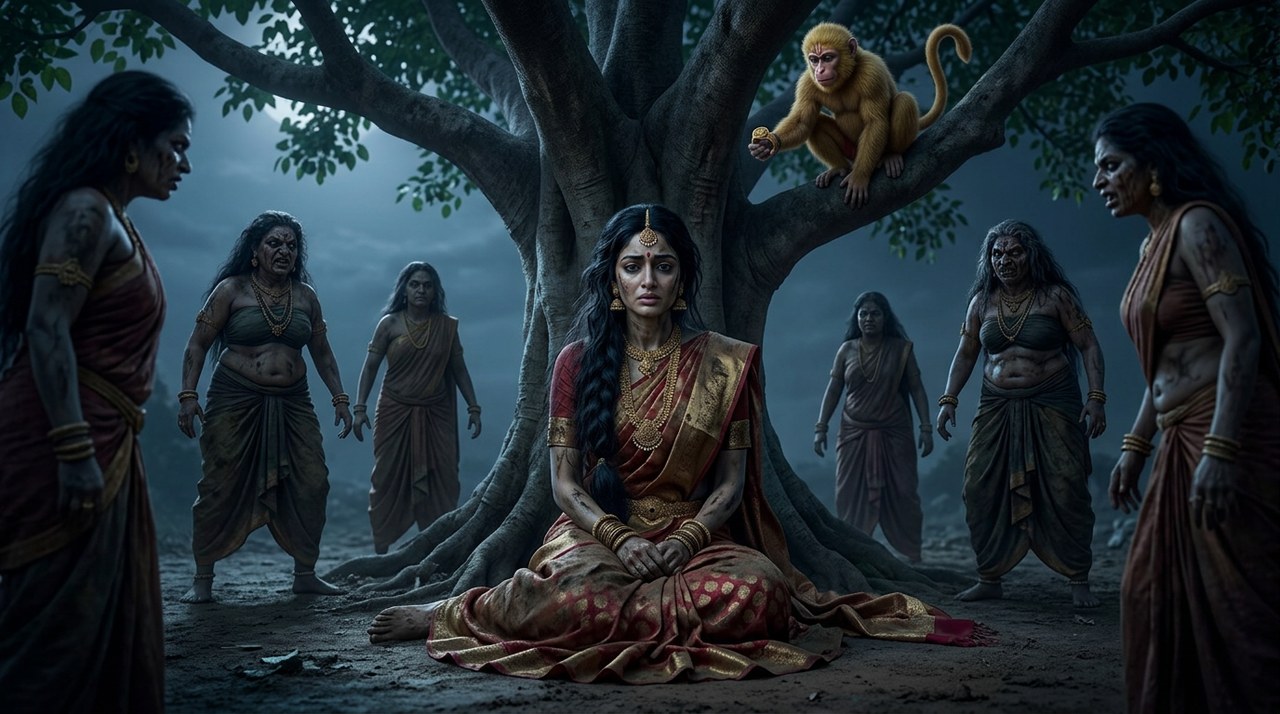
Sītā in the Aśoka Grove
अशोकवनिका — अङ्गुलीयकप्रदान
He finds her beneath a śiṃśapā tree, ringed by rākṣasīs. She wears the same fine silk she wore when she was seized — now crumpled, stained with dust and grief, her single braid unbound; she has refused every luxury Rāvaṇa offered and touches nothing of Laṅkā.
Hanumān drops Rāma's signet ring before her, tells her all, and offers to carry her away at once. She refuses: the glory must be Rāma's, and she will not be touched by another. She gives him her cūḍāmaṇi as the token of recognition.
न त्वहं तं नरव्याघ्रं विना जीवितुमुत्सहे
na tvahaṃ taṃ naravyāghraṃ vinā jīvitumutsahe
“Without that tiger among men I have no wish to remain alive.”
— Sundara Kāṇḍa 26.6
13
Scene 13 · Sundara Kāṇḍa, sargas 41–55
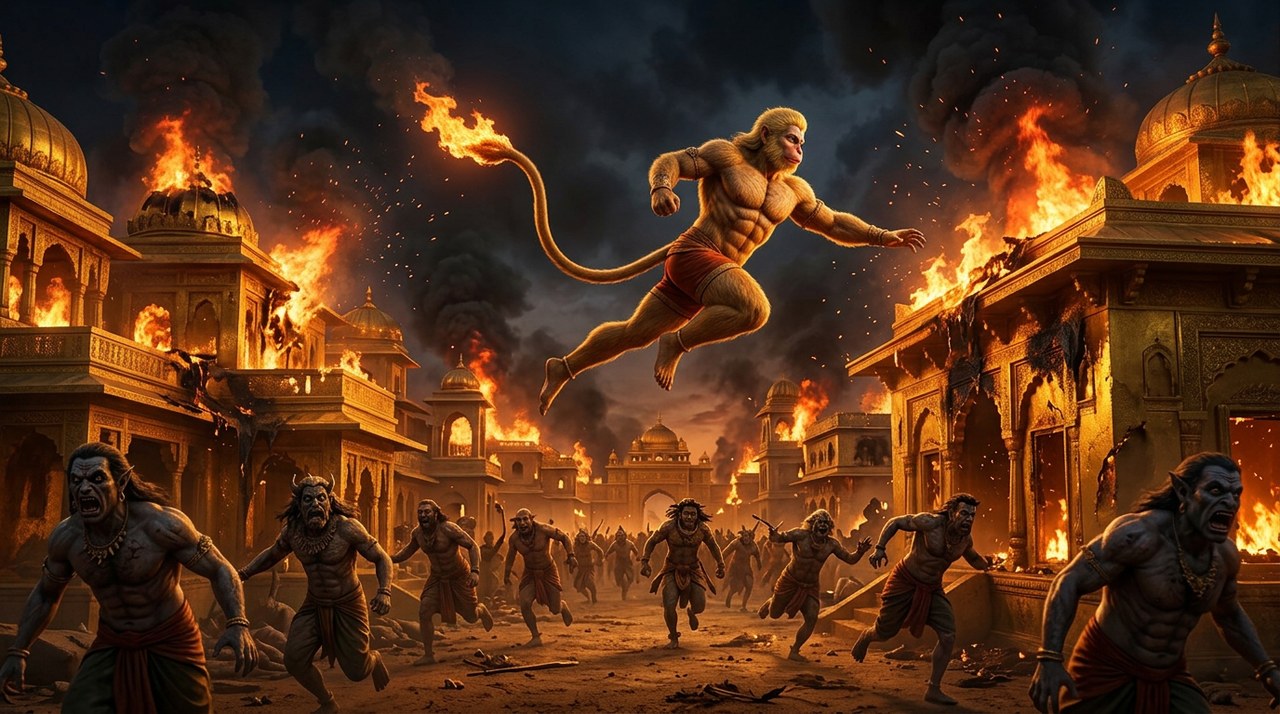
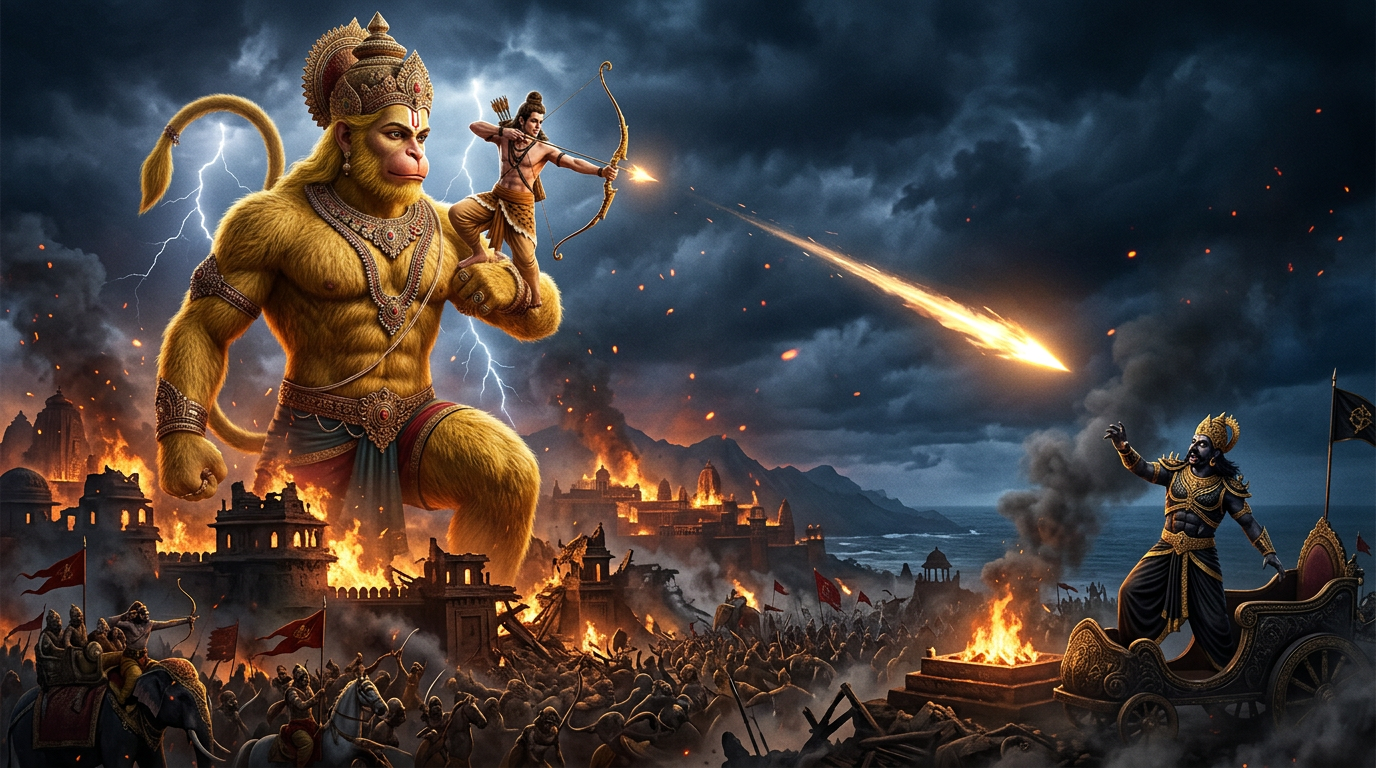
The Burning of Laṅkā
लङ्कादहन
Hanumān wrecks the pleasure grove, kills Jambumālī and Akṣakumāra, and allows Indrajit's brahmāstra to bind him. Though the rākṣasas' physical ropes instantly nullify the astra, he plays along to speak to Rāvaṇa face to face.
Sentenced to have his tail set alight, he leaps from roof to roof and turns the golden city into a furnace — sparing the grove where Sītā sits. Then he quenches the fire in the sea and returns to the vānaras with the joyful news that Sītā has been seen.
युद्धकाण्ड · The Book of War
Yuddha Kāṇḍa
The bridge of stones, the great battle, the fall of Kumbhakarṇa and Indrajit, the death of Rāvaṇa, and the return to Ayodhyā.
14
Scene 14 · Yuddha Kāṇḍa, sargas 19–22
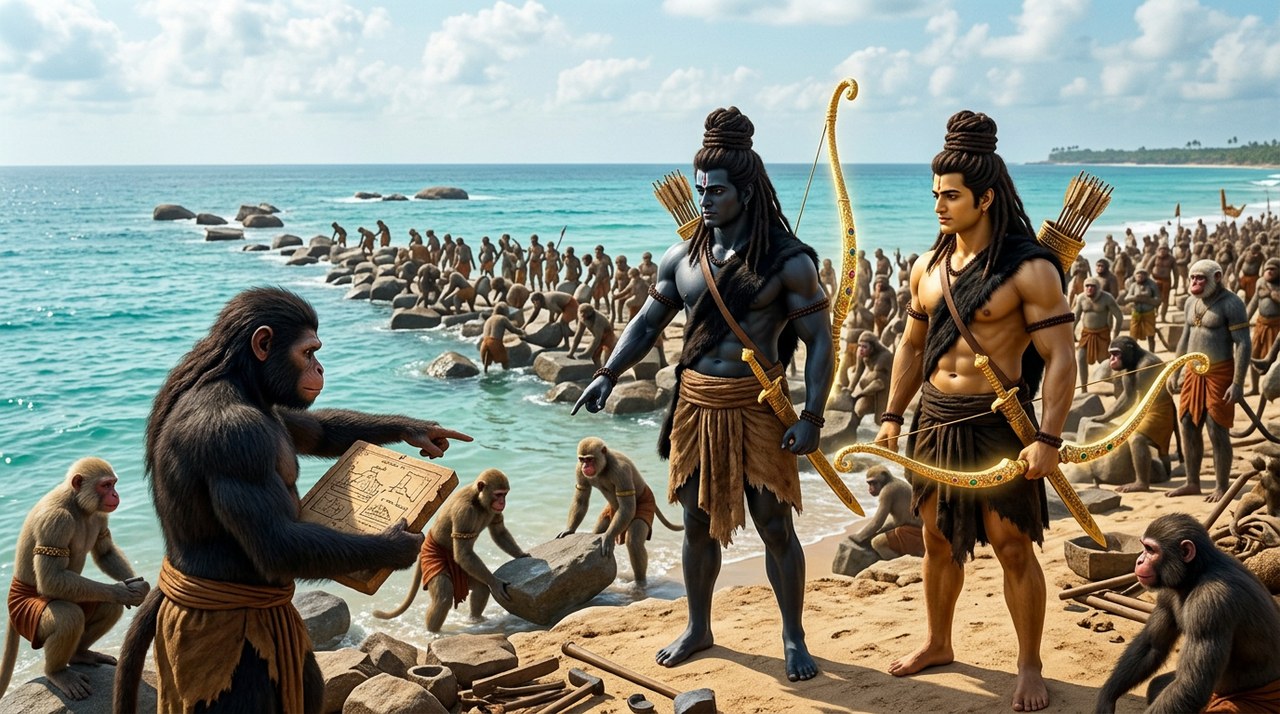
The Bridge of Stones
सेतुबन्ध
Vibhīṣaṇa, refusing his brother's adharma, takes refuge with Rāma and is accepted and crowned king of Laṅkā in advance. Rāma fasts three days on the shore; when the ocean does not answer he raises his bow, and Samudra appears.
Nala, son of Viśvakarmā, builds the setu — a hundred yojanas long, ten wide — in five days. The army of vānaras crosses to Laṅkā.
15
Scene 15 · Yuddha Kāṇḍa, sargas 60–67
The Waking of Kumbhakarṇa
कुम्भकर्णवध
Kumbhakarṇa is woken from his half-year sleep with drums, elephants and cold water. Told of the war, he rebukes Rāvaṇa plainly: the abduction of Sītā was adharma, and no counsel of ministers can undo it.
Yet he will not abandon his brother. He goes out, devours and scatters the vānara host, strikes Sugrīva down and is finally felled by Rāma — arms and head severed by the aindrāstra, his colossal body falling into the sea.
16
Scene 16 · Yuddha Kāṇḍa, sargas 44–50, 73–74
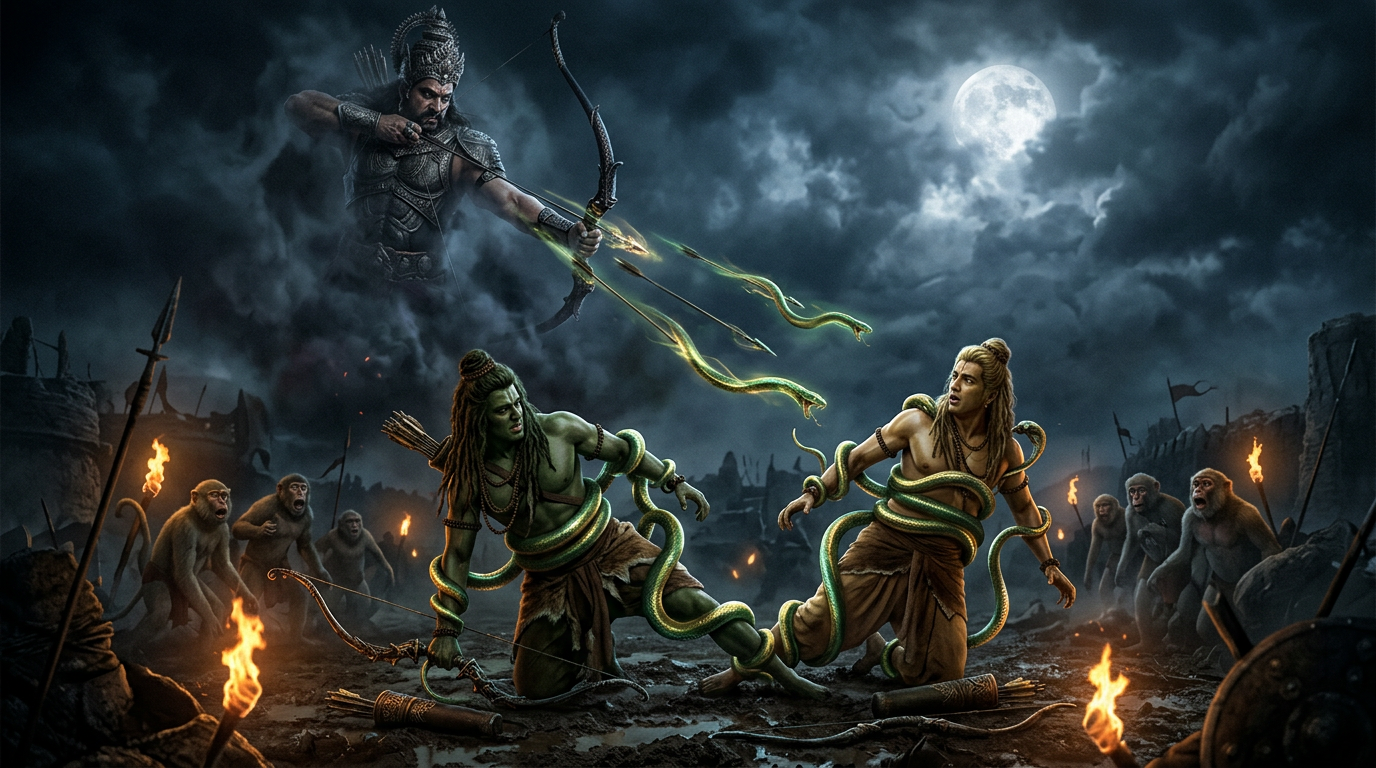
Meghanāda's Deceit — the Serpent Noose
इन्द्रजित् — नागपाश
Meghanāda — called Indrajit since he defeated Indra himself — never fights in the open. Rising into the sky and vanishing behind his māyā, he wounds an enemy who cannot see where the arrows come from. This is his whole art: victory by concealment.
In his first sortie he binds Rāma and Lakṣmaṇa in the nāgapāśa, the noose of serpents, and both brothers fall to the earth pierced through and motionless. The vānara host despairs; Vibhīṣaṇa and Hanumān hold the line. Garuḍa, the eternal enemy of serpents, arrives out of friendship for Rāma, and at his mere presence the snakes flee and the wounds close.
Later Indrajit tries deceit of another kind: he conjures an illusory Sītā and slays her before Hanumān's eyes to break the army's will. Vibhīṣaṇa exposes the trick at once — the real Sītā is guarded in the Aśoka grove, and Rāvaṇa would never permit her death.
मायायोधी हि दुर्धर्षो रावणिः समितिञ्जयः
māyāyodhī hi durdharṣo rāvaṇiḥ samitiñjayaḥ
“Rāvaṇa's son, unassailable and victorious in battle, fights by illusion.”
— Yuddha Kāṇḍa 73 (of Indrajit)
17
Scene 17 · Yuddha Kāṇḍa, sargas 73–74, 100–101
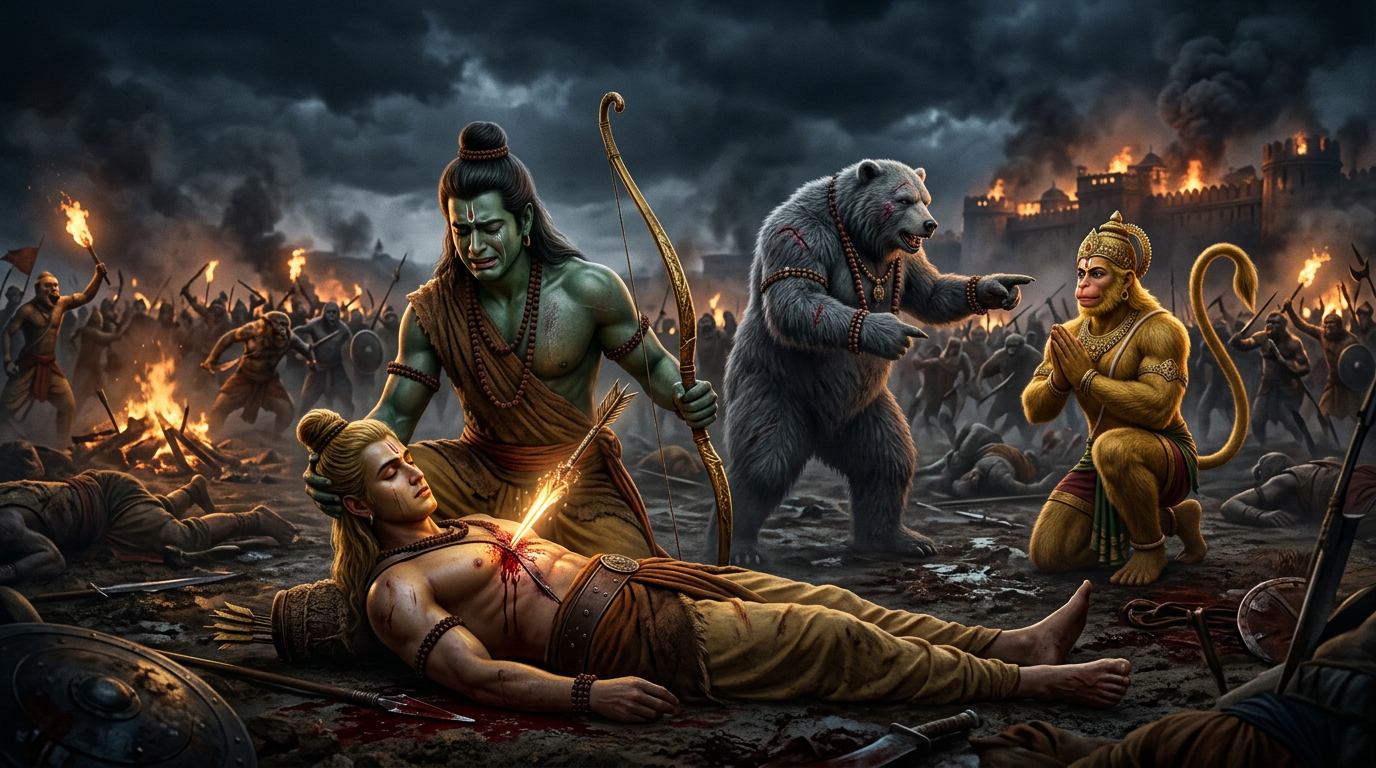
Indrajit's Śakti Fells Lakṣmaṇa
शक्तिप्रहार — लक्ष्मणमूर्च्छा
Unable to overcome Lakṣmaṇa in open combat, Indrajit hurls the śakti — the blazing javelin given to him by Brahmā's grace — straight into his chest. Lakṣmaṇa falls senseless upon the field, breath failing, and the vānara army goes silent around him.
Rāma, who has faced every loss without flinching, breaks here. Vālmīki lets him say that kingdoms and wives may be found again anywhere, but never a brother such as this; he speaks of following Lakṣmaṇa in death and abandoning the war altogether.
It is Jāmbavān, the ancient bear-king, who steadies the host. He does not ask whether Rāma still stands — he asks only whether Hanumān lives, for while Hanumān lives the army is not dead. Told that he lives, Jāmbavān sends him north at once to the mountain of healing herbs beyond the Himavat, and Hanumān rises into the night sky.
देशे देशे कलत्राणि देशे देशे च बान्धवाः। तं तु देशं न पश्यामि यत्र भ्राता सहोदरः॥
deśe deśe kalatrāṇi deśe deśe ca bāndhavāḥ | taṁ tu deśaṁ na paśyāmi yatra bhrātā sahodaraḥ ||
“In every land there are wives, in every land there are kinsmen — but I see no land where one may find a brother born of the same womb.”
— Yuddha Kāṇḍa (Rāma's lament over Lakṣmaṇa)
18
Scene 18 · Yuddha Kāṇḍa, sargas 74, 101
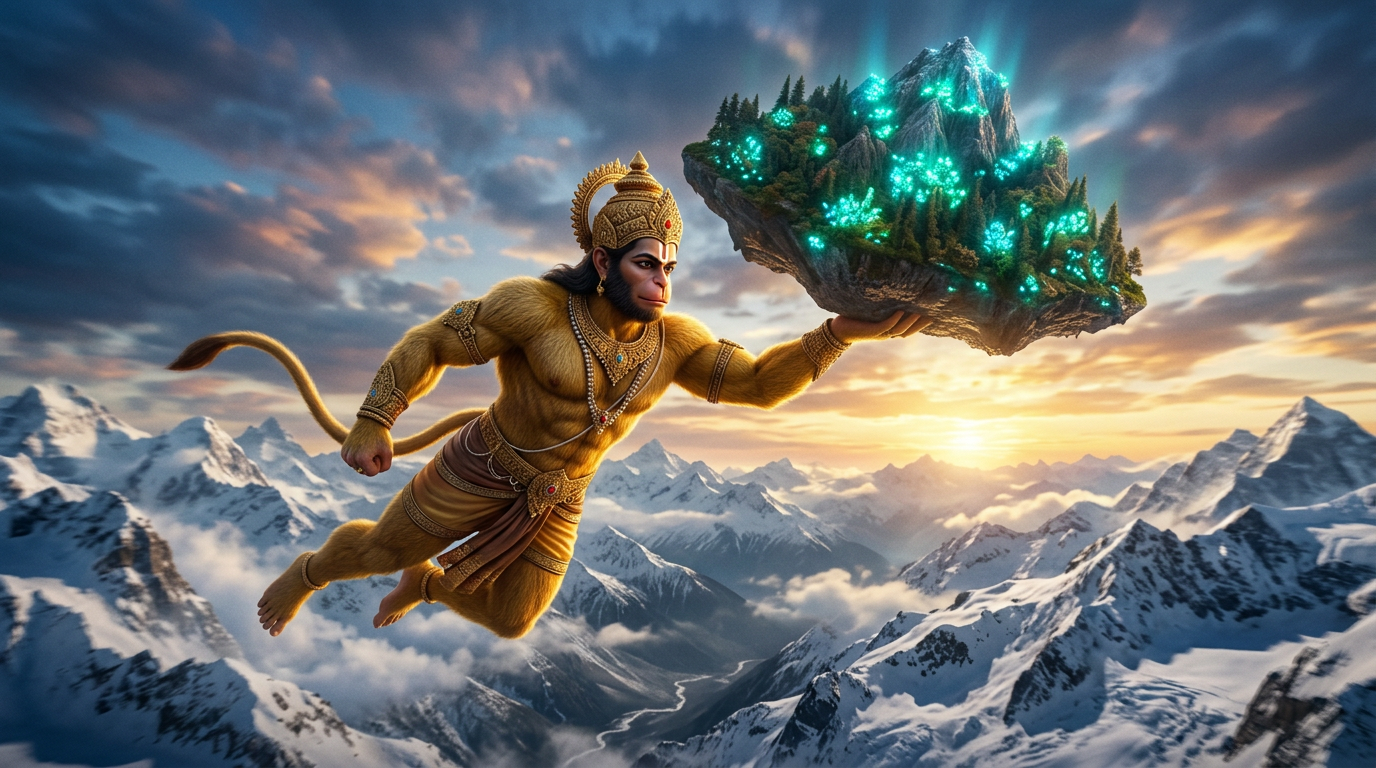
Hanumān and the Healing Herbs
विशल्यकरणी — औषधिपर्वत
When Indrajit's brahmāstra lays Lakṣmaṇa and Rāma among the dead, Jāmbavān's first question is not whether Rāma lives but whether Hanumān lives — for while Hanumān lives, the army lives.
He sends him north beyond the Himavat to the mountain of herbs for the four great oṣadhis: mṛtasañjīvanī, viśalyakaraṇī, sāvarṇyakaraṇī and sandhānī — that restore life, draw out embedded weapons, restore complexion and knit broken limbs.
The herbs hide themselves from him. Rather than search, Hanumān tears up the whole peak and carries it through the sky to Laṅkā. Their scent alone raises the fallen; the vānaras slain in battle rise healed, and the peak is carried back and set in its place.
19
Scene 19 · Yuddha Kāṇḍa, sargas 84–91
Lakṣmaṇa Slays Indrajit
इन्द्रजिद्वध — निकुम्भिला
Vibhīṣaṇa reveals the secret: at the grove of Nikumbhilā, Indrajit performs a sacrifice that makes him invincible for the day. If he completes it he cannot be killed by anyone; interrupted before the offering, he can be killed. Whoever strikes must strike before the rite ends.
Lakṣmaṇa goes with Vibhīṣaṇa, Hanumān and Jāmbavān, and breaks up the sacrifice. Indrajit rushes out in fury: 'You are the one who killed my uncles' sons.' A duel follows that Vālmīki says neither gods nor sages had ever seen the like of — three days of arrows, illusions and chariot warfare.
Fighting from Hanumān's shoulders, Lakṣmaṇa at last fits the aindrāstra, the arrow of Indra, and swears upon the dharma and truth of Rāma. The arrow severs Indrajit's head, ornamented and crowned, from his body. With his son dead, Rāvaṇa's last shield is gone.
धर्मात्मा सत्यसन्धश्च रामो दाशरथिर्यदि
dharmātmā satyasandhaś ca rāmo dāśarathir yadi
“If Rāma, son of Daśaratha, is righteous and true to his word — let this arrow slay Rāvaṇa's son.”
— Yuddha Kāṇḍa 90.72
20
Scene 20 · Yuddha Kāṇḍa, sargas 93–110
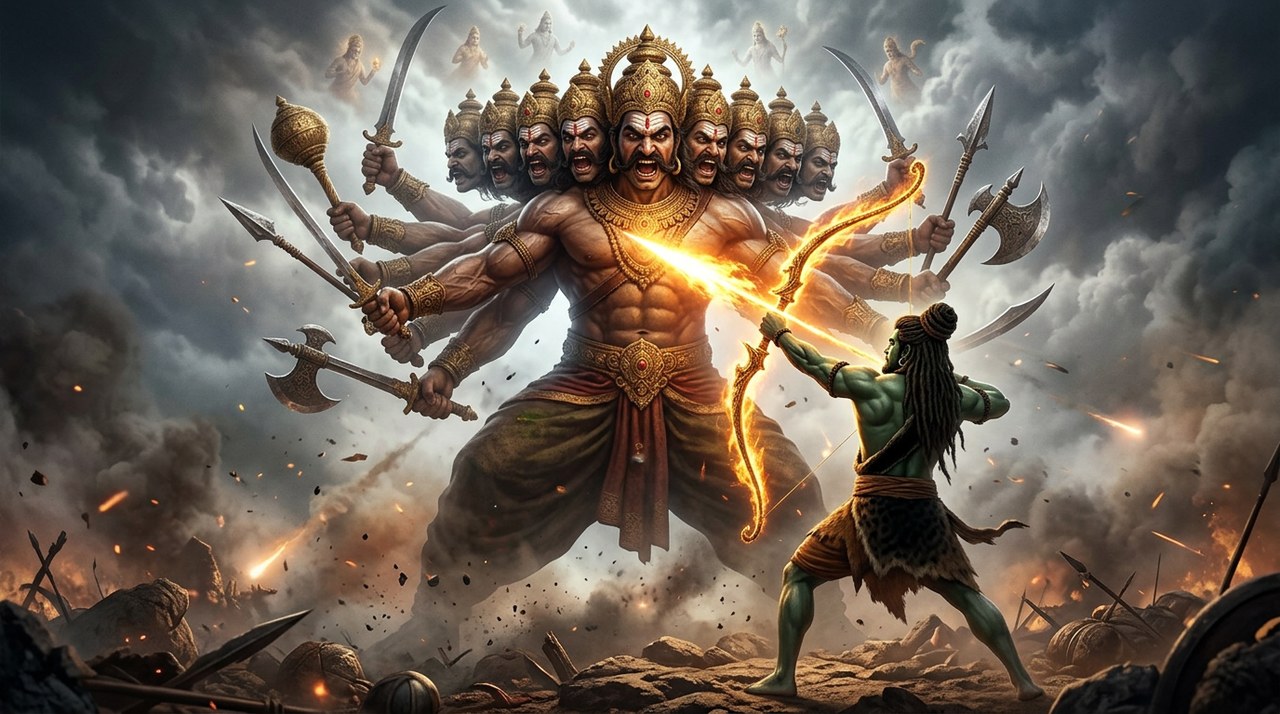
Rāma and Rāvaṇa
रावणवध
Agastya teaches Rāma the Āditya-hṛdayam; Indra sends his own chariot and charioteer Mātali. Heads struck from Rāvaṇa grow back until Rāma fits the brahmāstra given by Agastya and pierces the rākṣasa lord's heart.
Rāvaṇa falls, and Rāma orders him honoured in death: 'enmity ends with death — he is now as much my brother as yours,' he tells Vibhīṣaṇa. Sītā passes through the fire, Agni himself restoring her, and the puṣpaka carries them home.
मरणान्तानि वैराणि निर्वृत्तं नः प्रयोजनम्
maraṇāntāni vairāṇi nirvṛttaṃ naḥ prayojanam
“Enmities end with death; our purpose here is now fulfilled.”
— Yuddha Kāṇḍa 109.25
21
Scene 21 · Yuddha Kāṇḍa, sargas 127–128
Rāma-rājya
श्रीराम राज्याभिषेक
Fourteen years to the day, Bharata meets them at Nandigrāma with the sandals. Vasiṣṭha and the sages anoint Rāma and Sītā, and the city rejoices in an era of unprecedented righteousness.
Sītā gifts Hanumān a divine pearl necklace she receives from Rāma, and Hanumān asks only to remain wherever the Rāmāyaṇa is told. The reign that follows becomes the byword for just governance in every later Indian text.
उत्तरकाण्ड · The Final Book
Uttara Kāṇḍa
Sītā at Vālmīki's hermitage, the birth of Lava and Kuśa, and the first recitation of the Rāmāyaṇa itself.
22
Scene 22 · Uttara Kāṇḍa, sargas 42–97
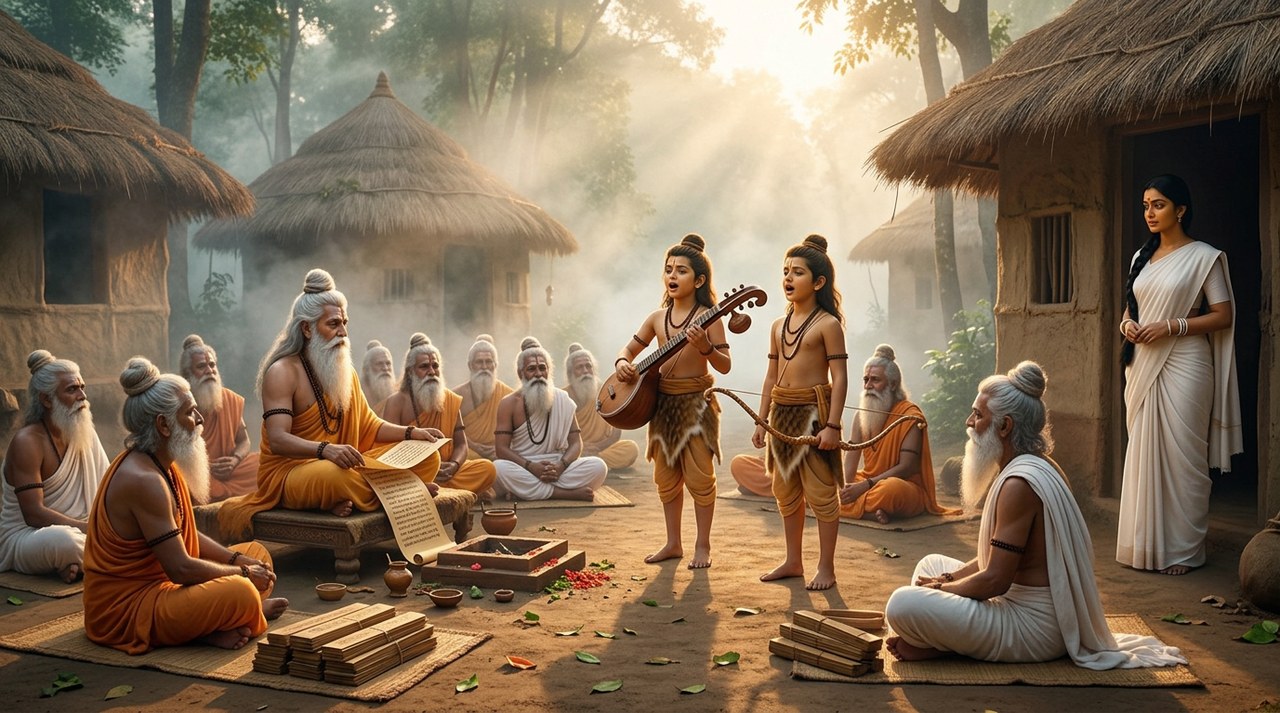
Lava, Kuśa and the First Rāmāyaṇa
लवकुश — रामायणगान
A citizen's doubt reaches the king, and Rāma — bound as a ruler by the standard he set for himself — sends Sītā to Vālmīki's āśrama, where she bears the twins Lava and Kuśa.
Vālmīki teaches them the poem he has composed, and they sing it at Rāma's aśvamedha before their unknowing father. Sītā, called to declare her purity a second time, calls instead upon Mādhavī, her mother the Earth, who opens and receives her. Rāma reigns his appointed span and returns to Vaikuṇṭha through the Sarayū.
Beyond the story
Who They Truly Are — Expansions of the One True God
Vālmīki tells the Rāmāyaṇa as the life of a man who never breaks dharma. The Purāṇas and the later recensions lift the veil and name the players. Read together, the four central figures are not four gods but four faces of one undivided Reality.
Śrī Rāma
Mahā-Viṣṇu · Kṛṣṇa · The 8th Rudra
At the end of the war Brahmā and the gods declare him Nārāyaṇa, the eternal Viṣṇu. The Bhāgavata counts Rāma and Kṛṣṇa as descents of the same Puruṣa. The Śaiva reading goes further: Rāma is the eighth Rudra himself, the very power through whom the universe is withdrawn and renewed, so that Viṣṇu and Śiva are not two but one Reality seen from two sides.
As Rāma is Viṣṇu, Sītā is Lakṣmī — Yoga-māyā herself, taken up from the furrow and returned to the Earth. The Adbhuta Rāmāyaṇa goes further: when the thousand-headed Rāvaṇa fells Rāma, it is Sītā who takes the form of Ādyā Kālī, dark and garlanded with heads, and ends him. Grace and terror are one Goddess.
Never apart from Rāma, never asleep, never self-seeking — the Vaiṣṇava recensions call him Ananta-Śeṣa, the endless serpent-bed of Viṣṇu, and the Śaiva reading calls that same principle Rudra: the destroyer who guards. His fury at Nikumbhilā is Rudra's fury; his service is Śeṣa's service.
Adhyātma Rāmāyaṇa · Śeṣa/Rudra identification in Purāṇic tradition
Śrī Hanumān
Rudra · Bhairava
The Śiva Purāṇa states plainly that Hanumān is the eleventh Rudra, born of Śiva's own portion through Vāyu. Tantric worship reads that same form as Bhairava — fearless, fire-coloured, breaking every obstruction — which is why Hanumān alone can cross the ocean, carry the mountain, and bear Lakṣmaṇa's arrow into battle.
Śiva Purāṇa, Śatarudra Saṁhitā 20 · Hanumān as Rudrāvatāra
The Proof in Their Own Names
This is not poetry. Each of these figures has a Sahasranāma of his or her own, and the lists overlap — the same names, the same epithets, recited to what tradition calls different deities. Compare them side by side and the identity is textual, not interpretive.
“Truth is one; the wise speak of it in many ways.” Rāma, Lakṣmaṇa, Hanumān and Sītā are not rivals in a pantheon — they are expansions of the one Supreme, appearing as king, brother, servant and Mother so that dharma could be shown in human form.