Vedic Panchang
The Ten Descents of Vishnu

Dashavatara — whenever dharma fades, the Lord descends

Yada yada hi dharmasya glanir bhavati Bharata… Across four ages, from a fish in a flood to a future warrior on a white horse, Vishnu has descended again and again to restore the balance of the world. These are the ten Avatars — Matsya, Kurma, Varaha, Narasimha, Vamana, Parashurama, Rama, Krishna, Buddha and the avatar still to come, Kalki.

Avatars
10
Yugas
4
Past descents
9
Yet to come
1

Why the Lord descends

Vishnu is the preserving aspect of the Trimurti — the still centre that holds creation in being. When that balance is shattered by adharma, when the strong devour the weak and truth is forgotten, the Lord does not stay seated on Vaikuntha. He takes a body, breathes mortal air, and walks into the wound of the age.

"yada yada hi dharmasya glanir bhavati Bharata, abhyutthanam adharmasya tadatmanam srijamy aham" — Bhagavad Gita 4.7

The ten avatars also tell the long story of consciousness itself: a fish in the ocean, a tortoise that crawls onto land, a boar that walks upright, a being half-man half-lion, a small human, a wild human with an axe, a perfect king, a perfect lover-teacher, an awakened sage, and finally the future warrior who closes one age and opens another.

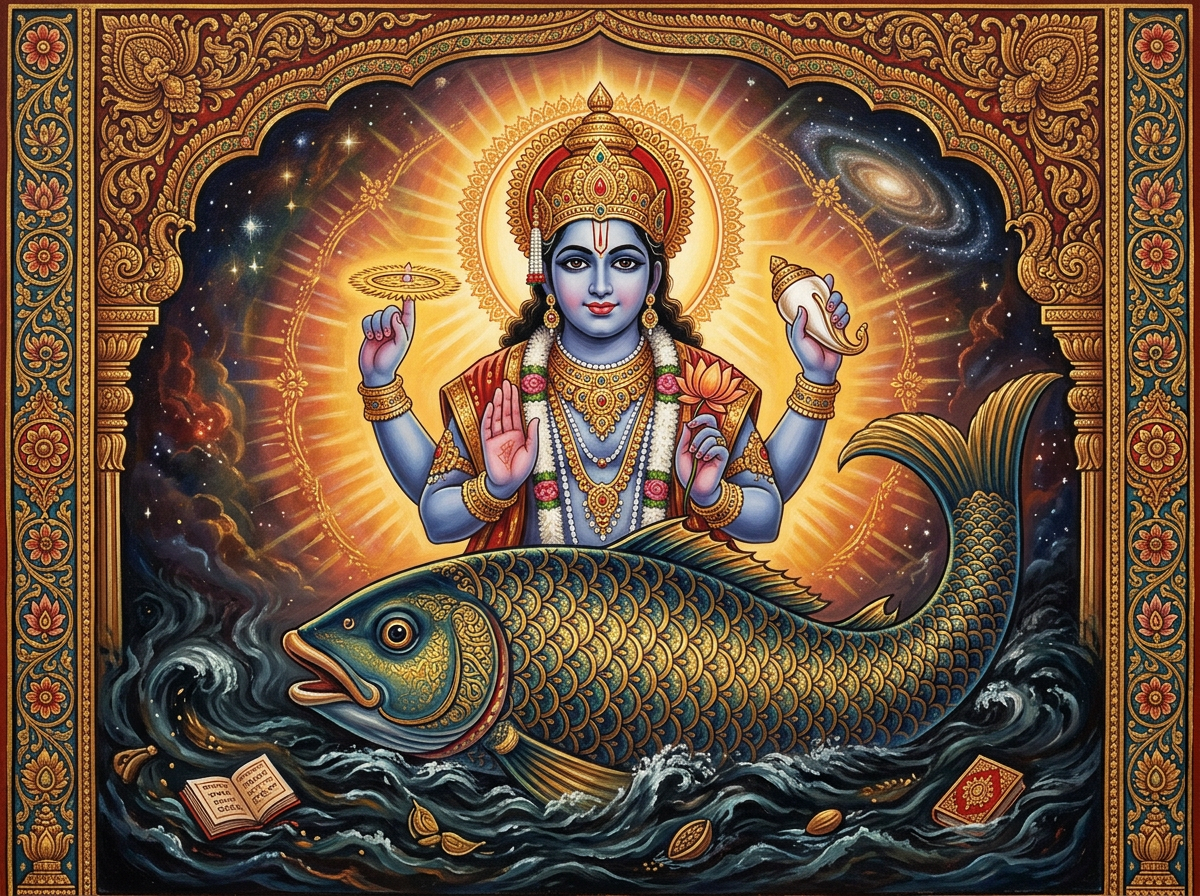
Matsya — The Fish — The Divine Fish
01 · Satya Yuga

Avatar 1

Matsya — The Fish

The Divine Fish

Yuga
Satya Yuga
Consort
Lakshmi
Weapon
Shankha & Chakra
Purpose of descent

To save the Vedas and the seed of all life from a cosmic deluge.

When the demon Hayagriva stole the Vedas while Brahma slept, the universe stood on the brink of darkness. Vishnu took the form of Matsya, a luminous fish with a single horn, and warned the sage-king Manu of the coming pralaya. Manu built a great ship carrying the seven sages, the seeds of every plant, and one pair of every creature. The fish grew vast as continents, towed the ship through the flood, slew Hayagriva, and restored the Vedas to Brahma. Creation was reborn from the survivors of that ark.

When the world drowns in ignorance, divine knowledge alone is the ark.
Kurma — The Tortoise — The Divine Tortoise
02 · Satya Yuga

Avatar 2

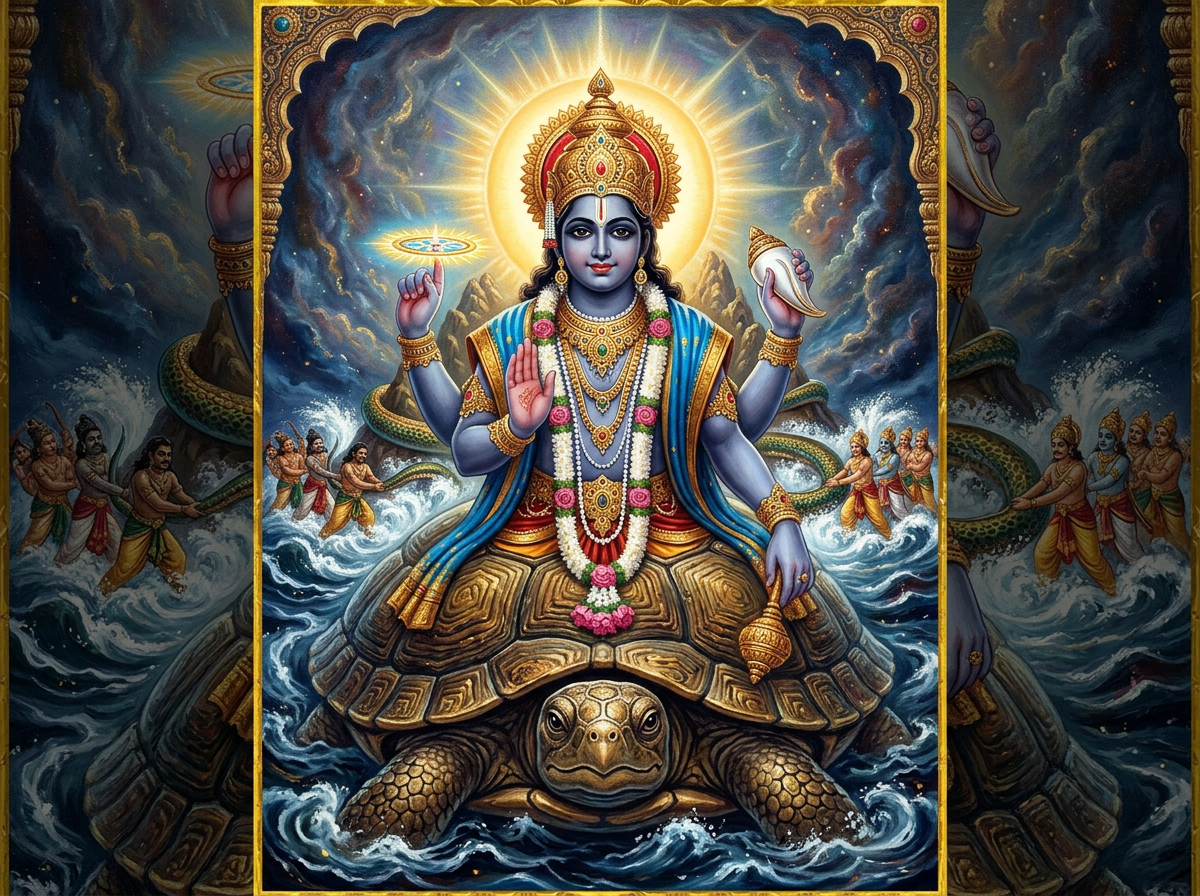
Kurma — The Tortoise

The Divine Tortoise

Yuga
Satya Yuga
Consort
Lakshmi
Weapon
Shankha & Chakra
Purpose of descent

To bear the cosmic mountain during the churning of the ocean of milk.

Devas and asuras together churned Kshira Sagara, the ocean of milk, to obtain Amrita — the nectar of immortality. They used Mount Mandara as the churning rod and the serpent Vasuki as the rope. As the mountain began to sink, Vishnu became Kurma, an immense tortoise, and slid beneath it as a living pivot. From the churning emerged Lakshmi, Dhanvantari with the Amrita, the wish-cow Kamadhenu, and many other treasures.

Stability beneath the world's churn is the unshakable Self.

Varaha — The Boar — The Divine Boar
03 · Satya Yuga

Avatar 3

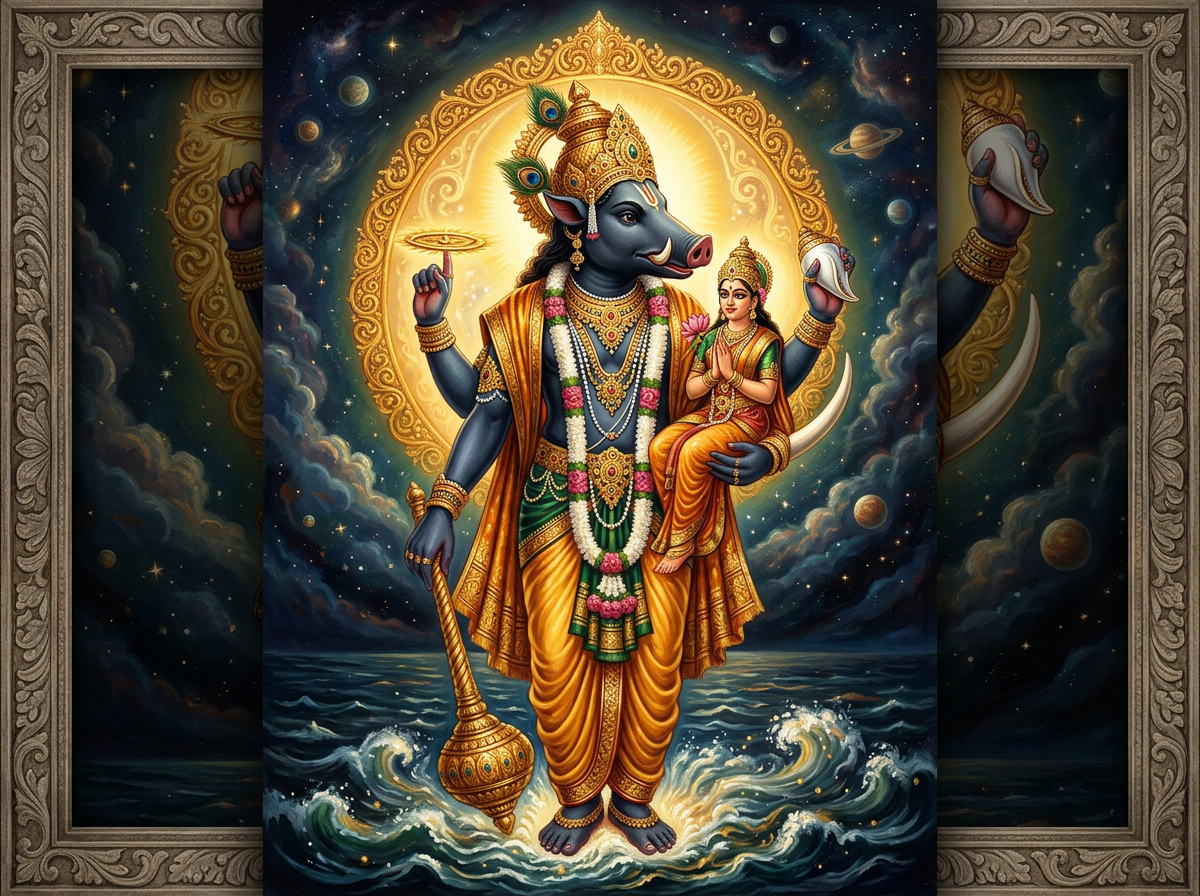
Varaha — The Boar

The Divine Boar

Yuga
Satya Yuga
Consort
Bhudevi (Earth)
Weapon
Tusks, Mace, Chakra
Purpose of descent

To rescue the Earth (Bhudevi) from the cosmic waters.

The asura Hiranyaksha dragged Mother Earth into the depths of the cosmic ocean and hid her there. Vishnu emerged from Brahma's nostril as a tiny boar that grew into a mountain. Varaha plunged into the abyss, fought Hiranyaksha for a thousand years, and finally pierced him with his tusks. He lifted Bhudevi gently on his tusks and restored her to her orbit, reverently marrying her as his consort.

Even the heaviest burden of the world is light to one who serves with love.

Narasimha — The Man-Lion — Half man, half lion
04 · Satya Yuga

Avatar 4

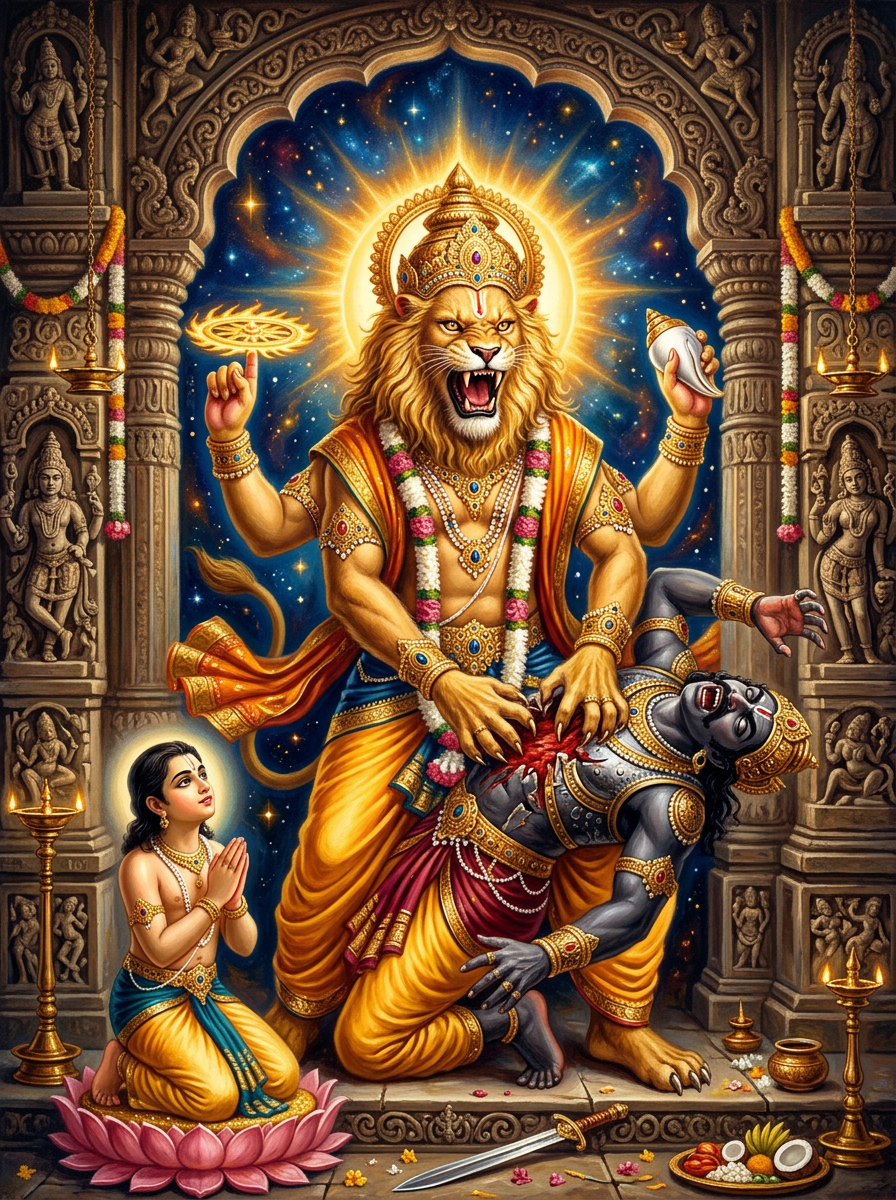
Narasimha — The Man-Lion

Half man, half lion

Yuga
Satya Yuga
Consort
Maha Lakshmi / Maa Kamala
Weapon
Claws
Purpose of descent

To protect his devotee Prahlada and slay the tyrant Hiranyakashipu.

Hiranyakashipu received a boon: he could not be killed by man or beast, by day or night, indoors or outdoors, on earth or in air, by any weapon. Drunk with power, he tortured his own son Prahlada for worshipping Vishnu. When Prahlada declared that the Lord is everywhere, his father struck a pillar in fury. Vishnu burst from the pillar as Narasimha — neither man nor beast — at twilight, on the threshold, placed the demon on his lap, and tore him apart with his claws. Prahlada was crowned and the world released a long held breath.

When devotion is pure, the Divine bursts even out of stone.

Vamana — The Dwarf Brahmin — The Cosmic Dwarf
05 · Treta Yuga

Avatar 5

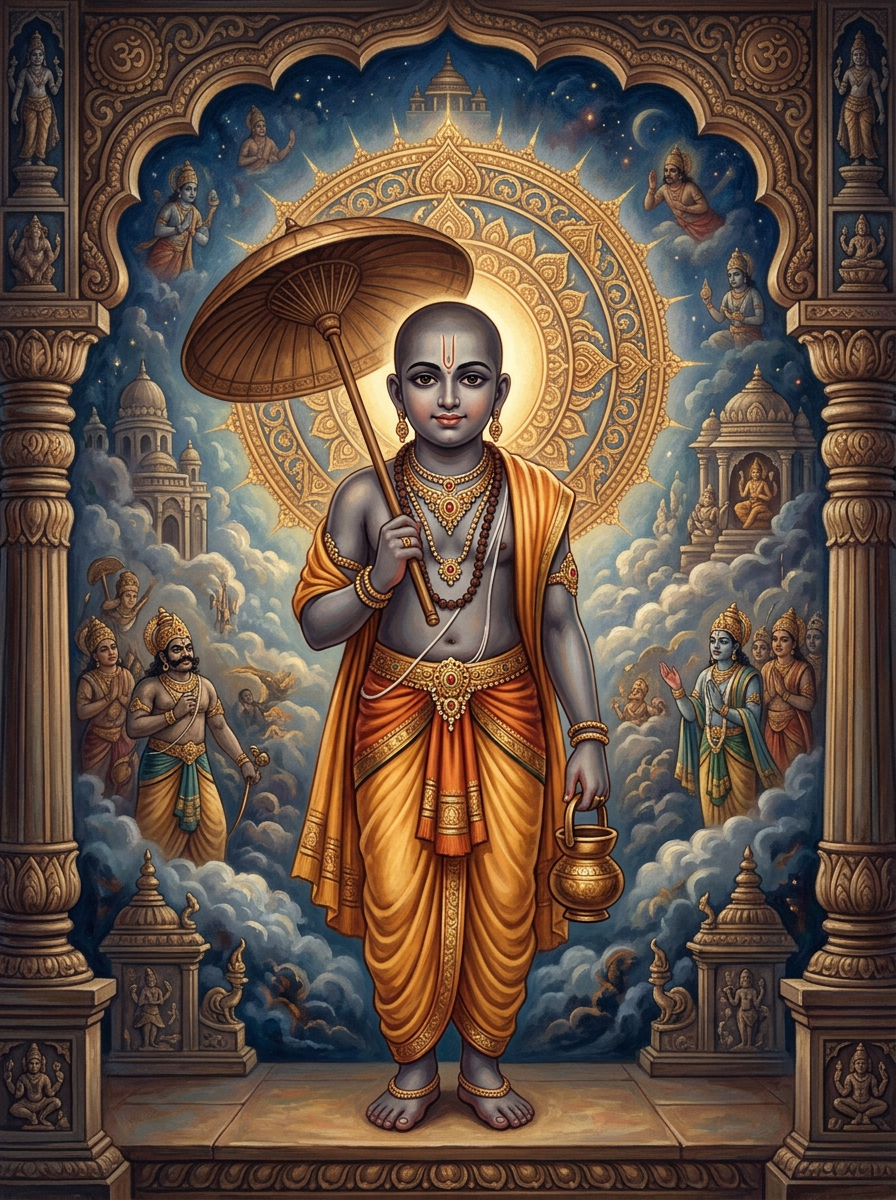
Vamana — The Dwarf Brahmin

The Cosmic Dwarf

Yuga
Treta Yuga
Consort
Lakshmi
Weapon
Wooden umbrella, kamandalu
Purpose of descent

To restore the three worlds from the asura king Bali.

Bali, grandson of Prahlada, was a generous and powerful king who had conquered the three worlds. Vishnu came to his sacrifice as Vamana, a small Brahmin boy, and asked for only as much land as he could cover in three steps. Amused, Bali agreed. Vamana then expanded into Trivikrama: with one step he covered the earth, with another the heavens, and asked Bali where to place the third. Bali offered his own head. Vishnu pressed him gently into Patala and granted him kingship there forever — honoured each year as Onam.

True greatness measures the world by what it gives, not what it takes.

Parashurama — The Warrior with the Axe — Rama with the parashu (axe)
06 · Treta Yuga

Avatar 6

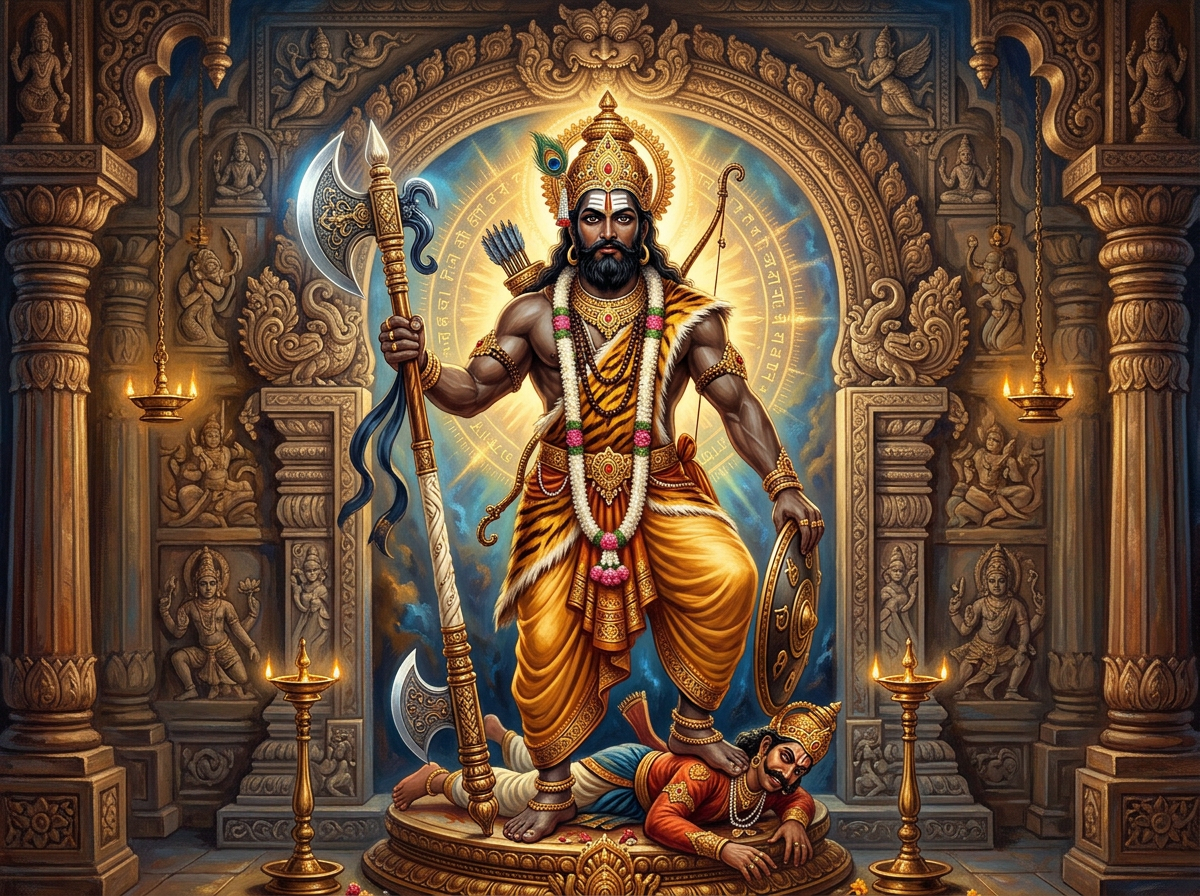
Parashurama — The Warrior with the Axe

Rama with the parashu (axe)

Yuga
Treta Yuga
Consort
Dharani
Weapon
Parashu (battle-axe) given by Shiva
Purpose of descent

To rid the earth of corrupt warrior-kings who oppressed dharma.

Born to the sage Jamadagni and Renuka, Parashurama received the great axe from Shiva after intense austerity. When the arrogant king Kartavirya Arjuna stole the wish-cow from his father and later killed him, Parashurama vowed to cleanse the earth of unrighteous kshatriyas. Twenty-one times he circled the earth, restoring dharma and donating the conquered land to sages. He still lives in the Mahendra mountains, considered a chiranjivi — an immortal — and is also the guru of Bhishma, Drona and Karna.

Even compassion must hold a blade when dharma is mocked.

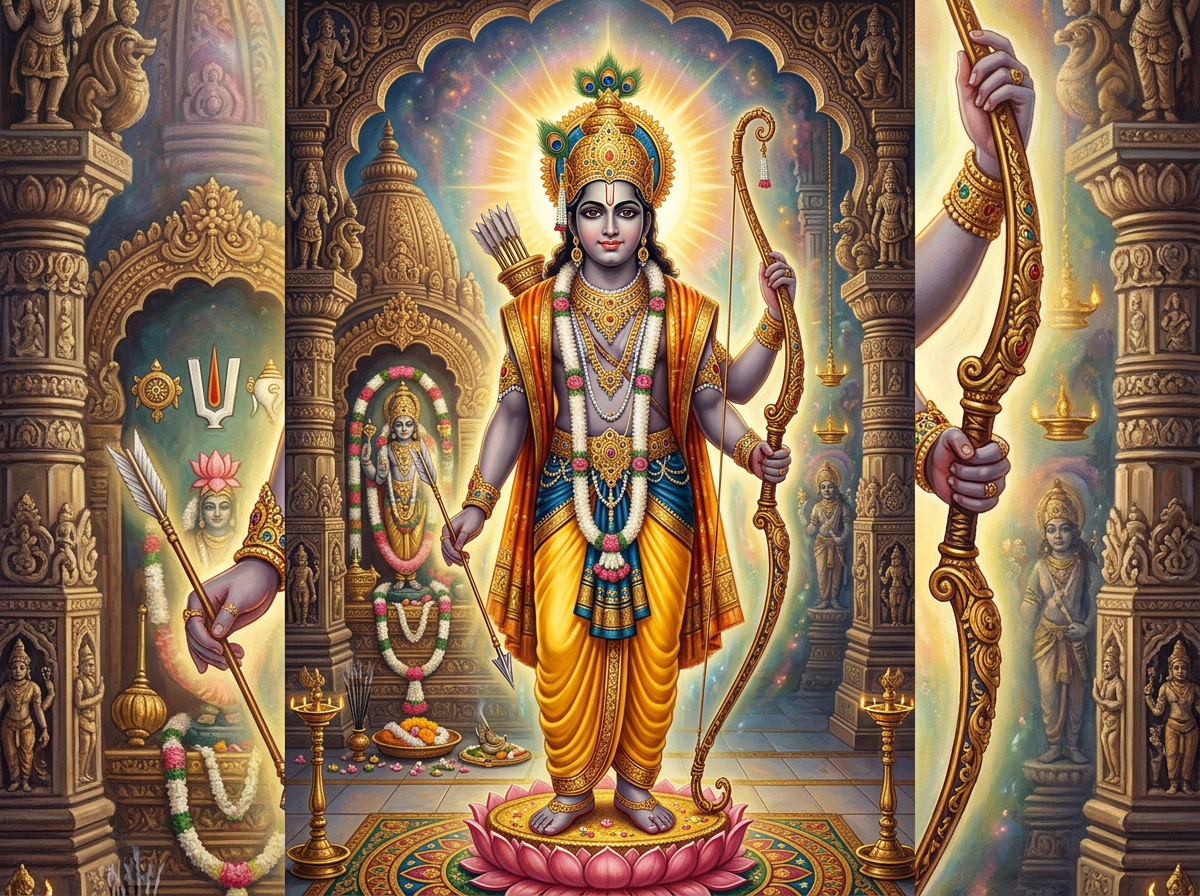
Rama — The Ideal King — The one who delights all
07 · Treta Yuga

Avatar 7

Rama — The Ideal King

The one who delights all

Yuga
Treta Yuga
Consort
Sita
Weapon
Kodanda (divine bow) and arrows
Vahana
Pushpaka vimana
Purpose of descent

To slay the rakshasa king Ravana and uphold dharma in human form.

Born to King Dasharatha of Ayodhya, Rama lived the perfect life of son, husband, brother and king. Exiled to the forest for fourteen years, he lost Sita to the demon king Ravana and crossed the ocean with an army of vanaras led by Hanuman. After a great war at Lanka, he slew Ravana, freed Sita and returned home. The Ramayana, sung by Valmiki and Tulsidas, became the pattern of dharma for every generation that followed. Rama embodies maryada — the radiant boundary of right conduct.

Hold your word, your love and your duty even at the cost of the throne.

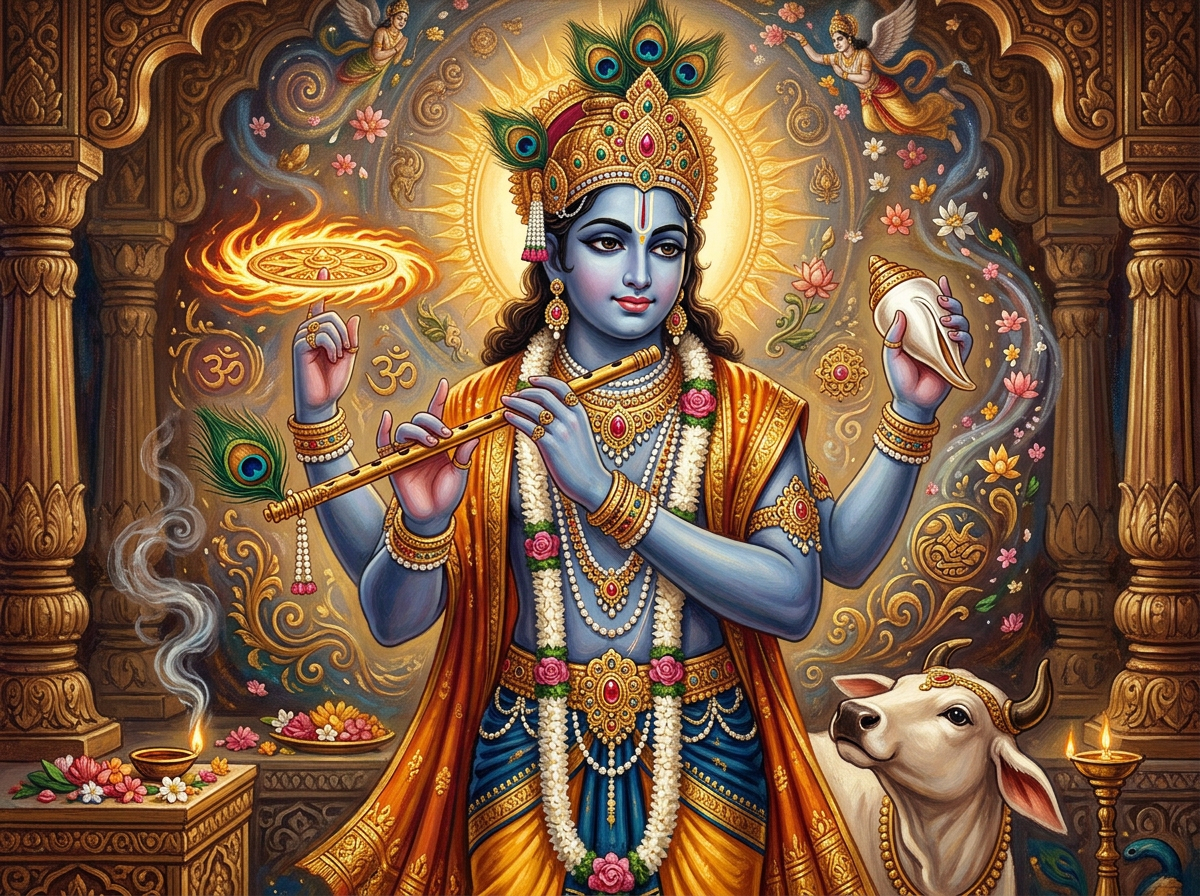
Krishna — The Divine Cowherd — The All-attractive One
08 · Dvapara Yuga

Avatar 8

Krishna — The Divine Cowherd

The All-attractive One

Yuga
Dvapara Yuga
Consort
Radha & Rukmini
Weapon
Sudarshana Chakra, flute
Vahana
Garuda
Purpose of descent

To deliver the Bhagavad Gita and re-establish dharma at Kurukshetra.

Born in a prison of Mathura to slay the tyrant Kamsa, Krishna grew up among cowherds in Vrindavan, stealing butter, dancing the rasa-leela with the gopis and lifting Govardhan hill on a single finger. He became the friend, charioteer and teacher of Arjuna, revealing the Bhagavad Gita on the battlefield of Kurukshetra: the eternal song of selfless action, devotion and self-knowledge. Krishna is the fullest descent of Vishnu — leela in form, jnana in voice, prema in heart.

Act, but offer the fruit; love, but remain unbound.

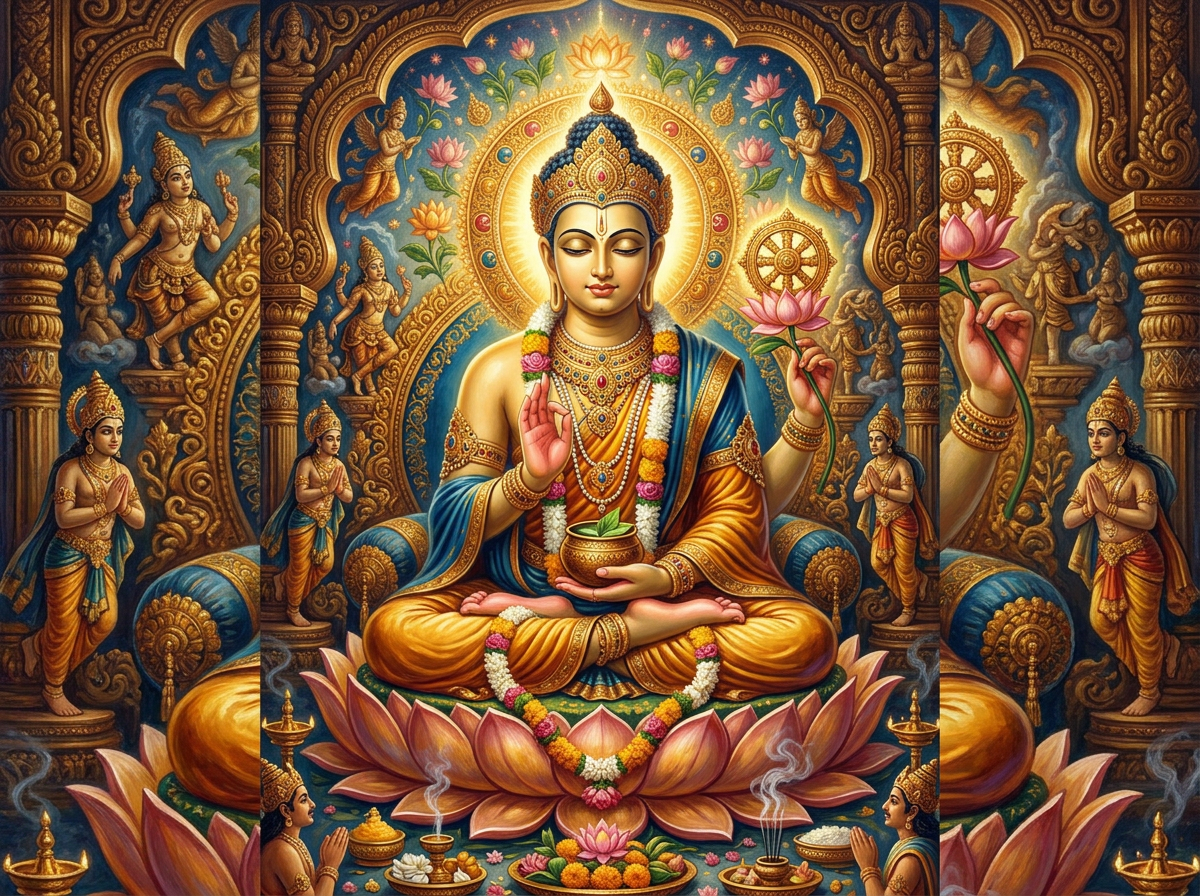
Buddha — The Awakened One — The Enlightened
09 · Kali Yuga (early)

Avatar 9

Buddha — The Awakened One

The Enlightened

Yuga
Kali Yuga (early)
Consort
Weapon
Compassion, the Dharma wheel
Purpose of descent

To turn the world away from cruelty and toward compassion and inner inquiry.

Prince Siddhartha Gautama left his palace at Kapilavastu after seeing old age, sickness and death, and seven years later attained nirvana under the Bodhi tree at Bodhgaya. He taught the Four Noble Truths and the Eightfold Path: that suffering arises from craving, and ceases when craving is seen through. The Vaishnava tradition recognises him as the ninth avatara of Vishnu, descended to dissolve ritual violence and re-orient humanity toward ahimsa.

When sacrifice forgets compassion, awakening itself becomes the offering.

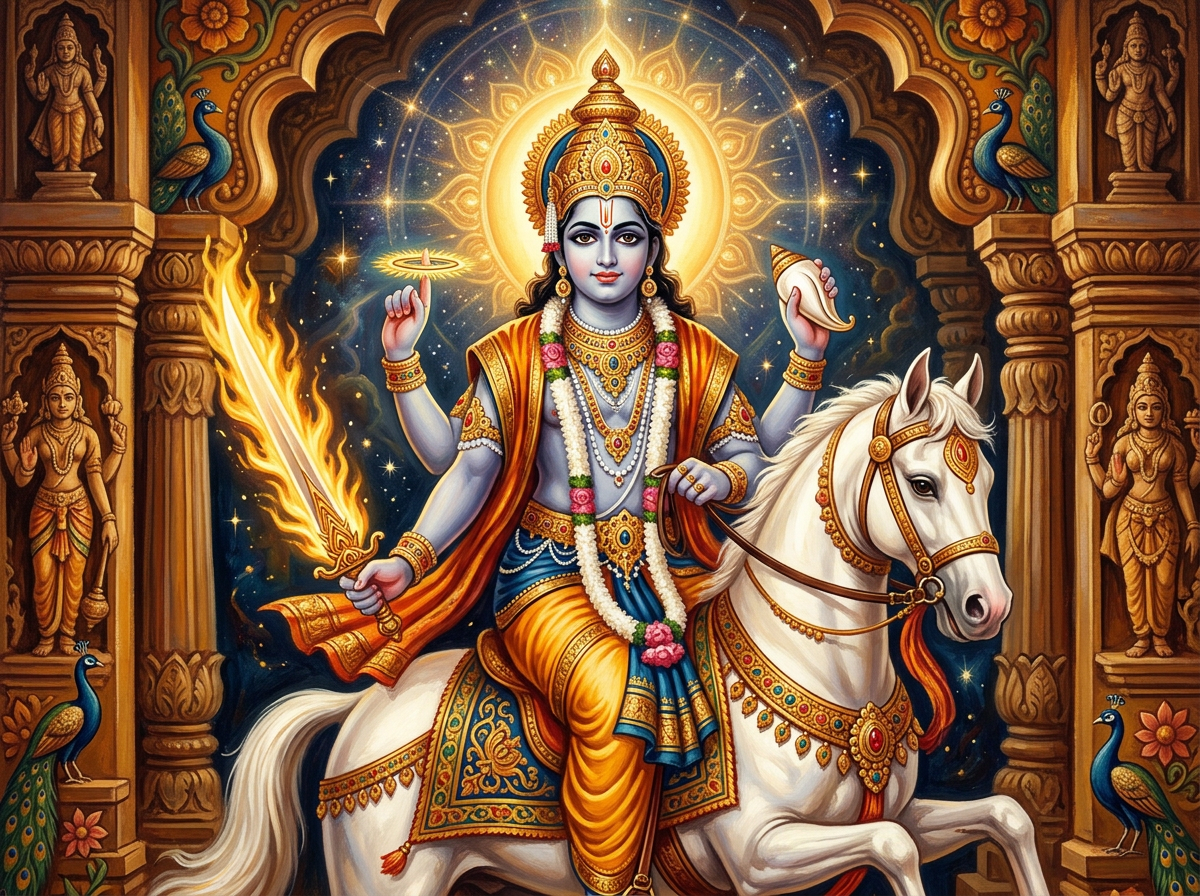
Kalki — The Future Avatar — The Destroyer of Darkness
10 · End of Kali Yuga (yet to come)

Avatar 10

Kalki — The Future Avatar

The Destroyer of Darkness

Yuga
End of Kali Yuga (yet to come)
Consort
Padma
Weapon
Nandaka, the flaming sword
Vahana
Devadatta, the white horse
Purpose of descent

To end the Kali Yuga and inaugurate a new age of truth.

When dharma has nearly vanished and the world is drowning in greed, deception and violence, Vishnu will descend as Kalki: a warrior on a white horse, blazing sword in hand. He will destroy the unrighteous, end the Kali Yuga and usher in a new Satya Yuga of truth. The Puranas place his birth in the village of Shambhala, to a Brahmin named Vishnuyasha. Kalki is the cosmic promise that no age of darkness is final — the dawn is already saddled.

However deep the night, the white horse of dharma is being saddled.