Sacred Names of Lord Balabhadra
The Śrī Balabhadra (Balarāma) Sahasranāma from the Garga Saṃhitā — spoken by the sage Pradīpaka to Duryodhana, as Gargācārya once gave it to the gopīs on the banks of the Yamunā. Here Lord Sankarṣaṇa — the plough-bearing elder brother of Śrī Kṛṣṇa, Ananta Śeṣa who upholds the worlds, and the Śrī Mandira's Balabhadra of Purī — is praised in 957 names, each with Devanāgarī, IAST transliteration and English meaning.
- बलभद्र#1balabhadra
The Auspiciously Strong One. A primary name emphasizing his immense strength combined with his benevolent and auspicious nature, indicating his role as a divine protector.
Śloka 1 - रामभद्र#2rāmabhadra
The Auspicious Rāma. This name connects him to the concept of 'Rāma,' meaning one who gives pleasure, combined with auspiciousness.
Śloka 1 - राम#3rāma
He who delights others. An epithet he shares with his younger brother Kṛṣṇa, signifying his charming and pleasing personality.
Śloka 1 - सङ्कर्षण#4saṅkarṣaṇa
The one who ploughs or attracts all together. This name refers to his role in agriculture and his spiritual power to attract all beings.
Śloka 1 - अच्युत#5acyuta
The Infallible One. A name also for Viṣṇu and Kṛṣṇa, indicating that he never falls from his divine position or fails his devotees.
Śloka 1 - रेवतीरमण#6revatīramaṇa
The beloved of Revatī. He is the cherished husband of Revatī, the daughter of King Kakudmī, and their divine love is celebrated.
Śloka 1 - देव#7deva
The Divine One. A general term for a god, here it signifies his supreme divine status as a plenary portion of the Godhead.
Śloka 1 - कामपाल#8kāmapāla
The Fulfiller of Desires. He is the protector and granter of all righteous desires, fulfilling his devotees' material and spiritual aspirations.
Śloka 1 - हलायुध#9halāyudha
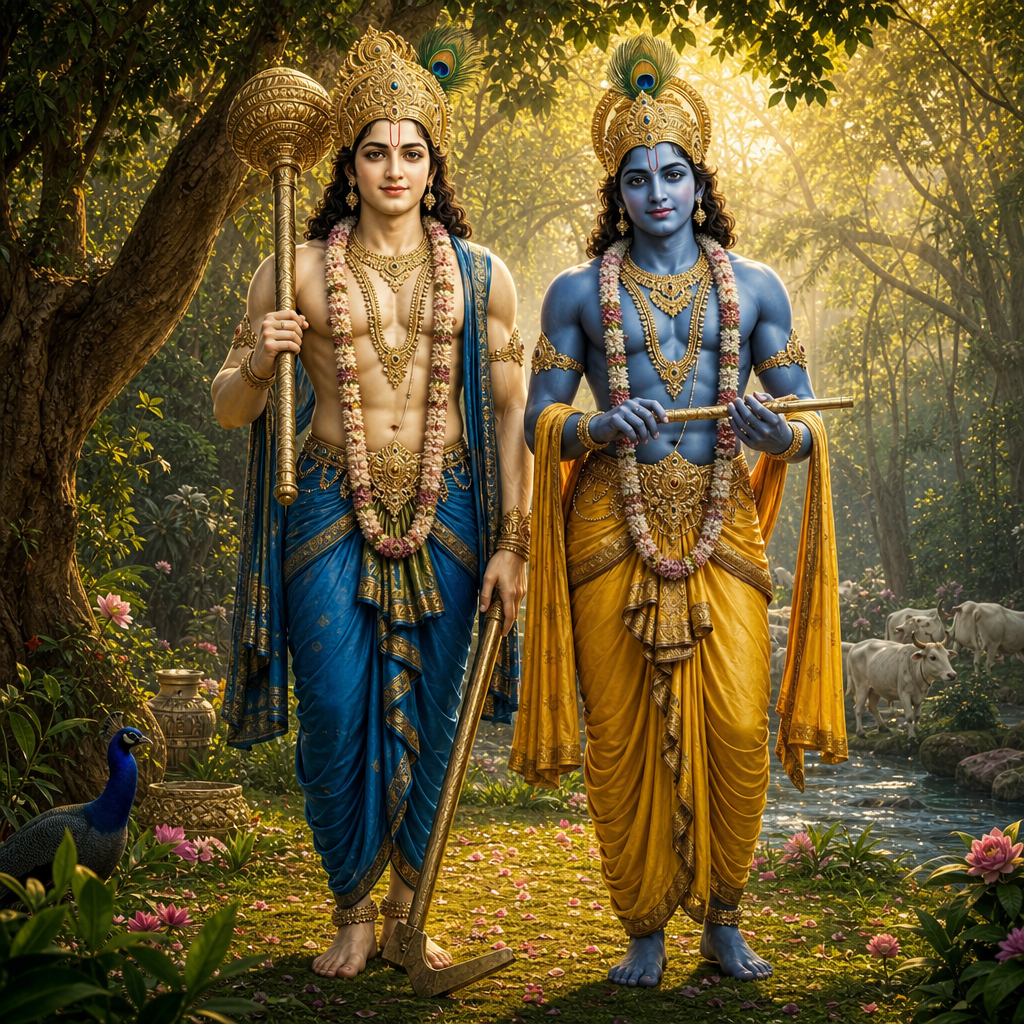
He whose weapon is the plough. This is one of his most famous epithets, referring to the divine plough he wields.
Śloka 1 - नीलाम्बर#10nīlāmbara
The one clad in blue garments. This epithet describes his typical attire, a striking blue cloth that contrasts with his fair complexion.
Śloka 2 - श्वेतवर्ण#11śvetavarṇa
He of white complexion. His skin is described as being as brilliantly white as a mountain of snow or a white lotus flower.
Śloka 2 - बलदेव#12baladeva
The God of Strength. A primary name that directly translates to 'God of Strength,' highlighting his unparalleled physical and spiritual power.
Śloka 2 - अच्युताग्रज#13acyutāgraja
The elder brother of Acyuta (Kṛṣṇa). This name defines his relationship to Kṛṣṇa, emphasizing his role as the protective elder sibling.
Śloka 2 - प्रलम्बघ्न#14pralambaghna
The slayer of the demon Pralamba. He killed the demon Pralambāsura, who had disguised himself as a cowherd boy, by striking him dead.
Śloka 2 - महावीर#15mahāvīra
The Great Hero. This title celebrates his supreme courage, martial prowess, and heroic feats in protecting dharma and defeating powerful demons.
Śloka 2 - रौहिणेय#16rauhiṇeya
The son of Rohiṇī. He was miraculously transferred from the womb of Devakī to that of Rohiṇī, who became his loving mother.
Śloka 2 - प्रतापवान्#17pratāpavān
The Valiant and Majestic One. This denotes his immense valor, influence, and glorious majesty that commands respect from all, including gods and demons.
Śloka 2 - तालाङ्क#18tālāṅka
He who is marked by the palm tree emblem. His royal banner is decorated with the insignia of a Tāla, or palm tree.
Śloka 3 - मुसली#19musalī
The wielder of the mace (musala). Along with his plough, he carries a powerful club or mace known as the Musala weapon.
Śloka 3 - हाली#20hālī
The Ploughman. A name that points to his identity as Halāyudha, the one who wields the plough for both agriculture and battle.
Śloka 3 - हारी#21hārī
He who wears a garland. He is always adorned with a beautiful Vaijayantī garland of unfading forest flowers, which signifies his eternal victory.
Śloka 3 - यदुवर#22yaduvara
The best among the Yadus. He is a prominent and highly respected leader within the Yadu dynasty, second only to Lord Kṛṣṇa.
Śloka 3 - बली#23balī
The All-Powerful One. A simple yet profound name emphasizing his immense, incomprehensible strength, which he uses to uphold righteousness in the universe.
Śloka 3 - सीरपाणि#24sīrapāṇi
He in whose hand is the plough. 'Sīra' is another word for plough, so this name reinforces his identity as the divine plough-wielder.
Śloka 3 - पद्मपाणि#25padmapāṇi
The lotus-handed one. His hands are soft and marked with auspicious signs like the lotus, indicating his divine and gentle nature despite his power.
Śloka 3 - लगुडी#26laguḍī
The wielder of the staff. He sometimes carries a staff or cudgel (laguḍa), another of his signature weapons used in his pastime battles.
Śloka 3 - वेणुवादक#27veṇuvādaka
The flute player. Like his brother Kṛṣṇa, Balarāma also enjoys playing the flute, enchanting all living beings with its divine, sweet melody.
Śloka 3 - कालिन्दीभेदन#28kālindībhedana
The one who split the Kālindī (Yamunā) river. He once used his mighty plough to drag the river Yamunā when she disrespected him.
Śloka 4 - वीर#29vīra
The Heroic One. This epithet praises his supreme valor and heroic nature, demonstrated in his many battles against powerful demonic forces for righteousness.
Śloka 4 - बल#30bala
Strength personified. The most basic form of his name, signifying that he is the very embodiment and original source of all strength.
Śloka 4 - प्रबल#31prabala
The Exceedingly Mighty One. An intensified form of 'Bala,' indicating that his strength is supreme, overwhelming, and absolutely unmatched in all the worlds.
Śloka 4 - ऊर्ध्वग#32ūrdhvaga
He who goes upwards. This refers to his divine nature, his status as Ananta Śeṣa above all planets, and his power to elevate devotees.
Śloka 4 - वासुदेवकलानन्तः#33vāsudevakalā'nantaḥ
Ananta, who is a plenary portion (kalā) of Vāsudeva. This name explains his theological position as the first expansion of Vāsudeva (Kṛṣṇa), manifesting as Ananta Śeṣa.
Śloka 4 - सहस्रवदन#34sahasravadana
The Thousand-Faced One. As his expansion Ananta Śeṣa, he possesses a thousand hoods or faces, upon which the entire planetary systems rest.
Śloka 4 - स्वराट्#35svarāṭ
The Self-Sufficient and Independent King. He is completely independent and self-effulgent, ruling over his own spiritual domain without dependence on any other being.
Śloka 4 - वसु#36vasu
The Abode of All. He is the ultimate dwelling place and substance of the entire cosmos, in whom all beings and elements reside.
Śloka 5 - वसुमतीभर्ता#37vasumatībhartā
The sustainer of the Earth (Vasumatī). As Ananta Śeṣa, he holds the entire Earth and all planets on his hoods, effortlessly sustaining creation.
Śloka 5 - वासुदेव#38vāsudeva
The son of Vasudeva. This is a patronymic, referring to him as the son of Vasudeva, although his birth involved Rohiṇī's womb.
Śloka 5 - वसूत्तम#39vasūttama
The best among the Vasus. He is considered the chief of the eight Vasus, the divine attendants of Indra, signifying his preeminent celestial position.
Śloka 5 - यदूत्तम#40yadūttama
The best of the Yadu dynasty. He stands as a pinnacle of virtue, power, and leadership within the great and powerful Yadu clan.
Śloka 5 - यादवेन्द्र#41yādavendra
The King of the Yādavas. Along with Kṛṣṇa, he is a chief and ruler of the Yādava people, guiding and protecting them always.
Śloka 5 - माधव#42mādhava
The husband of the Goddess of Fortune, or one born in the Madhu dynasty. This name connects him to Lakṣmī and the Yadu lineage.
Śloka 5 - वृष्णिवल्लभ#43vṛṣṇivallabha
The beloved of the Vṛṣṇis. He is dearly loved and cherished by all members of the Vṛṣṇi sub-clan of the Yadu dynasty.
Śloka 5 - द्वारकेश#44dvārakeśa
The Lord of Dvārakā. As a king of the Yādavas, he was one of the lords and principal protectors of the magnificent city of Dvārakā.
Śloka 6 - मथुरेश#45mathureśa
The Lord of Mathurā. After he and Kṛṣṇa slew the tyrant Kaṃsa, they became the de facto rulers of their ancestral kingdom of Mathurā.
Śloka 6 - दानी#46dānī
The Great Giver. He is supremely charitable and generous, bestowing boundless material blessings and spiritual liberation upon his devotees without any hesitation.
Śloka 6 - मानी#47mānī
The Highly Respected One. He holds a position of immense honor and is revered by all, including the gods, for his absolute power.
Śloka 6 - महामनाः#48mahāmanāḥ
The Great-Minded or Magnanimous One. His mind is vast, noble, and free from pettiness. He is forgiving and always thinks of others' welfare.
Śloka 6 - पूर्ण#49pūrṇa
The Complete and Perfect One. He is the full, complete whole, lacking nothing and embodying all six opulences in their absolute entirety.
Śloka 6 - पुराण#50purāṇa
The Ancient and Primeval One. He is the oldest being, existing before the creation of the material universe, yet he is eternally youthful.
Śloka 6 - पुरुष#51puruṣa
The Supreme Person. He is the ultimate Enjoyer and the Supreme Personality who resides within every heart and pervades the entire cosmos.
Śloka 6 - परेश#52pareśa
The Supreme Lord. He is the master of all other controllers and demigods, exercising ultimate authority over the whole cosmic manifestation.
Śloka 6 - परमेश्वर#53parameśvara
The Supreme Controller. A title signifying his absolute dominion over all of creation, being the 'īśvara' (controller) of all other 'īśvaras' (controllers).
Śloka 6 - परिपूर्णतमः#54paripūrṇatamaḥ
The most perfect and complete. As the original Saṅkarṣaṇa, Balarāma is the source of all spiritual and material energies, lacking nothing.
Śloka 7 - साक्षात्#55sākṣāt
The direct, visible manifestation of Godhead. He is not an indirect emanation but the immediate expansion of Lord Kṛṣṇa himself.
Śloka 7 - परमः#56paramaḥ
The Supreme. He is transcendental to the material world and holds a supreme position as the elder brother of Kṛṣṇa and the original guru.
Śloka 7 - पुरुषोत्तमः#57puruṣottamaḥ
The Supreme Person. While this title is most famously used for Kṛṣṇa, it is also applied to Balarāma as his non-different expansion.
Śloka 7 - अनन्तः#58anantaḥ
The endless and limitless one. This is one of his primary names as Ananta Śeṣa, the infinite serpent who holds the universes.
Śloka 7 - शाश्वतः#59śāśvataḥ
The eternal and ever-existing one. He is without beginning or end, participating in the divine pastimes in all cycles of creation.
Śloka 7 - शेषः#60śeṣaḥ
The remainder. As Ananta Śeṣa, he is all that remains after the cosmic dissolution, providing the couch upon which Viṣṇu rests.
Śloka 7 - भगवान् प्रकृतेः परः#61bhagavān prakṛteḥ paraḥ
The Supreme Lord who is transcendental to material nature. He possesses all opulences and is beyond the influence of the three modes (guṇas).
Śloka 7 - जीवात्मा#62jīvātmā
The original soul of all living entities (jīvas). As Saṅkarṣaṇa, he is the source from which the individual souls emanate.
Śloka 8 - परमात्मा#63paramātmā
The Supersoul. He resides within the hearts of all living beings and within every atom, witnessing and sanctioning all activities.
Śloka 8 - अन्तरात्मा#64antarātmā
The inner soul or conscience. He is the internal guide and prompter, the divine presence seated deep within every conscious being.
Śloka 8 - ध्रुवाव्ययः#65dhruvāvyayaḥ
The constant and imperishable one. Unlike material creations, he is eternally fixed, unchanging, and indestructible in his nature and form.
Śloka 8 - चतुर्व्यूहः#66caturvyūhaḥ
He who is the source of the Catur-vyūha, the four primary expansions of Godhead: Vāsudeva, Saṅkarṣaṇa, Pradyumna, and Aniruddha.
Śloka 8 - चतुर्वेदः#67caturvedaḥ
The personification of the four Vedas. All divine knowledge emanates from him, and he is the ultimate goal described in the scriptures.
Śloka 8 - चतुर्मूर्तिः#68caturmūrtiḥ
He of four forms. This refers again to his role in the Catur-vyūha, from which all other incarnations and universal functions arise.
Śloka 8 - चतुष्पदः#69catuṣpadaḥ
He who possesses four feet. This symbolizes his dominion over the four parts of cosmic manifestation or the four states of consciousness.
Śloka 8 - प्रधानम्#70pradhānam
The unmanifested source of the material world. As Saṅkarṣaṇa, he glances upon pradhāna, thus initiating the process of cosmic creation.
Śloka 9 - प्रकृतिः#71prakṛtiḥ
The material nature itself. He is the master and controller of prakṛti, which acts under his supreme will and direction.
Śloka 9 - साक्षी#72sākṣī
The neutral witness. As Paramātmā, he observes the activities of all conditioned souls without being entangled in their karmic reactions.
Śloka 9 - संघातः#73saṅghātaḥ
The aggregate. He is the underlying reality of the cosmic manifestation, which is an aggregate of the material elements originating from him.
Śloka 9 - संघवान्#74saṅghavān
He who is always surrounded by his associates. This refers to his eternal companions in the spiritual world and his assembly of devotees.
Śloka 9 - सखा#75sakhā
A dear friend. He is the intimate friend and elder brother of Kṛṣṇa, sharing in the playful and loving pastimes of Vraja.
Śloka 9 - महामनाः#76mahāmanāḥ
The great-minded one. He is supremely magnanimous, noble-hearted, and possesses an intellect that encompasses the entire cosmos.
Śloka 9 - बुद्धिसखः#77buddhisakhaḥ
The friend of the intelligence (buddhi). As the original spiritual master, he guides the intellect of the devotee towards pure consciousness.
Śloka 9 - चेतः#78cetaḥ
The principle of consciousness. He is the source of citta, the field of mental activities and consciousness, which he directs.
Śloka 9 - अहंकारः#79ahaṅkāraḥ
The principle of ego. In cosmology, Saṅkarṣaṇa is the presiding deity of ahaṅkāra-tattva, the cosmic ego from which matter and senses develop.
Śloka 9 - आवृतः#80āvṛtaḥ
The one who pervades and covers all. As Ananta, his energy permeates the entire creation, sustaining and encompassing everything within it.
Śloka 9 - इन्द्रियेशः#81indriyeśaḥ
The Lord of the senses. He is the master of his own senses and also the presiding deity controlling the senses of all beings.
Śloka 10 - देवतात्मा#82devatātmā
The soul of the demigods. All the devas derive their power and existence from him as their inner soul and ultimate source.
Śloka 10 - ज्ञानम्#83jñānam
Knowledge personified. He is the embodiment of pure, transcendental knowledge and the source of the jñāna-śakti, the Lord's cognitive potency.
Śloka 10 - कर्म#84karma
Action personified. He is the origin of all activity (kriyā-śakti) and the ultimate arbiter of the law of karma, yet he is untouched by it.
Śloka 10 - शर्म#85śarma
Bliss and refuge personified. He is the giver of supreme happiness, shelter, and protection to his devotees, removing all distress.
Śloka 10 - अद्वितीयः#86advitīyaḥ
He who is one without a second. This emphasizes his absolute, non-dual nature as the Supreme Personality of Godhead, equal to Kṛṣṇa.
Śloka 10 - द्वितीयः#87dvitīyaḥ
The second one. This refers to his position as the first expansion of Kṛṣṇa, eternally manifest as his companion, brother, and servant.
Śloka 10 - निराकारः#88nirākāraḥ
The formless one. This points to his identity with the impersonal Brahman effulgence, the unmanifest aspect that underlies his personal form.
Śloka 10 - निरञ्जनः#89nirañjanaḥ
The spotless and untainted one. He is eternally pure and completely untouched by the contamination of the material world and its qualities.
Śloka 10 - विराट्#90virāṭ
The universal or cosmic form. The entire material cosmos is considered a manifestation of his gigantic form, containing all planetary systems.
Śloka 11 - सम्राट्#91samrāṭ
The universal emperor. He is the supreme sovereign over all rulers and all realms within the material and spiritual worlds.
Śloka 11 - महौघः#92mahaughaḥ
The great flood or mighty current. His power is like an irresistible deluge that carries everything before it, representing his immense potency.
Śloka 11 - धारः#93dhāraḥ
The supporter or holder. As Ananta Śeṣa, he effortlessly supports the billions of universes upon his hoods like tiny mustard seeds.
Śloka 11 - स्थाणुः#94sthāṇuḥ
The stable and immovable one. He is the firm foundation of the entire creation, eternally fixed and unchanging in his position.
Śloka 11 - चरिष्णुमान्#95cariṣṇumān
The one who is mobile and active. In contrast to his immovable nature, he also actively moves throughout the worlds in his pastimes.
Śloka 11 - फणीन्द्रः#96phaṇīndraḥ
The chief of all hooded serpents. As Ananta Śeṣa, he is the original and most powerful serpent, the lord of Nāgaloka.
Śloka 11 - फणिराजः#97phaṇirājaḥ
The king of all serpents. This epithet reaffirms his absolute monarchy over all nāgas and serpents throughout the cosmos.
Śloka 11 - सहस्रफणमण्डितः#98sahasraphaṇamaṇḍitaḥ
He who is adorned with a thousand hoods. As Ananta, he is famed for his limitless hoods, each decorated with a brilliant jewel.
Śloka 11 - फणीश्वरः#99phaṇīśvaraḥ
The supreme controller of serpents. As the ultimate lord of all nāgas, he commands their absolute obedience and devotion.
Śloka 12 - फणी#100phaṇī
The great hooded serpent. This name simply and directly identifies him with his form as the divine cosmic serpent, Ananta Śeṣa.
Śloka 12 - स्फूर्तिः#101sphūrtiḥ
The divine inspiration and manifestation. He is the source of sphūrti, the sudden flash of divine realization and revelation in the devotee's heart.
Śloka 12 - फूत्कारी#102phūtkārī
One who makes a powerful hissing sound. This sound, emanating from Ananta at the time of dissolution, produces fire to destroy the universe.
Śloka 12 - चीत्कारः#103cītkāraḥ
He who makes a great cry. His mighty roar can shake the entire cosmos, expressing his immense power and supreme authority.
Śloka 12 - प्रभुः#104prabhuḥ
The Supreme Lord and Master. He is the master of all creation, all living beings, and all potencies, the ultimate proprietor.
Śloka 12 - मणिहारः#105maṇihāraḥ
He who wears a necklace of jewels. This refers to the brilliant gems that adorn his hoods and his divine form.
Śloka 12 - मणिधारः#106maṇidhāraḥ
The bearer of the jewel. He holds the crest-jewels upon his hoods that illuminate the subterranean realms and dispel all darkness.
Śloka 12 - वितली#107vitalī
He who is manifest as the Vitala region. He is the lord of this subterranean heaven, which is one of the seven lower planetary systems.
Śloka 12 - सुतली#108sutalī
He who is manifest as the Sutala region. He is the presiding lord of Sutala, the realm of the great devotee Bali Mahārāja.
Śloka 12 - तली#109talī
He who is manifest as the lower regions (Tala). This refers to his dominion over all the netherworlds, beginning with Talātala.
Śloka 12 - अतली#110atalī
He is the Lord of the subterranean realm of Atala, the first of the seven lower worlds, which he supports as Ananta.
Śloka 13 - सुतलेशः#111sutaleśaḥ
He is the master of the Sutala realm. As Sankarṣaṇa, he presides over all the lower planetary systems, maintaining cosmic order and balance.
Śloka 13 - पातालः#112pātālaḥ
He is the personification of Pātāla, the lowest of the seven netherworlds, where the Nāgas reside and where he himself dwells as Ananta Śeṣa.
Śloka 13 - तलातलः#113talātalaḥ
He is the embodiment of the Talātala realm, another of the seven subterranean heavens, which is upheld by his immeasurable power as Ananta.
Śloka 13 - रसातलः#114rasātalaḥ
He is the Lord of the Rasātala realm, a lower world inhabited by powerful demonic beings, which rests upon one of his divine hoods.
Śloka 13 - भोगितलः#115bhogitalaḥ
He is the foundation for the Bhogīs (serpents), referring to the Pātāla region which is his abode and that of countless celestial serpents.
Śloka 13 - स्फुरद्दन्तः#116sphuraddantaḥ
He whose teeth are brilliantly shining. This epithet highlights his divine, effulgent form as the serpent king Ananta Śeṣa in the lower worlds.
Śloka 13 - महातलः#117mahātalaḥ
He is the personification of the Mahātala realm, a subterranean world known as the abode of multi-hooded Nāgas, over whom he is the supreme sovereign.
Śloka 13 - वासुकिः#118vāsukiḥ
He is identified with Vāsuki, the great king of the Nāgas. All prominent serpents are considered to be partial manifestations of his power as Ananta.
Śloka 14 - शङ्खचूडाभः#119śaṅkhacūḍābhaḥ
His splendor is like that of the great Nāga Śaṅkhacūḍa. Balabhadra, as the original Śeṣa, is the ultimate source and lord of all serpents.
Śloka 14 - देवदत्तः#120devadattaḥ
He is identified with Devadatta, one of the principal Nāga kings mentioned in the scriptures, signifying his dominion over all serpents and the nether regions.
Śloka 14 - धनञ्जयः#121dhanañjayaḥ
He is identified with Dhanañjaya, another chief among the Nāgas. This name highlights his identity as Sankarṣaṇa, the master of the entire serpentine race.
Śloka 14 - कम्बलाश्वः#122kambalāśvaḥ
He is the source of the great Nāgas Kambala and Aśvatara. This compound name signifies that he is the supreme lord of all prominent serpent kings.
Śloka 14 - वेगतरः#123vegataraḥ
He who is exceedingly swift. As Ananta, his power and influence pervade the entire cosmos with unimaginable speed, upholding dharma and cosmic order.
Śloka 14 - धृतराष्ट्रः#124dhṛtarāṣṭraḥ
He is identified with the great Nāga king Dhṛtarāṣṭra, highlighting his role as the progenitor and ruler of all serpentine beings in the universe.
Śloka 14 - महाभुजः#125mahābhujaḥ
He who possesses mighty arms. This refers to his immense strength, used to effortlessly uphold the innumerable universes and to wield his divine plow and mace.
Śloka 14 - वारुणीमदमत्ताङ्गः#126vāruṇīmadamattāṅgaḥ
He whose limbs are joyfully intoxicated by the divine Vāruṇī liquor. This nectar was personally offered to him by Varuṇa's wife, the goddess Vāruṇī.
Śloka 15 - मदघूर्णितलोचनः#127madaghūrṇitalocanaḥ
He whose eyes roll due to divine intoxication. This describes his blissful state while enjoying Vāruṇī, a famous pastime in the forests of Vraja.
Śloka 15 - पद्माक्षः#128padmākṣaḥ
He whose eyes are like lotus petals, expressing his supreme beauty, boundless compassion, and a divine vision that captivates the hearts of all beings.
Śloka 15 - पद्ममाली#129padmamālī
He is adorned with a garland of lotuses. This garland symbolizes his absolute purity, spiritual enlightenment, and his eternal connection to the goddess of fortune.
Śloka 15 - वनमाली#130vanamālī
He wears the victorious Vanmālā garland, made of forest flowers of five different colors and reaching down to his knees, a characteristic of Viṣṇu-tattva deities.
Śloka 15 - मधुश्रवाः#131madhuśravāḥ
He whose fame is as sweet as honey (madhu). Hearing the narrations of his glorious pastimes and qualities brings immense spiritual sweetness and bliss to devotees.
Śloka 15 - कोटिकन्दर्पलावण्यः#132koṭikandarpalāvaṇyaḥ
His beauty and charm surpass that of millions (koṭi) of Kandarpas (Cupids), indicating his unparalleled transcendental attractiveness that enchants the entire universe.
Śloka 16 - नागकन्यासमर्चितः#133nāgakanyāsamārcitaḥ
He is devoutly worshipped by the daughters of the Nāgas (Nāgakanyās), who are completely captivated by his divine handsomeness and power in his abode of Pātāla.
Śloka 16 - नूपुरी#134nūpurī
He who wears tinkling anklets (nūpura). These sacred ornaments on his lotus feet produce a divine, auspicious sound that purifies the hearts of his devotees.
Śloka 16 - कटिसूत्री#135kaṭisūtrī
He who wears a sacred belt or sash around his waist (kaṭisūtra), which is often made of gold and jewels, signifying his divine princely status.
Śloka 16 - कटकी#136kaṭakī
He who is adorned with beautiful bracelets (kaṭaka) on his wrists. These ornaments enhance the splendor of his powerful, universe-sustaining arms that wield his weapons.
Śloka 16 - कनकाङ्गदी#137kanakāṅgadī
He who wears golden armlets (aṅgada) on his upper arms. These ornaments highlight the divine strength and beauty of his arms, which perform heroic feats.
Śloka 16 - मुकुटी#138mukuṭī
He who wears a divine crown (mukuṭa). His single, unique earring (kuṇḍala) is set beneath his crown, signifying his supreme and unparalleled position.
Śloka 17 - कुण्डली#139kuṇḍalī
He who wears a single, magnificent earring (kuṇḍala). This unique feature distinguishes his divine form and symbolizes his non-dual status as the Supreme Personality of Godhead.
Śloka 17 - दण्डी#140daṇḍī
He who carries a staff or club (daṇḍa). This refers to his mighty mace, named Saunandā, with which he vanquishes evil and protects his devotees.
Śloka 17 - शिखण्डी#141śikhaṇḍī
He who is adorned with a peacock feather crest (śikhaṇḍa). Like his younger brother Kṛṣṇa, he wears this emblem of Vraja's natural beauty.
Śloka 17 - खण्डमण्डली#142khaṇḍamaṇḍalī
He who breaks the circle (maṇḍala) of his enemies. With his plow and club, he shatters the formations and pride of arrogant kings and demons.
Śloka 17 - कलिः#143kaliḥ
He is the personification of strife (Kali). As Sankarṣaṇa, his tamasic nature is employed to bring about necessary conflict that leads to the destruction of the wicked.
Śloka 17 - कलिप्रियः#144kalipriyaḥ
He who is fond of quarrels (kali). He delights in conflicts that allow him to punish the unrighteous and re-establish the principles of dharma.
Śloka 17 - कालः#145kālaḥ
He is Time itself, the ultimate force that brings about creation, sustenance, and destruction, acting as the irresistible power of the Supreme Lord.
Śloka 17 - निवृत्तकवचेश्वरः#146nivṛttakavaceśvaraḥ
The supreme lord who requires no armor (kavaca), or from whom armor is cast off. His body is naturally invulnerable, rendering any external protection unnecessary.
Śloka 17 - संहारकृत्#147saṁhārakṛt
He is the agent of cosmic annihilation (saṁhāra). At the end of the universe, Sankarṣaṇa initiates the process of dissolution to withdraw creation back into himself.
Śloka 18 - रुद्रवपुः#148rudravapuḥ
He whose form is Rudra. Balarāma's Sankarṣaṇa aspect, embodying the mode of ignorance (tamas), manifests as Lord Śiva (Rudra) to perform the act of destruction.
Śloka 18 - कालाग्निः#149kālāgniḥ
He is the fire of time (Kālāgni). From the mouth of Sankarṣaṇa emanates the fire that consumes the entire universe at the time of final dissolution.
Śloka 18 - प्रलयः#150pralayaḥ
He is the cosmic dissolution (pralaya) itself. The entire destructive process is simply a manifestation of his will and power as the original Sankarṣaṇa.
Śloka 18 - लयः#151layaḥ
He is the state of absorption or final rest (laya). All universes, once destroyed, merge and rest within him until the next cycle of creation.
Śloka 18 - महाहिः#152mahāhiḥ
He is the great serpent (mahā-ahi). This refers directly to his eternal form as Ananta Śeṣa, the king of all serpents and cosmic support.
Śloka 18 - पाणिनिः#153pāṇiniḥ
He is identical to the great grammarian Pāṇini. This signifies that he is the ultimate source of all knowledge, including the perfect science of language.
Śloka 18 - शास्त्रभाष्यकारः#154śāstrabhāṣyakāraḥ
He is the author of commentaries (bhāṣya) on the scriptures (śāstra), specifically pointing to his incarnation as Patañjali, author of the Mahābhāṣya on Pāṇini's grammar.
Śloka 18 - पतञ्जलिः#155patañjaliḥ
He is Patañjali, the revered sage who compiled the Yoga Sūtras and wrote the Mahābhāṣya. Tradition holds that Patañjali was a direct incarnation of Ananta Śeṣa.
Śloka 18 - कात्यायनः#156kātyāyanaḥ
The one venerated by the great sage Kātyāyana. Balarāma, as the Supreme Lord, is the object of worship for all enlightened sages who seek ultimate truth.
Śloka 19 - पक्विमाभः#157pakvimābhaḥ
He whose effulgence is like that of a ripe fruit. This describes Balarāma's splendid, fair complexion which shines with a brilliant golden-white hue.
Śloka 19 - स्फोटायनः#158sphoṭāyanaḥ
The original propounder of Sphoṭa, the philosophy of eternal sound. As Ananta Śeṣa, he is the source of all scriptures and linguistic philosophy.
Śloka 19 - उरङ्गमः#159uraṅgamaḥ
The great serpent. This name directly refers to his primary identity as Ananta Śeṣa, the cosmic divine serpent who serves as Viṣṇu's couch.
Śloka 19 - वैकुण्ठः#160vaikuṇṭhaḥ
The Lord of Vaikuṇṭha, the spiritual world free from all anxiety. As the original Saṅkarṣaṇa, Balarāma presides over the eternal spiritual planets.
Śloka 19 - याज्ञिकः#161yāgyikaḥ
The ultimate performer of sacred rituals (yajña). He upholds dharma by engaging in prescribed sacrifices and is the foremost among all who perform them.
Śloka 19 - यज्ञः#162yajñaḥ
The personification of sacrifice itself. He is both the ritual and its beneficiary, as all yajñas are ultimately meant for the satisfaction of the Supreme Lord.
Śloka 19 - वामनः#163vāmanaḥ
The Vāmana incarnation. As the source of all avatāras, Balarāma contains within him Lord Vāmana, the dwarf brāhmaṇa who reclaimed the three worlds.
Śloka 19 - हरिणः#164hariṇaḥ
The deer. This epithet signifies his divine beauty, purity, and swiftness, moving with the grace and alertness characteristic of a sacred deer in the forest.
Śloka 19 - हरिः#165hariḥ
The remover of all sins and sorrows. As a primary name of Viṣṇu, it signifies Balarāma's power to liberate his devotees from material suffering.
Śloka 19 - कृष्णः#166kṛṣṇaḥ
The all-attractive one. Though his brother's name, it applies to Balarāma as they are non-different, and Balarāma also possesses a dark form in other eras.
Śloka 20 - विष्णुः#167viṣṇuḥ
The all-pervading Lord. Balarāma is the original Saṅkarṣaṇa, the first expansion from whom all Viṣṇu forms emanate for the creation and maintenance of the cosmos.
Śloka 20 - महाविष्णुः#168mahāviṣṇuḥ
The great Viṣṇu lying in the causal ocean. Mahāviṣṇu, who creates universes from his breath, is an expansion of Balarāma in his form as Saṅkarṣaṇa.
Śloka 20 - प्रभविष्णुः#169prabhaviṣṇuḥ
The all-powerful source of everything. This name highlights his position as the potent origin of all material and spiritual manifestations, being the first expansion of Godhead.
Śloka 20 - विशेषवित्#170viśeṣavit
The knower of all details and distinctions. As Ananta Śeṣa, he has infinite knowledge and perfectly understands the specific nature of every atom in existence.
Śloka 20 - हंसः#171haṃsaḥ
The divine swan. He is the Haṃsa avatāra, who taught supreme spiritual knowledge, symbolizing his purity and ability to discriminate between spirit and matter.
Śloka 20 - योगेश्वरः#172yogeśvaraḥ
The supreme master of all mystic powers. As Ananta, he effortlessly balances innumerable universes on his hoods, an inconceivable display of ultimate yogic potency.
Śloka 20 - कूर्मः#173kūrmaḥ
The divine tortoise incarnation. Balarāma embodies all avatāras, including Kūrma, who demonstrated immense strength by supporting Mount Mandara during the ocean churning.
Śloka 20 - वराहः#174varāhaḥ
The divine boar incarnation. He is non-different from Lord Varāha, who heroically lifted the submerged earth from the cosmic ocean, protecting her from evil.
Śloka 20 - नारदः#175nāradaḥ
The divine sage Nārada. Balarāma is the source of all great empowered devotees, like Nārada Muni, who eternally travel and chant the Lord's glories.
Śloka 20 - मुनिः#176muniḥ
The silent sage. This name indicates his profound, contemplative nature, as he is the ultimate preceptor who meditates upon and embodies the highest spiritual truths.
Śloka 20 - सनकः#177sanakaḥ
The great sage Sanaka. Balarāma is the source of the four Kumāras, the boy-sages who are the foremost authorities on transcendental knowledge and impersonal philosophy.
Śloka 21 - कपिलः#178kapilaḥ
The sage Kapila. He is the incarnation Kapila, the original expounder of the analytical Sāṅkhya philosophy, which distinguishes spirit (puruṣa) from matter (prakṛti).
Śloka 21 - मत्स्यः#179matsyaḥ
The fish incarnation. As the fountainhead of all incarnations, he is one with Matsya, who saved the Vedas and the seeds of life during the deluge.
Śloka 21 - कमठः#180kamaṭhaḥ
The great tortoise. A synonym for Kūrma, this name reiterates his identity with the tortoise incarnation who served as the pivot for churning the ocean.
Śloka 21 - देवमङ्गलः#181devamaṅgalaḥ
He who is auspiciousness for the demigods. He brings good fortune, victory, and divine bliss to the celestial beings who are devoted to him.
Śloka 21 - दत्तात्रेयः#182dattātreyaḥ
The incarnation Dattātreya. Balarāma is identified with this great sage, a master of yoga and a combined avatāra of Brahmā, Viṣṇu, and Śiva.
Śloka 21 - पृथुः#183pṛthuḥ
The sovereign king Pṛthu. He embodies the ideal monarch who made the earth abundantly prosperous and established the principles of righteous and benevolent governance.
Śloka 21 - वृद्धः#184vṛddhaḥ
The ancient one. He is the eldest of all, existing before creation itself. In Vraja, this also refers to his respected position as an elder.
Śloka 21 - ऋषभः#185ṛṣabhaḥ
The best or most excellent one. This refers to the incarnation Ṛṣabhadeva, the foremost of all beings, who taught the path of renunciation and self-realization.
Śloka 21 - भार्गवोत्तमः#186bhārgavottamaḥ
The best among the descendants of Bhṛgu. This is an epithet for Paraśurāma, the warrior-sage incarnation, who is contained within the divine personality of Balarāma.
Śloka 21 - धन्वन्तरिः#187dhanvantariḥ
The divine physician Dhanvantari. Balarāma is the source of this incarnation who appeared with the pot of nectar and founded the science of Āyurveda.
Śloka 22 - नृसिंहः#188nṛsiṃhaḥ
The half-man, half-lion incarnation. Balarāma is non-different from Lord Nṛsiṃha, the ferocious protector of devotees who saved Prahlāda from his tyrannical father.
Śloka 22 - कल्किः#189kalkiḥ
The future Kalki incarnation. He is also the avatāra who will appear at the end of the Kali-yuga to destroy evil and reestablish the age of truth.
Śloka 22 - नारायणः#190nārāyaṇaḥ
The supreme shelter of all living beings. As Saṅkarṣaṇa, he is the original Nārāyaṇa in the spiritual sky, the source of all other divine forms.
Śloka 22 - नरः#191naraḥ
The perfect man; Nara. This refers to his aspect as Nara, the eternal companion of Nārāyaṇa Ṛṣi, representing the ideal and divine human form.
Śloka 22 - रामचन्द्रः#192rāmacandraḥ
Lord Rāmacandra. The name Rāma, meaning one who gives pleasure, belongs to both Balarāma and Lord Rāma of Ayodhyā, indicating their shared divine nature.
Śloka 22 - राघवेन्द्रः#193rāghavendraḥ
The chief of the Raghu dynasty. A title of Lord Rāma applied to Balarāma, signifying his supreme royal bearing and heroic qualities as a leader.
Śloka 22 - कोशलेन्द्रः#194kośalendraḥ
The Lord of the Kośala kingdom. Another epithet of Rāmacandra, attributing the sovereign majesty and glory of the king of Ayodhyā to Balarāma.
Śloka 22 - रघूद्वहः#195raghūdvahaḥ
The foremost descendant of the Raghu dynasty. This name, primarily for Lord Rāma, celebrates Balarāma as the sustainer and greatest hero of a noble lineage.
Śloka 22 - ककुत्स्थः#196kakutsthaḥ
One who stands on the hump of a bull. This is an epithet of an ancestor of Lord Rāma, here applied to Balarāma to denote his heroic lineage.
Śloka 23 - करुणासिन्धुः#197karuṇāsindhuḥ
An ocean of compassion. Balarāma's mercy is boundless like the ocean, offering shelter and solace to all souls who turn to him for protection.
Śloka 23 - राजेन्द्रः#198rājendraḥ
The king of kings. He holds supreme dominion over all spiritual and material worlds, ruling with absolute power, justice, and majestic splendor.
Śloka 23 - सर्वलक्षणः#199sarvalakṣaṇaḥ
He who possesses all auspicious bodily marks. His divine form is adorned with every perfect sign that indicates his status as the Supreme Personality of Godhead.
Śloka 23 - शूरः#200śūraḥ
The great hero. He is the ultimate, undefeatable warrior who fearlessly protected the residents of Vraja by single-handedly slaying mighty demons like Pralamba and Dhenuka.
Śloka 23 - दाशरथिः#201dāśarathiḥ
The son of Daśaratha. A direct name for Lord Rāma, applied to Balarāma to emphasize their essential oneness and Balarāma's identity with the Rāmāyaṇa's hero.
Śloka 23 - त्राता#202trātā
The ultimate savior and protector. He provides the supreme refuge for all beings, delivering his devotees from the cycle of birth and death and all worldly dangers.
Śloka 23 - कौशल्यानन्दवर्धनः#203kauśalyānandavardhanaḥ
He who increases the joy of Kauśalyā. A name for Lord Rāma, it shows Balarāma embodies the same loving nature that brought limitless happiness to his mother.
Śloka 23 - सौमित्रिः#204saumitriḥ
The son of Sumitrā, Lakṣmaṇa. As Ananta Śeṣa, Balarāma incarnated as Lakṣmaṇa to exemplify the perfect attitude of service to his Lord, Rāmacandra.
Śloka 24 - भरतः#205bharataḥ
Lord Bharata. Balarāma is also identified with Lord Rāma's supremely devoted brother, Bharata, who ruled Ayodhyā in his name with unwavering dedication and love.
Śloka 24 - धन्वी#206dhanvī
The wielder of the bow. Though famed for his plow and club, he is a master of all weapons, including the bow, befitting his status as a supreme warrior.
Śloka 24 - शत्रुघ्नः#207śatrughnaḥ
The destroyer of enemies; Śatrughna. He is identified with Śatrughna, Lakṣmaṇa's twin, who vanquished the demon Lavaṇāsura, symbolizing Balarāma's power to destroy evil.
Śloka 24 - शत्रुतापनः#208śatrutāpanaḥ
The tormentor of enemies. He inflicts unbearable distress upon the foes of dharma and his devotees, as he did to the powerful ape-demon Dvivida.
Śloka 24 - निषङ्गी#209niṣaṅgī
He who carries a quiver. This name highlights his constant readiness for battle, always equipped with his weapons to uphold righteousness and protect the innocent.
Śloka 24 - कवची#210kavacī
He who wears divine armor. This symbolizes his invincibility in battle and his role as the ultimate protector who shields his devotees from all dangers.
Śloka 24 - खड्गी#211khaḍgī
He who wields a sword. As an all-powerful kṣatriya, he is an expert with the sword, which represents his ability to sever the bonds of ignorance.
Śloka 24 - शार्ङ्गज्याहतकोष्ठकः#212śārṅgajyāhatakoṣṭhakaḥ
He who struck the demon Koṣṭhaka with the bowstring of the Śārṅga bow. This feat of Kṛṣṇa is attributed to Balarāma, showing their inseparable, non-different nature.
Śloka 24 - बद्धगोधाङ्गुलित्राणः#213baddhagodhāṅgulitrāṇaḥ
He who wears a leather finger guard (godhā). As Lakṣmaṇa, an archer of supreme skill, he always wore this protective gear, signifying his constant readiness to defend Dharma and his brother Rāma.
Śloka 25 - शम्भुकोदण्डभञ्जनः#214śambhukodaṇḍabhañjanaḥ
He who participated in breaking Śiva's bow. While Rāma physically broke the bow, Balarāma as Lakṣmaṇa was fully prepared to do so himself, sharing in the glory and demonstrating their inseparable power.
Śloka 25 - यज्ञत्राता#215yajñatrātā
The protector of the sacrifice. As Lakṣmaṇa, he tirelessly stood guard with Rāma for six days and nights to protect the sage Viśvāmitra's sacred yajña from the attacks of Mārica and Subāhu.
Śloka 25 - यज्ञभर्ता#216yajñabhartā
The sustainer of the sacrifice. By ensuring the yajña was completed without disturbance, he upheld its sanctity and allowed the sages to perform their sacred duties, thereby sustaining cosmic order through his vigilance.
Śloka 25 - मारीचवधकारकः#217mārīcavadhakārakaḥ
The one who caused the death of Mārica. In his incarnation as Lakṣmaṇa, his actions and unwavering support for Rāma were instrumental in the eventual demise of the deceptive demon Mārica.
Śloka 25 - असुरारिः#218asurāriḥ
The enemy of the asuras. In all his incarnations, especially as Lakṣmaṇa and Balarāma, he is a formidable foe to the demonic forces, relentlessly protecting the devotees and righteousness from their influence.
Śloka 26 - ताटकारिः#219tāṭakāriḥ
The enemy of the demoness Tāṭakā. He assisted Rāma in confronting and defeating the fearsome yakṣī Tāṭakā, helping to liberate the forest region from her terror under the guidance of Viśvāmitra.
Śloka 26 - विभीषणसहायकृत्#220vibhīṣaṇasahāyakṛt
He who helped Vibhīṣaṇa. As Lakṣmaṇa, he was pivotal in accepting Vibhīṣaṇa into their camp and later performed the rites to consecrate him as the new king of Laṅkā after Rāvaṇa's defeat.
Śloka 26 - पितृवाक्यकरः#221pitṛvākyakaraḥ
He who acts according to his father's words. By willingly choosing to follow Rāma into exile, he honored the spirit of his father Daśaratha's command, demonstrating profound fraternal and filial piety.
Śloka 26 - हर्षी#222harṣī
The joyful one. Despite the severe austerities and dangers of forest life, his heart was always filled with joy from the bliss of serving his beloved elder brother, Rāma, his eternal companion.
Śloka 26 - वीरधारी#223vīradhārī
The upholder of heroic vows. As Lakṣmaṇa, he undertook the difficult vows of celibacy and sleepless vigilance for fourteen years to perfectly serve and protect Rāma and Sītā during their exile.
Śloka 26 - वनेचरः#224vanecaraḥ
The forest-wanderer. This name describes his life for fourteen years as Lakṣmaṇa, traversing the dense forests of India with Rāma and Sītā, facing hardships with unwavering devotion and courage.
Śloka 26 - मुनिः#225muniḥ
The great sage. His life in exile as Lakṣmaṇa, characterized by complete sense control, austerity, and profound focus on serving the Lord, was equivalent to that of the greatest contemplative sages (munis).
Śloka 27 - मुनिप्रियः#226munipriyaḥ
He who is dear to the sages. As Lakṣmaṇa, he was beloved by the forest-dwelling ascetics because he, along with Rāma, offered them protection from the harassment of vicious rākṣasas.
Śloka 27 - चित्रकूटारण्यनिवासकृत्#227citrakūṭāraṇyanivāsakṛt
He who made his abode in the Citrakūṭa forest. He constructed the beautiful hermitage at Citrakūṭa hill where he, Rāma, and Sītā spent a peaceful and idyllic part of their early exile.
Śloka 27 - कबन्धः#228kabandhaḥ
He who is one with Kabandha. This signifies his control over the destiny of the demon Kabandha, whom he and Rāma liberated from a curse by destroying his monstrous form.
Śloka 27 - दण्डकेशः#229daṇḍakeśaḥ
The lord of the Daṇḍaka forest. By wandering through the Daṇḍaka forest as Lakṣmaṇa and eliminating numerous demonic threats, he established his sovereignty and made the region safe for the ascetics.
Śloka 27 - रामः#230rāmaḥ
He who is Rāma. This name reveals the ultimate truth that Balarāma (as Ananta-Śeṣa and Lakṣmaṇa) is non-different from the Supreme Lord Viṣṇu (as Kṛṣṇa and Rāma), being his first expansion.
Śloka 27 - राजीवलोचनः#231rājīvalocanaḥ
The lotus-eyed one. This classic epithet praises the divine beauty and compassionate glance of his eyes, which are shaped like the petals of a fresh lotus flower, a feature shared with Rāma.
Śloka 27 - मातङ्गवनसञ्चारी#232mātaṅgavanasancārī
He who roamed the Mātaṅga forest. As Lakṣmaṇa, he accompanied Rāma to the vicinity of the sage Mātaṅga's hermitage near Pampā Lake, where they met the devoted Śabarī.
Śloka 28 - नेता#233netā
The leader. Though acting as a servant to Rāma, his incarnation Lakṣmaṇa was a leader in his own right, providing sharp counsel, taking initiative, and guiding their path through the wilderness.
Śloka 28 - पञ्चवटीपतिः#234pañcavaṭīpatiḥ
The lord and master of Pañcavaṭī. He established their dwelling at Pañcavaṭī and acted as its guardian, fiercely protecting Sītā and confronting Śūrpaṇakhā when she threatened their peace.
Śloka 28 - सुग्रीवः#235sugrīvaḥ
He who is Sugrīva. Similar to other such names, this indicates that Balarāma, as Lakṣmaṇa, was the ultimate controller of Sugrīva's destiny, orchestrating the alliance that was crucial for finding Sītā.
Śloka 28 - सुग्रीवसखः#236sugrīvasakhaḥ
The friend of Sugrīva. As Lakṣmaṇa, he was a key figure in forming the friendship and alliance with Sugrīva, the exiled vānara king, which led to the marshalling of the monkey army.
Śloka 28 - हनुमत्प्रीतमानसः#237hanumatprītamānasaḥ
He whose mind is pleased with Hanumān. In his form as Lakṣmaṇa, he held immense love and appreciation for Hanumān, delighting in his unparalleled devotion, service, and extraordinary feats performed for Rāma.
Śloka 28 - सेतुबन्धः#238setubandhaḥ
The builder of the bridge. As Lakṣmaṇa, he participated with the vānara army in the miraculous construction of the Setu bridge across the ocean to Laṅkā, a testament to their divine power.
Śloka 29 - रावणारिः#239rāvaṇāriḥ
The enemy of Rāvaṇa. Balarāma as Lakṣmaṇa was a principal antagonist to the demon king Rāvaṇa, fighting valiantly in the war and being instrumental in the downfall of his entire clan.
Śloka 29 - लङ्कादहनतत्परः#240laṅkādahanatatparaḥ
He who was intent on the burning of Laṅkā. This refers to his role in the great war that led to Laṅkā's ultimate devastation, a necessary act to vanquish evil and rescue Sītā.
Śloka 29 - रावण्यारिः#241rāvaṇyāriḥ
The enemy of Rāvaṇa's son, Indrajit. This name celebrates Lakṣmaṇa's greatest personal military achievement: the slaying of Indrajit (Rāvaṇi), the most powerful warrior in Rāvaṇa's army, who had defeated even Indra.
Śloka 29 - पुष्पकस्थः#242puṣpakasthaḥ
He who was seated on the Puṣpaka aircraft. After achieving victory, he boarded the celestial Puṣpaka vimāna with Rāma, Sītā, and their allies for the triumphant aerial journey back to Ayodhyā.
Śloka 29 - जानकीविरहातुरः#243jānakīvirahāturaḥ
He who was afflicted by the separation from Jānakī (Sītā). As Lakṣmaṇa, he felt Rāma's pain of separation from Sītā as his own, demonstrating his complete empathy and unity of heart with his brother.
Śloka 29 - अयोध्याधिपतिः#244ayodhyādhipatiḥ
The sovereign lord of Ayodhyā. As the brother of King Rāma, Lakṣmaṇa was a prince and ruler in Ayodhyā. In his eternal form, Ananta-Śeṣa, he supports all worlds, including Ayodhyā.
Śloka 30 - श्रीमान्#245śrīmān
He who is possessed of all glory and opulence. Whether as Prince Lakṣmaṇa or as Lord Balarāma, he is eternally endowed with the six divine opulences (śrī), radiating transcendental splendor and majesty.
Śloka 30 - लवणारिः#246lavaṇāriḥ
The enemy of the demon Lavaṇa. Though his brother Śatrughna killed Lavaṇāsura, this name is given to Balarāma (as Lakṣmaṇa) to show the inseparable unity and shared purpose of all four brothers.
Śloka 30 - सुरार्चितः#247surārcitaḥ
He who is worshipped by the celestial gods (suras). The demigods perpetually offer him worship in gratitude for his actions as Lakṣmaṇa and Balarāma, which protect the cosmic order and relieve the world's burdens.
Śloka 30 - सूर्यवंशी#248sūryavaṁśī
A scion of the Solar Dynasty. This name refers to his incarnation as Lakṣmaṇa, when he appeared in the Sūrya-vaṁśa, the great lineage of kings descending from the sun god, Vivasvān.
Śloka 30 - चन्द्रवंशी#249candravaṁśī
A scion of the Lunar Dynasty. This name refers to his original appearance as Balarāma, when he incarnated in the Candra-vaṁśa, the Yadu dynasty, as the elder brother of Lord Kṛṣṇa.
Śloka 30 - वंशीवाद्यविशारदः#250vaṁśīvādyaviśāradaḥ
An expert in playing the flute. While Kṛṣṇa is most famous as the flute-player, Balarāma also participated in the joyous pastoral pastimes of Vraja and was skilled in its musical traditions.
Śloka 30 - गोपतिः#251gopatiḥ
The lord and master of the cows. This name emphasizes His primary role as the protector and leader of the countless cows of Vraja.
Śloka 31 - गोपवृन्देशः#252gopavṛndeśaḥ
The chief of the multitudes of cowherds. He was the elder brother and a natural leader among the cowherd boys of Vṛndāvana.
Śloka 31 - गोपः#253gopaḥ
The protector of the cows. A simple yet profound name signifying His divine occupation as a cowherd and guardian of Vraja's wealth.
Śloka 31 - गोपीशतावृत्तः#254gopīśatāvṛtaḥ
He who is surrounded by hundreds of gopīs (cowherd maidens). Like Kṛṣṇa, He participated in the rāsa dance and was an object of pure affection.
Śloka 31 - गोकुलेशः#255gokuleśaḥ
The Lord of Gokula. He shares this title with Kṛṣṇa as one of the two divine masters of the pastoral community of Vraja.
Śloka 31 - गोपपुत्रः#256gopaputraḥ
The son of a cowherd. This refers to His identity as the beloved son of his foster-father Nanda Mahārāja, the king of the cowherds.
Śloka 31 - गोपालः#257gopālaḥ
The sustainer and protector of the cows. It highlights His daily loving activities of tending to the calves and cows in the pastures of Vṛndāvana.
Śloka 31 - गोगणाश्रयः#258gogaṇāśrayaḥ
The ultimate shelter for all the herds of cows. The cows looked to Him and Kṛṣṇa for their complete protection, sustenance, and happiness.
Śloka 31 - पूतनारिः#259pūtanāriḥ
The enemy of the demoness Pūtanā. Though Pūtanā was killed by the infant Kṛṣṇa, Balarāma shares the glory as His inseparable counterpart.
Śloka 32 - बकारिः#260bakāriḥ
The enemy of Bakāsura, the great crane demon. This name celebrates the victory over evil, a feat of Kṛṣṇa's attributed also to Balarāma.
Śloka 32 - तृणावर्तनिपातकः#261tṛṇāvartanipātakaḥ
He who caused the downfall of Tṛṇāvarta, the whirlwind demon. This celebrates the divine power of the two brothers in protecting Vraja's residents.
Śloka 32 - अघारिः#262aghāriḥ
The enemy of Aghāsura, the great serpent demon. This highlights the non-difference between Balarāma and Kṛṣṇa, who performed this pastime in Vṛndāvana.
Śloka 32 - धेनुकारिः#263dhenukāriḥ
The enemy of Dhenukāsura. Balarāma personally killed this donkey demon, liberating the Tālavana forest and allowing the cowherds to enjoy its fruits.
Śloka 32 - प्रलम्बारिः#264pralambāriḥ
The enemy of Pralambāsura. Balarāma single-handedly killed this powerful demon who disguised himself as a cowherd boy in an attempt to abduct Him.
Śloka 32 - व्रजेश्वरः#265vrajeśvaraḥ
The Lord of Vraja. He is the divine master and sovereign of the sacred land of Vṛndāvana, where He performed His blissful childhood pastimes.
Śloka 32 - अरिष्टहा#266ariṣṭahā
The killer of Ariṣṭāsura. Kṛṣṇa killed this terrible bull demon, and Balarāma, being His other self, receives the honor for this heroic deed.
Śloka 33 - केशिशत्रुः#267keśiśatruḥ
The enemy of the Keśī demon. This name refers to the defeat of the horse demon sent by Kaṃsa, a pastime performed by Kṛṣṇa.
Śloka 33 - व्योमासुरविनाशकृत्#268vyomāsuravināśakṛt
The destroyer of the demon Vyomāsura. Balarāma is glorified for this act of Kṛṣṇa, where He killed the demon who trapped their friends in a cave.
Śloka 33 - अग्निपानः#269agnipānaḥ
The drinker of the forest fire. Along with Kṛṣṇa, Balarāma miraculously swallowed a raging forest fire to save their cowherd friends and cattle.
Śloka 33 - दुग्धपानः#270dugdhapānaḥ
The drinker of milk. This endearing name recalls His childhood pastimes in Vraja, where He enjoyed fresh milk and butter with great delight.
Śloka 33 - वृन्दावनलताश्रितः#271vṛndāvanalatāśritaḥ
He who takes shelter of the creepers of Vṛndāvana, signifying His deep love for the sacred forest and its serene, blissful natural environment.
Śloka 33 - यशोमतीसुतः#272yaśomatīsutaḥ
The son of Mother Yaśodā (Yaśomatī). Although not her biological child, she raised Him with immense affection as her own son alongside Kṛṣṇa.
Śloka 34 - भव्यः#273bhavyaḥ
The auspicious and glorious one. This name denotes His beautiful divine form, His majestic nature, and the blessedness He bestows upon all.
Śloka 34 - रोहिणीलालितः#274rohiṇīlālitaḥ
He who is cherished and pampered by His mother, Rohiṇī. His bond with His mother is a source of immense bliss for all devotees.
Śloka 34 - शिशुः#275śiśuḥ
The divine child. His form as a beautiful and powerful child in Vraja is the object of sweet parental affection for His devotees.
Śloka 34 - रासमण्डलमध्यस्थः#276rāsamṇḍalamadhyasthaḥ
He who is situated in the middle of the circle of the rāsa dance, participating directly in this most exalted and blissful pastime.
Śloka 34 - रासमण्डलमण्डनः#277rāsamṇḍalamaṇḍanaḥ
The ornament of the rāsa dance circle. His presence, with his fair complexion contrasting Kṛṣṇa's dark hue, greatly beautified the divine dance.
Śloka 34 - गोपिकाशतयूथार्थी#278gopikāśatayūthārthī
He who is desired by groups of hundreds of gopīs. His divine charm, beauty, and prowess made Him extremely dear to the cowherd maidens.
Śloka 35 - शङ्खचूडवधोद्यतः#279śaṅkhacūḍavadhodyataḥ
He who was prepared to kill Śaṅkhacūḍa. When the demon abducted the gopīs, Balarāma and Kṛṣṇa pursued him, with Kṛṣṇa ultimately slaying him.
Śloka 35 - गोवर्धनसमुद्धर्ता#280govardhanasamuddhartā
The lifter of Govardhana Hill. While Kṛṣṇa visibly lifted the mountain, scriptures state that Balarāma provided immense support with His unlimited strength.
Śloka 35 - शक्रजित्#281śakrajit
The conqueror of Śakra (Indra). By participating in the Govardhana-līlā, He shared in the glory of humbling the king of heaven, Indra.
Śloka 35 - व्रजरक्षकः#282vrajarakṣakaḥ
The supreme protector of Vraja. This name summarizes His constant vigilance and heroic acts in defending the people and animals of Vraja-maṇḍala.
Śloka 35 - रजकारिः#283rajakāriḥ
The enemy of the washerman (rajaka). He and Kṛṣṇa punished Kaṃsa's insolent washerman in Mathurā who refused to give them suitable clothes.
Śloka 36 - मुष्टिकारिः#284muṣṭikāriḥ
The enemy of Muṣṭika. Lord Balarāma killed the great demon-wrestler Muṣṭika with a single, powerful blow from His fist in Kaṃsa's arena.
Śloka 36 - कंसकोदण्डभञ्जनः#285kaṃsakodaṇḍabhañjanaḥ
The breaker of Kaṃsa's great bow. While Kṛṣṇa broke the bow, Balarāma is glorified as a co-performer of these heroic Mathurā pastimes.
Śloka 36 - चाणूरारिः#286cāṇūrāriḥ
The enemy of Cāṇūra. Cāṇūra was killed by Kṛṣṇa, but Balarāma is also given this title as He fought and killed Muṣṭika simultaneously.
Śloka 36 - कूटहन्ता#287kūṭahantā
The killer of the wrestler Kūṭa. After killing Muṣṭika, Lord Balarāma effortlessly dispatched another of Kaṃsa's wrestlers named Kūṭa with his left fist.
Śloka 36 - शालारिः#288śālāriḥ
The enemy of Śala. In the wrestling arena of Mathurā, Lord Balarāma fought and killed the mighty wrestler Śala, one of Kaṃsa's champions.
Śloka 36 - तोसलान्तकः#289toṣalāntakaḥ
The one who brought an end to Toṣala. He killed the wrestler Toṣala, another of Kaṃsa's fighters, during the great wrestling festival.
Śloka 36 - कंसभृत्यनिहन्ता#290kaṃsabhṛtyunihantā
The slayer of Kaṃsa's servants. Before confronting Kaṃsa himself, Balarāma and Kṛṣṇa effortlessly defeated the tyrant's powerful guards and associates in Mathurā.
Śloka 37 - मल्लयुद्धप्रवर्तकः#291mallayuddhapravartakaḥ
The initiator of the wrestling match. He engaged the formidable wrestler Muṣṭika in Kaṃsa's arena, initiating the combat that led to the downfall of the demon king's regime.
Śloka 37 - गहन्ता#292gajahantā
The slayer of the elephant. While Kṛṣṇa killed the demon-elephant Kuvalayāpīḍa, Balarāma is also lauded for his power to destroy mighty, elephant-like demonic forces.
Śloka 37 - कंसहन्ता#293kaṃsahantā
The slayer of Kaṃsa. Though Kṛṣṇa delivered the final blow to the demon king, Balarāma's role was crucial, and he shares the honor for this great victory.
Śloka 37 - कालहन्ता#294kālahantā
The destroyer of time and death. As the timeless serpent Ananta Śeṣa, He is beyond the influence of time and is the conqueror of death itself.
Śloka 37 - कलङ्कहा#295kalaṅkahā
The remover of all blemishes. He purifies his devotees of all sins and removes any stain or disgrace from their lives, bestowing pure consciousness upon them.
Śloka 37 - मगधारिः#296magadhāriḥ
The enemy of the king of Magadha. He was a formidable adversary to Jarāsandha, the powerful emperor of Magadha, fighting alongside Kṛṣṇa in seventeen separate campaigns.
Śloka 38 - यवनः#297yavanaḥ
The foe of the Yavana king. He stood with Kṛṣṇa against the invasion of Kālayavana, demonstrating his power to defeat foreign and materialistic forces.
Śloka 38 - पाण्डुपुत्रसहायकृत्#298pāṇḍuputrasahāyakṛt
The helper of the sons of Pāṇḍu. Despite his official neutrality during the Kurukṣetra War, he held great affection for the Pāṇḍavas and always acted for their well-being.
Śloka 38 - चतुर्भुजः#299caturbhujaḥ
The four-armed one. This name reveals his divinity as Sankarṣaṇa, a primary expansion of Viṣṇu, who manifests four arms holding divine weapons and symbols.
Śloka 38 - श्यामलाङ्गः#300śyāmalāṅgaḥ
The one with a dark-hued body. Though famously fair, this name refers to a specific meditational form or to his characteristic wearing of dark blue garments (nīlāmbara).
Śloka 38 - सौम्यः#301saumyaḥ
The gentle and placid one. His nature is as cool and pleasant as the moon (soma), offering soothing tranquility and benign grace to his devotees.
Śloka 38 - औपगविप्रियः#302aupagavipriyaḥ
One who is dear to Aupagavi (Uddhava). He shared a deep, loving friendship with his cousin Uddhava, a great devotee and confidant in Dvārakā.
Śloka 38 - युद्धभृत्#303yuddhabhṛt
The bearer and sustainer of righteous battle. A master of warfare, he engages in combat not for aggression but to uphold dharma and protect the pious.
Śloka 39 - उद्धवसखा#304uddhavasakhā
The friend of Uddhava. This epithet highlights his intimate and affectionate bond with the supremely wise and devoted Uddhava, his cousin and trusted advisor.
Śloka 39 - मन्त्री#305mantrī
The great counselor. Possessing supreme wisdom, he offered invaluable strategic and political advice to Kṛṣṇa and the Yādava dynasty in the royal court of Dvārakā.
Śloka 39 - मन्त्रविशारदः#306mantraviśāradaḥ
An expert in sacred counsel and mantras. His knowledge of both spiritual truths and worldly strategy was profound, making his advice potent and infallible.
Śloka 39 - वीरहा#307vīrahā
The slayer of heroic demons. He vanquished numerous powerful and arrogant warriors, such as the gorilla demon Dvivida, who dared to challenge the divine order.
Śloka 39 - वीरमथनः#308vīramathanaḥ
The crusher of arrogant heroes. He is known for humbling the pride of mighty warriors, churning their power into nothingness with his supreme, irresistible strength.
Śloka 39 - शङ्खचक्रगदाधरः#309śaṅkhacakragadādharaḥ
The bearer of the conch, discus, and mace. This highlights his identity as Viṣṇu-tattva, holding the transcendental symbols of divine power, cosmic order, and authority.
Śloka 39 - रेवतीचित्तहर्ता#310revatīcittahartā
The captivator of Revatī's mind. His divine charm, unparalleled strength, and loving personality completely enchanted the heart and soul of his consort, Princess Revatī.
Śloka 40 - रेवतीहर्षवर्धनः#311revatīharṣavardhanaḥ
The increaser of Revatī's joy. He continuously brings ever-new waves of bliss and delight to his beloved wife through his divine words, actions, and loving pastimes.
Śloka 40 - रेवतीप्राणनाथः#312revatīprāṇanāthaḥ
The lord of Revatī's life-breath. For his eternal consort Revatī, he is her very life and soul, the sole object and center of her devotion.
Śloka 40 - रेवतीप्रियकारकः#313revatīpriyakārakaḥ
One who acts for Revatī's pleasure. He dedicates himself to fulfilling the desires and ensuring the happiness of his eternal consort, demonstrating ideal divine love.
Śloka 40 - ज्योतिः#314jyotiḥ
The supreme light. He is the self-effulgent source of all luminosity, the spiritual effulgence of Brahman that dispels the darkness of material ignorance.
Śloka 41 - ज्योतिष्मतीभर्ता#315jyotiṣmatībhartā
The husband of Jyotiṣmatī, 'the luminous one'. This is another name for his consort Revatī, indicating their shared divine effulgence and inseparable nature.
Śloka 41 - रेवताद्रिविहारकृत्#316revatādrivihārakṛt
One who enjoys pastimes on Mount Revata. He sported on the mountain named after his father-in-law, King Raivata Kakudmī, a place of blissful pastimes.
Śloka 41 - धृतनाथः#317dhṛtanāthaḥ
The lord who is held dear. He is the supreme master who is lovingly held fast in the hearts and minds of His pure devotees.
Śloka 41 - धनाध्यक्षः#318dhanādhyakṣaḥ
The supervisor of all wealth. As Ananta Śeṣa, who supports all the universes, he is the natural custodian and overseer of every material and spiritual treasure.
Śloka 41 - दानाध्यक्षः#319dānādhyakṣaḥ
The supervisor of all charity. He presides over every act of giving, ensuring that charity reaches the deserving and yields its proper spiritual fruit for the giver.
Śloka 41 - धनेश्वरः#320dhaneśvaraḥ
The ultimate lord of wealth. Far surpassing Kuvera, He is the original source of all material opulence and the supreme spiritual treasure of pure devotion.
Śloka 41 - मैथिलार्चितपादाब्जः#321maithilārcitapādābjaḥ
He whose lotus feet were worshipped by the king of Mithilā. The wise King Janaka, a great self-realized soul, revered and worshipped Balarāma's divine feet.
Śloka 42 - मानदः#322mānadaḥ
The bestower of honor. He graciously gives respect and recognition to his devotees, protecting their dignity and elevating them in the eyes of the world.
Śloka 42 - भक्तवत्सलः#323bhaktavatsalaḥ
He who is affectionate to his devotees. He feels a deep, nurturing love for his followers, treating them with the tenderness of a mother cow for her calf.
Śloka 42 - दुर्योधनगुरुः#324duryodhanaguruḥ
The martial preceptor of Duryodhana. He taught the art of mace-fighting to the Kaurava prince Duryodhana, who became his favored student in that specific martial science.
Śloka 42 - गुरुः#325guruḥ
The supreme spiritual master. As the original Guru (Ādi-Guru), he is the ultimate teacher who dispels ignorance and reveals the path of liberation to all beings.
Śloka 42 - गदाशिक्षाकरः#326gadāśikṣākaraḥ
The instructor in the art of the mace. As the world's foremost expert in mace combat, he famously taught this martial science to both Bhīma and Duryodhana.
Śloka 42 - क्षमी#327kṣamī
The all-forgiving one. He possesses limitless patience and forbearance, readily pardoning the faults and transgressions of those who sincerely take shelter of him.
Śloka 42 - मुरारिः#328murāriḥ
The enemy of Mura. While primarily an epithet for Krishna, who killed the demon Mura, it applies to Balarāma, signifying their non-different Tattvas and shared divine purpose in vanquishing evil.
Śloka 43 - मदनः#329madanaḥ
The god of love. Balarāma possesses supreme, transcendental beauty and charm, capable of inciting spiritual attraction and devotional love in the hearts of all, surpassing the allure of the mundane Kāmadeva.
Śloka 43 - मन्दः#330mandaḥ
The gentle or stately one. This describes his calm, majestic, and deliberate demeanor. He moves with the regal grace of a mighty elephant, a gait that reflects his immense, unshakeable power.
Śloka 43 - अनिरुद्धः#331aniruddhaḥ
The unobstructed one. As Saṅkarṣaṇa, Balarāma is the source of Aniruddha, a member of the Caturvyūha. This name signifies his irresistible will and unstoppable nature; his divine plans can never be thwarted.
Śloka 43 - धन्विनांवरः#332dhanvināṃvaraḥ
The best among archers. Although renowned for his plow and club, Balarāma is a master of all forms of weaponry, including the bow, demonstrating his complete martial prowess as the ultimate kṣatriya.
Śloka 43 - कल्पवृक्षः#333kalpavṛkṣaḥ
The wish-fulfilling tree. He is the celestial tree of desires for his devotees, bestowing upon them everything they need, from material boons and protection to the highest goal of spiritual liberation.
Śloka 43 - कल्पवृक्षी#334kalpavṛkṣī
The possessor of the wish-fulfilling tree. This name emphasizes his absolute lordship over all sources of benediction, indicating he not only is the tree but also controls the very principle of granting desires.
Śloka 43 - कल्पवृक्षवनप्रभुः#335kalpavṛkṣavanaprabhuḥ
The lord of the forest of wish-fulfilling trees. This signifies his supreme dominion over entire realms of divine opulence and his infinite capacity to grant endless blessings to all living entities.
Śloka 43 - स्यमन्तकमणिः#336syamantakamaṇiḥ
The Syamantaka jewel. An epithet linking him to the famed jewel, highlighting his role in the crisis where his righteous anger and insistence on truth ultimately helped clear Krishna's name.
Śloka 44 - मान्यः#337mānyaḥ
The honored one. He is universally respected and revered, not just by devotees but also by great kings and warriors like the Kauravas, who recognized his authority, piety, and unparalleled martial strength.
Śloka 44 - गाण्डीवी#338gāṇḍīvī
Wielder of a bow like the Gāṇḍīva. Though Arjuna is famous for the Gāṇḍīva, this name signifies that Balarāma’s prowess in archery is so great that his bow is as powerful as that celestial weapon.
Śloka 44 - कौरवेश्वरः#339kauraveśvaraḥ
The lord respected by the Kauravas. He was the martial preceptor (guru) to Duryodhana and was held in the highest esteem by the entire Kuru clan, who sought his favor and feared his wrath.
Śloka 44 - कुम्भाण्डः#340kumbhāṇḍaḥ
The vanquisher of Kumbhāṇḍa. This name celebrates his victory over Kumbhāṇḍa, a fierce minister of the demon king Bāṇāsura, whom he defeated during the great war to rescue his grandson Aniruddha.
Śloka 44 - खण्डनकरः#341khaṇḍanakaraḥ
The one who shatters. A descriptor of his immense power in battle, where he effortlessly breaks and shatters the pride, formations, and weapons of his arrogant adversaries with his club and plow.
Śloka 44 - कूपकर्णः#342kūpakarṇaḥ
The vanquisher of Kūpakarṇa. Commemorates his slaying of Kūpakarṇa, another of Bāṇāsura's powerful demonic ministers, showcasing Balarāma's role as a protector of his devotees and destroyer of evil forces.
Śloka 44 - प्रहारकृत्#343prahārakṛt
The one who delivers mighty blows. This epithet refers to his devastating combat style, especially with his club (gadā), delivering conclusive and crushing strikes that instantly overwhelm his opponents.
Śloka 44 - सेव्यः#344sevyaḥ
The one worthy of service. As the original spiritual master (Ādi Guru) and an expansion of the Godhead, all beings, including the demigods, find their ultimate perfection in rendering loving service unto him.
Śloka 45 - रैवतजामाता#345raivatajāmātā
The son-in-law of King Raivata. He married the princess Revatī, the daughter of King Raivata Kakudmī, after the king returned from Brahmaloka to find that countless ages had passed on Earth.
Śloka 45 - मधुमाधवसेवितः#346madhumādhavasevitaḥ
Served by Kṛṣṇa (Mādhava). This name beautifully illustrates the sweet, reciprocal love between the two brothers, where the Supreme Lord Kṛṣṇa himself lovingly serves his elder brother Balarāma.
Śloka 45 - बलिष्ठः#347baliṣṭhaḥ
The strongest. His very name, Balarāma, means 'one who finds pleasure in strength.' He possesses infinite physical and spiritual power, making him the strongest being in all of creation.
Śloka 45 - पुष्टसर्वाङ्गः#348puṣṭasarvāṅgaḥ
He whose entire body is perfectly formed. This describes his powerful, well-nourished, and robust physique, which glows with health and vitality, reflecting his immense strength and divine, transcendental nature.
Śloka 45 - हृष्टः#349hṛṣṭaḥ
The joyful one. He is perpetually blissful and cheerful, his heart filled with transcendental joy that arises from his own divine nature and his loving pastimes with Kṛṣṇa and his devotees.
Śloka 45 - पुष्टः#350puṣṭaḥ
The well-nourished one. This highlights his complete and perfect spiritual substance, indicating that he is the source of all nourishment and sustenance for the entire cosmos, both materially and spiritually.
Śloka 45 - प्रहर्षितः#351praharṣitaḥ
The exceedingly jubilant one. This name denotes a state of extreme, dynamic joy. He is not merely content but expresses his overflowing bliss through spirited dancing, laughing, and engaging in playful pastimes.
Śloka 45 - वाराणसीगतः#352vārāṇasīgataḥ
He who went to Vārāṇasī. When the king of Kāśī (Vārāṇasī) attacked Dvārakā, Balarāma retaliated, ultimately burning the entire city to ashes for its role in supporting the imposter Pauṇḍraka.
Śloka 46 - क्रुद्धः#353kruddhaḥ
The angry one. While generally calm, his divine anger, when roused by injustice or offense, is legendary and terrifying, as seen when he punished Romaharṣaṇa Sūta and dragged the city of Hastināpura.
Śloka 46 - शर्वः#354śarvaḥ
The auspicious destroyer. A name of Lord Śiva, applied to Balarāma as Saṅkarṣaṇa, who embodies the cosmic principle of destruction, which auspiciously purifies and resets the universe at the end of a cycle.
Śloka 46 - पौण्ड्रकघातकः#355pauṇḍrakaghātakaḥ
The slayer of Pauṇḍraka's ally. While Kṛṣṇa killed the imposter Vāsudeva Pauṇḍraka, Balarāma vanquished his supporter, the king of Kāśī, who foolishly challenged the might of the Yadu dynasty.
Śloka 46 - सुनन्दी#356sunandī
He who possesses the excellent Sunanda club. This name identifies him by his powerful divine club, Sunanda. As the wielder of this mighty weapon, he is the personification of divine strength.
Śloka 46 - शिखरी#357śikharī
The crested one. This can refer to his magnificent crown or turban, signifying his supreme sovereignty, or to his status as the pinnacle of existence, towering over all like a mountain peak.
Śloka 46 - शिल्पी#358śilpī
The supreme craftsman. This highlights his divine skill in shaping reality, most famously demonstrated when he altered geography by dragging the Yamunā river and the city of Hastināpura with his plow.
Śloka 46 - द्विविदाङ्गनिषूदनः#359dvividāṅganiṣūdanaḥ
The destroyer of the ape Dvivida's body. He killed the powerful ape demon Dvivida, a friend of Narakāsura who was wreaking havoc, by smashing him to pieces with his bare hands.
Śloka 46 - हस्तिनापुरः#360hastināpuraḥ
The master of Hastināpura. He asserted his absolute authority over the Kuru capital when he hooked it with his plow and began dragging it into the Ganges for their imprisonment of Sāmba.
Śloka 47 - सङ्कर्षी#361saṅkarṣī
The one who drags. A direct reference to his primary name Saṅkarṣaṇa ('the one who attracts or plows'), this epithet recalls his specific pastime of dragging both Hastināpura and the river Yamunā.
Śloka 47 - रथी#362rathī
The great chariot-warrior. He is a 'mahārathī,' an expert fighter who can battle thousands simultaneously from his chariot, which is famously marked by a palm tree banner (Tāladhvaja).
Śloka 47 - कौरवपूजितः#363kauravapūjitaḥ
Worshiped by the Kauravas. The Kaurava princes, especially Duryodhana, held Balarāma in the highest esteem as their venerable elder and martial arts teacher, always offering him deep respect and worship.
Śloka 47 - विश्वकर्मा#364viśvakarmā
The architect of the universe. As Ananta Śeṣa, he supports all the universes. As Saṅkarṣaṇa, he is the source of the creative impulse, making him the ultimate cosmic engineer and designer.
Śloka 47 - विश्वधर्मा#365viśvadharmā
The embodiment of universal law (Dharma). He is the very foundation upon which all cosmic laws, principles, and righteous duties rest, ensuring the proper functioning and order of the entire creation.
Śloka 47 - देवशर्मा#366devaśarmā
The bliss and protector of the demigods. He provides happiness, security, and ultimate shelter (śarma) to the demigods, consistently defending them from demonic forces and upholding the divine cosmic order.
Śloka 47 - दयानिधिः#367dayānidhiḥ
An ocean of mercy. Despite his immense power and occasional displays of fearsome wrath, his fundamental nature is one of infinite compassion, and he readily showers his mercy upon his sincere devotees.
Śloka 47 - महाराजः#368mahārājaḥ
The great king or emperor. He is the supreme sovereign, the emperor of all spiritual and material worlds, whose authority and opulence are absolute and boundless, ruling over all other rulers.
Śloka 48 - छत्रधरः#369chatradharaḥ
Bearer of the royal umbrella. This signifies his status as the supreme emperor (samrāṭ). As Ananta, his thousand hoods form a divine umbrella over the head of Lord Viṣṇu, symbolizing protection.
Śloka 48 - महाराजोपलक्षणः#370mahārājopalakṣaṇaḥ
He who has the signs of a great emperor. His body is marked with all the auspicious signs (lakṣaṇas) that denote a universal sovereign, reflecting his innate and supreme lordship over all.
Śloka 48 - सिद्धगीतः#371siddhagītaḥ
He whose glories are sung by the perfected beings. The Siddhas, self-realized souls dwelling in the higher planetary systems, perpetually chant and sing praises of his divine names, forms, and transcendental pastimes.
Śloka 48 - सिद्धकथः#372siddhakathaḥ
He whose stories are narrated by the perfected beings. The narrations (kathā) of his divine activities are a source of delight and purification for the Siddhas, who constantly discuss his lilas amongst themselves.
Śloka 48 - शुक्लः#373śuklaḥ
The white one. His transcendental body has a brilliant white complexion, like a mountain of crystal, a spotless autumn cloud, or a sea of milk, symbolizing his absolute purity and spiritual effulgence.
Śloka 48 - चामरवीजितः#374cāmaravījitaḥ
He who is fanned by cāmara whisks. A sign of his supreme royalty and divine majesty, he is constantly served by attendants who gently wave beautiful yak-tail whisks (cāmaras) to honor him.
Śloka 48 - जयी#375jayī
The ever-victorious one. He is eternally triumphant in all his endeavors. Whether in battle against demons or in his loving exchanges with devotees, he is always the conqueror, his victory assured.
Śloka 48 - तारक्षः#376tārakṣaḥ
He whose eyes are like stars. This epithet describes his large, luminous, and captivating eyes that shine brightly like stars, reflecting his divine perception and boundless vision.
Śloka 49 - किरणेशः#377kiraṇeśaḥ
The lord of rays of light. Balarāma's divine form radiates a cool, soothing effulgence, similar to the light of an autumn moon, dispelling the darkness of ignorance for his devotees.
Śloka 49 - बिम्बोष्ठः#378bimboṣṭhaḥ
He whose lips are like the Bimba fruit. His lips possess a beautiful, deep red hue and fullness, comparable to the ripe Bimba fruit, enhancing his exquisitely charming divine face.
Śloka 49 - सुस्मितच्छविः#379susmitacchaviḥ
He whose complexion is radiant with a beautiful smile. His countenance is perpetually adorned with a gentle, enchanting smile that illuminates his form and fills his devotees' hearts with joy and love.
Śloka 49 - करीन्द्रकरकोदण्डः#380karīndrakarakodaṇḍaḥ
He whose bow is like the trunk of a great elephant. This name highlights his incredible martial strength, indicating that his bow is as mighty and formidable as a king elephant's powerful trunk.
Śloka 49 - प्रचण्डः#381pracaṇḍaḥ
The fierce and formidable one. This name points to his terrifying aspect when confronting evil. His wrath against demons and the unjust is immense, showcasing his role as a divine enforcer.
Śloka 49 - मेघमण्डलः#382meghamaṇḍalaḥ
He who is surrounded by a circle of clouds. His fair complexion is often compared to a white autumnal cloud, and this name evokes the divine spectacle of his form appearing amidst clouds.
Śloka 49 - चैद्यशत्रुः#383caidyaśatruḥ
The enemy of the king of Cedi (Śiśupāla). Although Kṛṣṇa was the one to ultimately slay Śiśupāla, Balarāma also stood as a firm opponent to him and his allies, protecting dharma.
Śloka 50 - सत्त्वसन्धः#384satsandhaḥ
He who is bound to truth and righteousness. This name signifies his unwavering commitment to the eternal principles of truth (satya) and goodness, making his vows and actions always perfect.
Śloka 50 - दन्तवक्रनिषूदकः#385dantavakraniṣūdakaḥ
The slayer of Dantavakra. He killed the powerful king of Karūṣa, Dantavakra, an associate of Jarāsandha and a sworn enemy of Kṛṣṇa, with a single powerful blow from his mace.
Śloka 50 - अजातशत्रुः#386ajātaśatruḥ
One for whom no enemy is born. His divine power and righteous nature are so overwhelming that no being can truly stand as his enemy; he either has no foes or vanquishes them completely.
Śloka 50 - पापघ्नः#387pāpaghnaḥ
The destroyer of sins. Merely remembering his holy name, chanting his glories, or visiting the places he sanctified is enough to eradicate the accumulated sins of countless lifetimes for a sincere devotee.
Śloka 50 - हरिदाससहायकृत्#388haridāsasahāyakṛt
The helper of the servants of Hari (Kṛṣṇa). He provides unwavering support, protection, and assistance to the devotees of his younger brother, Kṛṣṇa, demonstrating his profound love for them.
Śloka 50 - शालभानुः#389śālabhānuḥ
The sun who scorches his enemies like Śālva. This epithet poetically suggests that just as the sun scorches, he burns away powerful foes like King Śālva with his immense prowess.
Śloka 51 - शाल्वहन्ता#390śālvahantā
The slayer of Śālva. Although Lord Kṛṣṇa delivered the final blow to King Śālva, Balarāma fought fiercely against him and his armies, thus sharing the credit for his defeat.
Śloka 51 - तीर्थयायी#391tīrthayāyī
The great pilgrim. To atone for the unavoidable killing of Romaharṣaṇa Sūta, Balarāma embarked on an extensive pilgrimage across the entire land of Bhārata, visiting all the sacred sites.
Śloka 51 - जनेश्वरः#392janeśvaraḥ
The lord and master of all people. As a divine personality and king of the Yadus, he is the supreme controller and beloved protector of all living beings, who look to him for guidance.
Śloka 51 - नैमिषारण्ययात्रार्थी#393naimiṣāraṇyayātrārthī
He who desired to travel to the Naimiṣa forest. His famous, lengthy pilgrimage across India had the sacred Naimiṣāraṇya as a principal destination, where great sages performed sacrifices.
Śloka 51 - गोमतीतीरवासकृत्#394gomatītīravāsakṛt
He who resided on the banks of the Gomatī river. During his pilgrimage, he stayed on the banks of the holy Gomatī, performing religious rites and sanctifying the area with his divine presence.
Śloka 51 - गण्डकीस्नानवान्#395gaṇḍakīsnānavān
One who bathed in the Gaṇḍakī river. This name commemorates his visit to the sacred Gaṇḍakī river in the Himalayas during his extensive pilgrimage, where he performed purifying ablutions.
Śloka 52 - स्रग्वी#396sragvī
He who is adorned with a garland. He is famously described as always wearing a long, beautiful garland of wild forest flowers (vanamālā) which never fades, symbolizing his eternal freshness and divinity.
Śloka 52 - वैजयन्तीविराजितः#397vaijayantīvirājitaḥ
He who is resplendent with the Vaijayantī garland. He is splendidly adorned with the celestial Vaijayantī garland of victory, composed of five kinds of precious gems that represent the five cosmic elements.
Śloka 52 - आम्लानपङ्कजधरः#398āmlānapaṅkajadharaḥ
The bearer of an unfading lotus. He holds or wears a lotus that is ever-fresh and never wilts, a symbol of his absolute purity, spiritual beauty, and eternal, transcendental nature.
Śloka 52 - विपाशी#399vipāśī
He who is connected with the Vipāśā river. His great pilgrimage included visiting and bathing in the holy Vipāśā (modern Beas) river, sanctifying its waters with his divine touch.
Śloka 52 - शोणासम्प्लुतः#400śoṇāsamplutaḥ
He who was immersed in the Śoṇa river. As part of his pilgrimage of atonement, he bathed in the sacred Śoṇa (Sone) river, one of the many holy bodies of water he purified with his presence.
Śloka 52 - प्रयागतीर्थराजः#401prayāgatīrtharājaḥ
He who is the king of holy places, Prayāga. He visited and is identified with Prayāga, the king of all tīrthas, where he performed sacrifices at the confluence of the three holy rivers.
Śloka 53 - सरयूः#402sarayūḥ
He who is the Sarayū river. By bathing in its sacred waters during his pilgrimage, he becomes one with the holy Sarayū river, the purifier of Lord Rāma's Ayodhyā.
Śloka 53 - सेतुबन्धनः#403setubandhanaḥ
He who is Setubandhana (Rāmeśvaram). He traveled to the southernmost point of India to visit Setubandhana, the holy site of Rāma's bridge, and is thus identified with it.
Śloka 53 - गयाशिरः#404gayāśiraḥ
He who is the Gayāśiras hill at Gayā. His pilgrimage took him to the holy city of Gayā, where he performed rites for ancestors, and is thus identified with its most sacred point.
Śloka 53 - धनदः#405dhanadaḥ
The bestower of wealth. As the Supreme Lord Saṅkarṣaṇa, he is the source of all opulence and generously grants both material prosperity and priceless spiritual wealth to his sincere devotees.
Śloka 53 - पुलस्त्यपुलहाश्रमः#406pulastyapulahāśramaḥ
He who is the hermitage of Pulastya and Pulaha. During his pilgrimage, he visited the sacred āśrama of the great sages Pulastya and Pulaha, becoming identified with the holiness of that place.
Śloka 53 - गङ्गासागरसङ्गार्थी#407gaṅgāsāgarasaṅgārthī
He who sought the confluence of the Gaṅgā and the ocean. His pilgrimage included the sacred site where the Ganges river meets the sea (Ganga Sagar), a place of immense spiritual merit.
Śloka 54 - सप्तगोदावरीपतिः#408saptagodāvarīpatiḥ
The lord of the Seven Godāvarī rivers. He visited the holy Godāvarī river and its branches, asserting his lordship and sanctifying the entire river system with his divine presence during his travels.
Śloka 54 - वेणी#409veṇī
He who is the Veṇī river. He is identified with the holy Veṇī river, a tributary of the Kṛṣṇā, where he bathed and performed rituals during his all-India pilgrimage.
Śloka 54 - भीमरथी#410bhīmarathī
He who is the Bhīmarathī river. This name signifies his visit to the Bhīmarathī (modern Bhīmā) river in the Deccan plateau, absorbing the sanctity of the place and becoming one with it.
Śloka 54 - गोदा#411godā
She who is the Godāvarī river. A shortened form of Godāvarī, this name shows his complete identification with the sacred South Indian river that he visited during his extensive religious tour.
Śloka 54 - ताम्रपर्णी#412tāmraparṇī
She who is the Tāmraparṇī river. He journeyed to the ancient and sacred Tāmraparṇī river in the southern part of the subcontinent, bathing in its waters and becoming identified with it.
Śloka 54 - वटोदका#413vaṭodakā
She who is the Vaṭodakā river. This name commemorates his visit to the holy river Vaṭodakā (also known as the Varadā), sanctifying it and absorbing its holiness during his pilgrimage.
Śloka 54 - कृतमाला#414kṛtamālā
Balarama is the sacred Kṛtamālā river, purifying all who bathe in her waters. This South Indian river is where King Satyavrata performed penance.
Śloka 55 - महापुण्या#415mahāpuṇyā
The greatly meritorious one. Balarama manifests as this highly sacred river whose sanctity is immense, washing away the countless sins of all beings.
Śloka 55 - कावेरी#416kāverī
The sacred Kāverī river. As the lifeblood of the southern lands, Balarama flows as this river, nourishing his devotees both physically and spiritually.
Śloka 55 - पयस्विनी#417payasvinī
The river full of milk-like water. Balarama is the ultimate source of all nourishment, represented by this river whose waters are sweet and life-sustaining.
Śloka 55 - प्रतीची#418pratīcī
The westward-flowing river, like the holy Sarasvatī. This indicates Balarama's all-pervading nature, flowing in all directions to bestow his purifying blessings upon the world.
Śloka 55 - सुप्रभा#419suprabhā
The one with beautiful radiance. Balarama is personified as this effulgent river, whose sparkling clear waters reflect his own divine, brilliantly shining form.
Śloka 55 - वेणी#420veṇī
The Veṇī river. Balarama is the sacred confluence point of divinity, just as this river joins others at holy pilgrimage sites to increase their sanctity.
Śloka 55 - त्रिवेणी#421triveṇī
The confluence of three sacred rivers. Balarama embodies the supreme sanctity of Prayāga, where Gaṅgā, Yamunā, and Sarasvatī meet, granting liberation.
Śloka 55 - सरयूपमा#422sarayūpamā
He who is comparable to the Sarayū river. Balarama's glory and purifying power are likened to the sacred Sarayū, eternally associated with Lord Rāma's pastimes.
Śloka 55 - कृष्णा#423kṛṣṇā
The Kṛṣṇā river. Balarama is this holy river of South India, a liquid manifestation of his own divine energy and immense purifying potency.
Śloka 56 - पम्पा#424pampā
The Pampā river. Balarama is identified with this sacred body of water, famous in the Rāmāyaṇa, which sanctifies the land and its inhabitants.
Śloka 56 - नर्मदा#425narmadā
The Narmadā river. Balarama is the embodiment of this river, sprung from Lord Śiva, whose very sight is considered to be deeply purifying.
Śloka 56 - गङ्गाभागीरथी#426gaṅgābhāgīrathī
The Gaṅgā river brought by Bhagīratha. He is the divine celestial stream brought to earth by King Bhagīratha's severe penance to purify the world.
Śloka 56 - नदी#427nadī
The River. Balarama is the archetypal river, the divine source from which all sacred waters flow to cleanse the world and liberate countless souls.
Śloka 56 - सिद्धाश्रमः#428siddhāśramaḥ
The hermitage of perfected beings. Balarama is this holy place, the abode of great sages, where all spiritual endeavors swiftly reach their successful fruition.
Śloka 56 - प्रभासः#429prabhāsaḥ
The Prabhāsa-kṣetra. Balarama is this sacred pilgrimage site on the coast of Saurashtra where He concluded His earthly pastimes, making it eternally holy.
Śloka 56 - बिन्दुसरोवरः#430bindusarovaraḥ
The Bindu Sarovara lake. He is this holy lake in Siddhpur, Gujarat, created from Lord Viṣṇu's tears of joy, where Kardama Muni performed austerities.
Śloka 56 - पुष्करः#431puṣkaraḥ
The holy place of Puṣkara. Balarama is the sanctity of this ancient pilgrimage site in Rajasthan, centered around a sacred lake created by Lord Brahmā.
Śloka 57 - सैन्धवः#432saindhavaḥ
One related to the Sindhu river. Balarama embodies the purity and power of the mighty Sindhu (Indus) river, one of the most significant rivers of the subcontinent.
Śloka 57 - जम्बुः#433jambuḥ
The Jambu river. He is the mystical river of rose-apple juice that flows in Jambūdvīpa, as described in the Bhāgavata Purāṇa.
Śloka 57 - नरनारायणाश्रमः#434naranārāyaṇāśramaḥ
The hermitage of Nara and Nārāyaṇa. Balarama is the sacred Badarikāśrama in the Himalayas, the abode of the twin sage incarnations of Lord Viṣṇu.
Śloka 57 - कुरुक्षेत्रपतिः#435kurukṣetrapatiḥ
The Lord of Kurukṣetra. Though neutral in the war, Balarama undertook a great pilgrimage that began and ended at the holy site of Kurukṣetra.
Śloka 57 - रामः#436rāmaḥ
The charming one. This is one of his primary names, meaning one who gives pleasure to all, connecting him to Paraśurāma and Raghunātha Rāma.
Śloka 57 - जामदग्न्यः#437jāmadagnyaḥ
He who is Jāmadagnya (Paraśurāma). Balarama is identified with the previous śaktyāveśa-avatāra, Paraśurāma, who was also named Rāma and carried an axe or plow.
Śloka 57 - महामुनिः#438mahāmuniḥ
The great sage. Though a powerful warrior, Balarama possessed supreme transcendental knowledge and wisdom, often acting as a revered teacher and advisor.
Śloka 57 - इल्वलात्मजहन्ता#439ilvalātmajahantā
The slayer of Ilvala's son. During his pilgrimage, Balarama killed the fearsome demon Balvala, the son of Ilvala, who was terrorizing the sages at Naimiṣāraṇya.
Śloka 58 - सुदामा#440sudāmā
The great giver, or having a good garland. This name also refers to Balarama's dear cowherd friend in Vraja, different from Krishna's brahmin friend.
Śloka 58 - सौख्यदायकः#441saukhyadāyakaḥ
The bestower of happiness and comfort. Balarama's very presence, words, and divine actions always bring profound spiritual bliss and joy to His loving devotees.
Śloka 58 - विश्वजित्#442viśvajit
The conqueror of the universe. As the Supreme Lord Sankarṣaṇa, the entire cosmos is under His complete control and undisputed dominion at all times.
Śloka 58 - विश्वनाथः#443viśvanāthaḥ
The Lord of the universe. He is the ultimate master, sustainer, and protector of all worlds and all living beings contained within them.
Śloka 58 - त्रिलोकविजयी#444trilokavijayī
The conqueror of the three worlds. His divine power and authority are unchallenged across all the three realms: heaven, earth, and the subterranean worlds.
Śloka 58 - जयी#445jayī
The ever-victorious one. Balarama is always triumphant in His battles against evil forces and is ever-successful in bestowing grace upon his surrendered followers.
Śloka 58 - वसन्तमाली#446vasantamālī
He who is wreathed with spring flowers. Balarama, adorned with garlands of seasonal forest flowers, is as pleasant and life-giving as the spring season itself.
Śloka 59 - मालतीकर्षी#447mālatīkarṣī
The one who attracts the Mālatī creepers. During his rāsa dance, his divine beauty and fragrance were so captivating that even the Mālatī flowers were drawn to him.
Śloka 59 - गदः#448gadaḥ
He who carries a club (gadā). Also the name of Krishna's younger brother. Balarama is identified with him and is the wielder of a famous club.
Śloka 59 - गद्यः#449gadyaḥ
He who is the subject of prose eulogies. The glories of Balarama are so magnificent and extensive that they are celebrated in beautiful prose compositions (gadya).
Śloka 59 - गदाग्रजः#450gadāgrajaḥ
The elder brother of Gada. This name specifically identifies Balarama's position as the respected elder brother of Gada, one of Vasudeva's other sons.
Śloka 59 - गुणारणवः#451guṇārṇavaḥ
An ocean of good qualities. Balarama’s divine attributes such as strength, compassion, knowledge, and beauty are as deep, vast, and immeasurable as the great ocean.
Śloka 59 - गुणनिधिः#452guṇanidhiḥ
A treasure-house of virtues. Balarama is the ultimate repository of all auspicious spiritual qualities, holding them within Himself like a vault full of precious jewels.
Śloka 59 - गुणपात्रः#453guṇapātraḥ
The worthy vessel of all qualities. He is the perfect container and the most deserving embodiment of all divine virtues and noble characteristics found anywhere.
Śloka 59 - गुणाकरः#454guṇākaraḥ
A mine of good qualities. Balarama is the very source from which all virtues and auspicious attributes originate, like a rich mine producing endless gems.
Śloka 59 - रङ्गवल्ली#455raṅgavallī
The joyous creeper. This name signifies his playful nature and describes him as a beautiful, vibrant creeper in the joyful garden of Vraja's pastimes.
Śloka 60 - जलकरः#456jalakaraḥ
The creator of water. As Ananta Śeṣa, he supports the Garbhodaka ocean, and as Sankarṣaṇa, he is the original source of all water in the universe.
Śloka 60 - निर्गुणः#457nirguṇaḥ
The one without material qualities. In his ultimate transcendental state, Balarama as the Supreme Lord is entirely beyond the three modes of material nature (guṇas).
Śloka 60 - सगुणः#458saguṇaḥ
The one endowed with qualities. For the sake of his divine pastimes, Balarama mercifully accepts a magnificent form endowed with limitless, purely spiritual qualities (guṇas).
Śloka 60 - बृहत्#459bṛhat
The great and immense one. He is the Absolute Truth, the Parabrahman, who is vaster than the entire cosmos, which rests within Him.
Śloka 60 - दृष्टः#460dṛṣṭaḥ
The seen one. While imperceptible to mundane senses, he is clearly perceived by his pure devotees through their spiritual eyes of selfless love and devotion.
Śloka 60 - श्रुतः#461śrutaḥ
The heard one. Balarama's glories, names, and activities are heard and celebrated throughout the sacred scriptures like the Vedas, Purāṇas, and Itihāsas.
Śloka 60 - भवद्भूतभविष्यत्#462bhavadbhūtabhaviṣyat
He who is the present, past, and future. As the controller of eternal time (kāla), Balarama encompasses and transcends all three temporal phases of existence.
Śloka 60 - अल्पविग्रहः#463alpavigrahaḥ
The one with a small form. Although he is infinite and all-pervading, he mercifully assumes a compact, human-like form to engage in intimate pastimes.
Śloka 60 - अनादिः#464anādiḥ
The one without beginning, the uncaused cause who exists eternally before all creation and from whom everything originates.
Śloka 61 - आदिः#465ādiḥ
The primeval origin of all, the first cause from whom the entire cosmic manifestation, including all demigods, emanates.
Śloka 61 - आनन्दः#466ānandaḥ
He who is the personification of supreme spiritual bliss, whose very nature is transcendental joy, which He shares with His devotees.
Śloka 61 - प्रत्यग्धामा#467pratyagdhāmā
The one whose divine effulgence or abode is perceived from within, as the indwelling Supersoul (Paramātmā) seated in everyone's heart.
Śloka 61 - निरन्तरः#468nirantaraḥ
The one who is continuous and without any interval, pervading all of time and space without a break or gap.
Śloka 61 - गुणातीतः#469guṇātītaḥ
He who completely transcends the three modes of material nature (sattva, rajas, tamas), remaining untouched and purely spiritual.
Śloka 61 - समः#470samaḥ
The one who is perfectly equitable and impartial, bestowing His mercy equally upon all living beings without any prejudice.
Śloka 61 - साम्यः#471sāmyaḥ
The very embodiment of equanimity and equilibrium, representing the state of perfect balance beyond all material dualities and distinctions.
Śloka 61 - समादृक्#472samādṛk
He who views everyone and everything with an equal eye, seeing the spiritual essence (ātmā) within all beings.
Śloka 61 - निर्विकल्पकः#473nirvikalpakaḥ
The undifferentiated Absolute, devoid of all material distinctions and false conceptions, representing pure, unadulterated consciousness and reality.
Śloka 61 - गूढव्यूढः#474gūḍhavyūḍhaḥ
He whose strategic arrangements (vyūhas), like the primary Saṅkarṣaṇa expansion, are profoundly mysterious and difficult to comprehend by mundane intelligence.
Śloka 62 - गुणः#475guṇaḥ
The possessor of all innumerable, transcendental qualities, such as infinite strength, knowledge, and compassion, in their fullest measure.
Śloka 62 - गौणः#476gauṇaḥ
He who is secondarily related to the material modes (gunas) as their ultimate controller, though He Himself is purely transcendental.
Śloka 62 - गुणभासः#477guṇabhāsaḥ
The illuminator of the material qualities, by whose power the gunas become manifest and perceptible, governing the phenomenal world.
Śloka 62 - गुणावृतः#478guṇāvṛtaḥ
He who appears to be covered by the material qualities to the conditioned eye, though He is eternally transcendental to them.
Śloka 62 - नित्यः#479nityaḥ
The eternal one, who is not subject to birth, death, old age, or disease, existing timelessly outside of material causality.
Śloka 62 - अक्षरः#480akṣaraḥ
The imperishable and infallible one who never deviates from his own nature or diminishes in potency at any time.
Śloka 62 - निर्विकारः#481nirvikāraḥ
The immutable one, who remains eternally changeless and unaffected by the transformations of the material world He sustains.
Śloka 62 - अक्षरः#482akṣaraḥ
The infallible and imperishable being; this repetition emphasizes His absolute, unchanging, and eternally existing spiritual nature beyond all doubt.
Śloka 62 - अजस्रसुखः#483ajasrasukhaḥ
He who perpetually experiences unending spiritual bliss and is the very source of that inexhaustible joy for all beings.
Śloka 62 - अमृतः#484amṛtaḥ
The embodiment of immortality, who is the divine nectar (amṛta) that liberates souls from the cycle of death.
Śloka 62 - सर्वगः#485sarvagaḥ
The all-pervading one who is present everywhere throughout the spiritual and material worlds, both inside and outside of everything.
Śloka 63 - सर्वातीत:#486sarvātītaḥ
He who transcends all cosmic manifestation, existing beyond the limits of time, space, and causality as the Supreme Personality.
Śloka 63 - सार्थकः#487sārthakaḥ
He whose every action, pastime, and incarnation is filled with profound purpose and ultimate benefit for all living beings.
Śloka 63 - समबुद्धिः#488samabuddhiḥ
He who possesses a perfectly balanced and equal intelligence, viewing friends and foes, saints and sinners with impartial grace.
Śloka 63 - समप्रभः#489samaprabhaḥ
He whose divine effulgence shines equally upon all, like the sun, without discrimination, illuminating all corners of existence.
Śloka 63 - अक्लेद्यः#490akledyaḥ
He who cannot be moistened by water, a quality of the eternal spirit soul, indicating his transcendental, non-material body.
Śloka 63 - अच्छेद्यः#491acchedyaḥ
The indivisible one who cannot be cut by any weapon, highlighting the eternal, indestructible nature of his spiritual form.
Śloka 63 - अपूर्यः#492apūryaḥ
The infinitely complete one who cannot be filled or augmented by anything else, as He already contains everything within Himself.
Śloka 63 - अशोष्यः#493aśoṣyaḥ
He who is impossible to dry by the wind, another quality of the eternal soul, signifying his transcendence to material elements.
Śloka 63 - अदाह्यः#494adāhyaḥ
The incombustible one who cannot be burned by fire, demonstrating that His form is made of pure spirit, unlike material bodies.
Śloka 63 - निवर्तकः#495nivartakaḥ
The one who causes the cessation of material existence, drawing the entire cosmic manifestation back into Himself during dissolution.
Śloka 63 - ब्रह्म#496brahma
The Supreme Brahman, the ultimate, impersonal, all-pervading spiritual reality, of whom Balarama is the personal source and support.
Śloka 64 - ब्रह्मधरः#497brahmadharaḥ
The ultimate supporter and foundation of the spiritual effulgence (Brahmajyoti), proving His supremacy over the impersonal aspect of the Absolute.
Śloka 64 - ब्रह्मा#498brahmā
The original creator, Lord Brahmā, emanates from Him, making Balarama the ultimate source of all creative power in the universe.
Śloka 64 - ज्ञापकः#499jñāpakaḥ
The great revealer of spiritual truth, who, as the original guru, enlightens the hearts of sincere souls with divine knowledge.
Śloka 64 - व्यापकः#500vyāpakaḥ
The all-pervasive Lord who permeates every atom of creation as the Supersoul, sustaining and witnessing all universal activities.
Śloka 64 - कविः#501kaviḥ
The supreme seer and omniscient poet who knows everything in the past, present, and future, and whose creation is perfect.
Śloka 64 - आध्यात्मिकः#502ādhyātmikaḥ
The supreme principle of the individual self (adhyātma), who presides over the soul and its inner consciousness as Paramātmā.
Śloka 64 - अधिभूतः#503adhibhūtaḥ
The supreme principle governing the material elements (adhibhūta), being the ultimate controller and reality behind all physical phenomena.
Śloka 64 - अधिदैवः#504adhidaivaḥ
The supreme principle governing the celestial beings and cosmic forces (adhidaiva), being the controller of all demigods and nature's laws.
Śloka 64 - स्वाश्रयाश्रयः#505svāśrayāśrayaḥ
The foundation of his own shelter; He is completely self-sufficient and depends on no other for His existence or support.
Śloka 64 - महावायुः#506mahāvāyuḥ
The great life force (prāṇa-vāyu) of the cosmos, sustaining all living beings with the vital air of life.
Śloka 65 - महावीरः#507mahāvīraḥ
The greatest of all heroes, whose unparalleled strength was famously displayed in His pastimes, like slaying the ass-demon Dhenukāsura.
Śloka 65 - चेष्टारूपः#508ceṣṭārūpaḥ
He whose very form is dynamic activity, being the prime mover and impetus behind all motion and action in the universe.
Śloka 65 - तनुस्थितः#509tanusthitaḥ
He who resides within the body of every living being as the indwelling Supersoul, guiding and witnessing from within.
Śloka 65 - प्रेरकः#510prerakaḥ
The supreme motivator, who inspires the thoughts, desires, and actions of all living entities according to their past karma.
Śloka 65 - बोधकः#511bodhakaḥ
The supreme enlightener who awakens true spiritual intelligence and consciousness within the living entity, dispelling the darkness of ignorance.
Śloka 65 - बोधिः#512bodhiḥ
The personification of supreme enlightenment and pure consciousness, the ultimate goal of all spiritual and philosophical inquiry.
Śloka 65 - त्रयोविंशतिकः#513trayoviṁśatikaḥ
The Lord of the twenty-three elements of material creation described in Sāṅkhya philosophy, being their origin and ultimate controller.
Śloka 65 - गणः#514gaṇaḥ
The supreme leader of all divine hosts (gaṇas) and the ultimate reality among all categories of existence (tattvas).
Śloka 65 - अंशांशः#515aṁśāṁśaḥ
The source of all plenary portions and parts of plenary portions, from whom all Viṣṇu-tattva expansions and jīva souls emanate.
Śloka 66 - नरवेशः#516naraveśaḥ
He who appears in a human-like guise for His earthly pastimes, captivating all with His divine beauty, strength, and charm.
Śloka 66 - अवतारः#517avatāraḥ
The original source of all divine descents (avatāras), from whom countless incarnations appear to protect the pious and reestablish dharma.
Śloka 66 - भूपरि स्थितः#518bhūpari sthitaḥ
He who is situated above the earthly plane, specifically as Lord Ananta Shesha who holds all the planets upon His hoods.
Śloka 66 - महः#519mahaḥ
He who is the embodiment of Mahar-loka, the fourth of the seven upper planetary systems, inhabited by great sages.
Śloka 66 - जनः#520janaḥ
He who is the embodiment of Janar-loka, the fifth of the upper planetary systems, the abode of Brahma's pure-minded sons.
Śloka 66 - तपः#521tapaḥ
He who is the embodiment of Tapo-loka, the sixth upper planetary system, home to great ascetics and demigods of austerity.
Śloka 66 - सत्यम्#522satyam
He who is the embodiment of Satya-loka, the highest material planet, the abode of ultimate truth and Lord Brahmā.
Śloka 66 - भूः#523bhūḥ
He who is the embodiment of the earthly realm, Bhūr-loka, which he supports as the foundation of all planetary systems.
Śloka 66 - भुवः#524bhuvaḥ
He who is the embodiment of the atmospheric realm, Bhuvar-loka, the space between the earth and the sun's region.
Śloka 66 - स्वः#525svaḥ
He who is the embodiment of the heavenly realm, Svar-loka, the celestial abode of Indra and the demigods.
Śloka 66 - नैमित्तिकः#526naimittikaḥ
He who is the cause of the occasional cosmic dissolution (pralaya) that occurs at the end of each day of Brahmā.
Śloka 67 - प्राकृतिकः#527prākṛtikaḥ
He who is the cause of the total material dissolution, returning all elements to primordial nature (prakṛti) at the end of Brahmā's life.
Śloka 67 - आत्यन्तिकमयः#528ātyantikamayaḥ
He who embodies the final and absolute dissolution, which for the individual soul is ultimate liberation (mokṣa) from the material cycle.
Śloka 67 - लयः#529layaḥ
He who is the very state of dissolution, absorption, and universal rest, into whom all beings and elements ultimately merge.
Śloka 67 - सर्गः#530sargaḥ
He who is the primary universal creation, the initial manifestation of the cosmic elements from the mahat-tattva by His supreme will.
Śloka 67 - विसर्गः#531visargaḥ
He who is the secondary creation, empowering Lord Brahmā to assemble the created elements into the detailed structure of the universe.
Śloka 67 - सर्गादिः#532sargādiḥ
The ultimate origin of all creation, the primeval cause who exists before even the primary cosmic manifestation (sarga).
Śloka 67 - निरोधः#533nirodhaḥ
He who is the cosmic winding-up, the process of dissolution (also known as saṁsthā) which is a principal function of Lord Ananta.
Śloka 67 - मन्वन्तरावतारः#534manvantarāvatāraḥ
The divine incarnation who appears within each Manvantara, the lifespan of a Manu, to protect dharma and the righteous.
Śloka 68 - मनुः#535manuḥ
He who manifests as the Manu himself, the progenitor of humanity in each cosmic age, establishing the sacred laws for society.
Śloka 68 - मनुस्तुतः#536manustutaḥ
He who is extolled and glorified by all the Manus, who worship Him and seek His guidance to govern their epochs.
Śloka 68 - अनघः#537anaghaḥ
The perfectly pure and sinless one, who remains completely untouched by the qualities and karmic reactions of the material world.
Śloka 68 - स्वयम्भूः#538svayambhūḥ
The self-manifested Lord, who is not born of any material cause but appears in the world by His own divine will.
Śloka 68 - शम्भुः#539śambhuḥ
The very source of all auspiciousness and happiness (śam), a name shared with Lord Śiva, who is an expansion of Saṅkarṣaṇa.
Śloka 68 - शङ्खः#540śaṅkhaḥ
He who holds the divine conch shell, the sound of which represents the primeval origin of creation and vanquishes all evil.
Śloka 68 - स्वयम्भुवासहायकृत्#541svayambhuvāsahāyakṛt
The great helper of the self-born Lord Brahmā (Svayambhū), whom He empowers with the knowledge and capacity for secondary creation.
Śloka 68 - सुरालयः#542surālayaḥ
The divine abode of the gods, manifest as great celestial mountains like Meru, which form the axis of the universe.
Śloka 69 - देवगिरिः#543devagiriḥ
He who is the 'Mountain of the Gods,' representing sacred peaks like Meru and Kailāsa where celestial beings reside.
Śloka 69 - मेरुः#544meruḥ
He who is the golden Mount Meru, the center of all planetary systems, symbolizing perfect stability and cosmic order.
Śloka 69 - हेमार्चितः#545hemārcitaḥ
He who is worshiped with offerings of pure gold, signifying His supreme value and the great opulence of His devotees.
Śloka 69 - गिरिः#546giriḥ
He who is the mountain itself, embodying immovability, strength, and providing shelter, as demonstrated in the pastimes with Govardhana.
Śloka 69 - गिरीशः#547girīśaḥ
The supreme lord of all mountains, a title often given to Lord Śiva, who is a form of Saṅkarṣaṇa's potency.
Śloka 69 - गणनाथः#548gaṇanāthaḥ
The lord of the divine attendants (Gaṇas), especially those serving Lord Śiva, thus showing His dominion over all celestial hosts.
Śloka 69 - गैरीशः#549gairīśaḥ
The supreme master of all mountain ranges, ruling over the great chains of peaks that stabilize the earth planet.
Śloka 69 - विन्ध्यः#550vindhyaḥ
He who is the Vindhya mountain range, personifying immense strength and the power to regulate cosmic movements, like the sun's path.
Śloka 70 - त्रिकूटः#551trikūṭaḥ
He who is the three-peaked Trikūṭa mountain, the site of the famous pastime of saving the elephant king Gajendra.
Śloka 70 - मैनाकः#552mainākaḥ
He who is the Maināka mountain, the golden peak hidden within the ocean, representing submerged and unseen spiritual potency.
Śloka 70 - सुबलः#553subalaḥ
He who is the Subala mountain, one of the great peaks surrounding Mount Meru, signifying His immense and auspicious strength.
Śloka 70 - परिभद्रकः#554paribhadrakaḥ
He who is the Paribhadraka mountain, a sacred peak known for its auspicious qualities and association with divine personalities.
Śloka 70 - पतङ्गः#555pataṅgaḥ
He who is the Pataṅga mountain, another of the boundary mountains of Jambudvīpa, representing His far-reaching presence and influence.
Śloka 70 - शिशिरः#556śiśiraḥ
He who is the Śiśira mountain, the 'cool' or 'snowy' peak, signifying His calming nature that soothes the burning pains of material existence.
Śloka 70 - कङ्कः#557kaṅkaḥ
He who is the Kaṅka mountain, a peak mentioned in Puranic geography, showing His divine presence in all sacred places on earth.
Śloka 70 - कालंजरः#558kālañjaraḥ
He who is the sacred Kālañjara mountain, a famous pilgrimage site dedicated to Lord Śiva, who is non-different from Saṅkarṣaṇa.
Śloka 71 - बृहत्सानुः#559bṛhatsānuḥ
He who possesses great mountain peaks, whose towering summits represent His supreme, lofty position above all in the cosmos.
Śloka 71 - दारीभृत्#560dārībhṛt
The supporter and sustainer of caves, providing shelter within the mountains and symbolizing His role as the ultimate refuge.
Śloka 71 - नन्दीकेश्वरः#561nandikeśvaraḥ
The lord of Nandī, who is the chief follower and divine bull-carrier of Lord Śiva, Saṅkarṣaṇa's tāmasika expansion.
Śloka 71 - सन्तानः#562santānaḥ
He who is the celestial Santāna tree, one of the five wish-fulfilling trees of heaven that bestows divine progeny.
Śloka 71 - तरुराजः#563tarurājaḥ
The supreme king of all trees, embodying the life-giving, nourishing, and sheltering qualities of the entire botanical kingdom.
Śloka 71 - मन्दारः#564mandāraḥ
He who is the divine Mandāra tree from the celestial realm, whose branches were used as the churning rod for the ocean.
Śloka 71 - पारिजातकः#565pārijātakaḥ
He who is the celestial Pārijāta tree, born from the churning of the milk ocean, whose divine fragrance and flowers fulfill all desires.
Śloka 71 - जयन्तकृत्#566jayantakṛt
The maker of victory, He who orchestrates the triumphs of His devotees and the demigods over all opposing forces.
Śloka 72 - जयन्ताङ्गः#567jayantāṅgaḥ
He whose divine limbs are ever-victorious, possessing a transcendental body that is invincible and the very embodiment of spiritual conquest.
Śloka 72 - जयन्ती#568jayantī
He who personifies victory itself and whose sacred appearance day, Balarāma Pūrṇimā, is celebrated as a festival of triumph (Jayantī).
Śloka 72 - दिग्जयाकुलः#569digjayākulaḥ
He whose family, the Yadu dynasty, is famous for its members conquering all directions (dig-jaya) and establishing righteous rule.
Śloka 72 - वृत्रहा#570vṛtrahā
The slayer of the demon Vṛtra; He is the ultimate power behind Indra, who performed the act of slaying this great demon.
Śloka 72 - देवलोकः#571devalokaḥ
He who is the higher planetary systems, the celestial worlds (Svarga) which are the abode of the demigods (devas).
Śloka 72 - शशी#572śaśī
He who is the moon, whose fair complexion is like the full moon and whose gentle nature cools the world.
Śloka 72 - कुमुदबान्धवः#573kumudabāndhavaḥ
The friend of the night-blooming water lily (kumuda), as the moon (Balarāma) causes these lotuses to joyfully blossom.
Śloka 72 - नक्षत्रेशः#574nakṣatreśaḥ
The lord of the nakṣatras (lunar mansions). As the foundation of time, Sankarṣaṇa governs the paths and influence of all celestial bodies.
Śloka 73 - सुधासिन्धुः#575sudhāsindhuḥ
The ocean of nectar. He is the infinite source of all immortal bliss and spiritual sweetness, providing unending joy to his loving devotees.
Śloka 73 - मृगः#576mṛgaḥ
The deer, representing the Mṛgaśīrṣā nakṣatra. Balarāma embodies the qualities of this lunar mansion, which symbolizes searching, wandering, and spiritual seeking.
Śloka 73 - पुष्यः#577puṣyaḥ
The nourisher, representing the Puṣya nakṣatra. As Ananta Śeṣa, he nourishes and supports the entire cosmos, reflecting this star's benevolent and sustaining energy.
Śloka 73 - पुनर्वसुः#578punarvasuḥ
The restorer of goods, representing the Punarvasu nakṣatra. He embodies the principle of cosmic renewal, recovery, and the return of light and fortune.
Śloka 73 - हस्तः#579hastaḥ
The hand, representing the Hasta nakṣatra. This epithet signifies his divine dexterity, creative power, and ability to bestow countless blessings upon his devotees.
Śloka 73 - अभिजित्#580abhijit
The victorious one, representing the Abhijit nakṣatra. This name signifies his inherent invincibility and the auspicious moments of triumph he creates for his followers.
Śloka 73 - श्रवणः#581śravaṇaḥ
The ear or hearing, representing the Śravaṇa nakṣatra. This name is especially significant as Śravaṇa is the birth star of Lord Balarāma himself.
Śloka 73 - वैधृतिः#582vaidhṛtiḥ
The great supporter, a specific astrological yoga. By embodying even difficult astrological periods, he shows his absolute control over all aspects of cosmic time.
Śloka 73 - भास्करोदयः#583bhāskarodayaḥ
The rising of the sun. He is the personification of the dawn of spiritual enlightenment, which dispels the darkness of ignorance with its brilliant effulgence.
Śloka 73 - ऐन्द्रः#584aindraḥ
He who personifies the Aindra yoga. He embodies the power, sovereignty, and opulence associated with Indra, the king of the celestial gods.
Śloka 74 - साध्यः#585sādhyaḥ
The achievable one, personifying the Sādhya yoga. He is the ultimate, achievable goal of all spiritual practices, the perfection attained through pure devotion.
Śloka 74 - शुभः#586śubhaḥ
The auspicious one, personifying the Śubha yoga. All good fortune and auspiciousness emanate from him, and his presence sanctifies any time or event.
Śloka 74 - शुक्लः#587śuklaḥ
The white or pure one, personifying the Śukla yoga. This refers to his brilliantly white complexion, his untainted nature, and spiritual purity.
Śloka 74 - व्यतिपातः#588vyatipātaḥ
He who personifies the Vyatīpāta yoga. By embodying this challenging astrological period, he demonstrates his complete mastery over all favorable and unfavorable forces.
Śloka 74 - ध्रुवः#589dhruvaḥ
The constant and unmoving one, like the pole star (Dhruva). He is the eternal, unchanging pivot around which the entire dynamic cosmos revolves.
Śloka 74 - सितः#590sitaḥ
The white one. This name again praises his divine, pure white complexion, which is compared to crystal, jasmine flowers, and autumnal clouds.
Śloka 74 - शिशुमारः#591śiśumāraḥ
The celestial dolphin (Śiśumāra-cakra). The universal form, often visualized as a dolphin, is supported and held by him in his form as Ananta Śeṣa.
Śloka 74 - देवमयः#592devamayaḥ
He who consists of all the gods. All demigods are considered expansions or parts of his universal form; he is their ultimate source.
Śloka 74 - ब्रह्मलोकः#593brahmalokaḥ
The sustainer of Brahmaloka. He is the foundation upon which even the highest material planet, the abode of Lord Brahmā, is established and sustained.
Śloka 74 - विलक्षणः#594vilakṣaṇaḥ
The extraordinary and distinguished one. He possesses wonderfully unique qualities, characteristics, and pastimes that set him apart from all other beings in existence.
Śloka 74 - रामः#595rāmaḥ
The one who gives the highest pleasure. This primary name signifies his ability to bestow supreme spiritual bliss (ānanda) upon all living beings.
Śloka 75 - वैकुण्ठनाथः#596vaikuṇṭhanāthaḥ
The Lord of Vaikuṇṭha. As Mūla Sankarṣaṇa, he is the original master of the spiritual world, the transcendental realm free from all anxiety.
Śloka 75 - व्यापी#597vyāpī
The all-pervading one. In his form as Ananta, he permeates and supports every atom of both the spiritual and material creations.
Śloka 75 - वैकुण्ठनायकः#598vaikuṇṭhanāyakaḥ
The ruler and guide of Vaikuṇṭha. This name emphasizes his supreme authority and leadership position within the eternal, spiritual abode of the Lord.
Śloka 75 - श्वेतद्वीपः#599śvetadvīpaḥ
He who resides in Śvetadvīpa. He is the Lord of the celestial 'White Island' where Garbhodakaśāyī Viṣṇu rests upon him as Ananta Śeṣa.
Śloka 75 - जितपादः#600jitapādaḥ
He whose feet are conquered by love. Though he is invincible, he allows his lotus feet to be captured and controlled by his devotees' pure love.
Śloka 75 - लोकालोकाचलाश्रितः#601lokālokācalāśritaḥ
The support of the Lokāloka Mountain. As Ananta Śeṣa, he single-handedly upholds this massive cosmic mountain range that divides the illuminated and dark parts of the universe.
Śloka 75 - भूमिगोलोकदेवः#602bhūmigolokadevaḥ
The Lord of the earthly Goloka. Vraja-maṇḍala is the terrestrial manifestation of the supreme spiritual world, Goloka, and Balarāma presides there with Kṛṣṇa.
Śloka 76 - कोटिब्रह्माण्डकारकः#603koṭibrahmāṇḍakārakaḥ
The creator of millions of universes. As Sankarṣaṇa, he is the original cause from whom countless material universes (brahmāṇḍas) emanate for the cosmic manifestation.
Śloka 76 - असंख्यब्रह्माण्डपतिः#604asaṅkhyabrahmāṇḍapatiḥ
The master of innumerable universes. Not only does he create all universes, but he also presides over and effortlessly governs every one of them.
Śloka 76 - गोलोकेशः#605golokeśaḥ
The Lord of Goloka. He is the master of Goloka Vṛndāvana, the supreme and most confidential planet of Lord Kṛṣṇa, where he eternally resides.
Śloka 76 - गवाम्पतिः#606gavāmpatiḥ
The Lord and protector of the cows. In his earthly pastimes as a cowherd boy in Vraja, he is a beloved master of the cows.
Śloka 76 - गोलोकधामाधिषणः#607golokadhāmādhiṣaṇaḥ
The presiding Lord of the abode of Goloka. This title highlights his supreme authority and sovereignty over the highest spiritual realm, Kṛṣṇa's personal abode.
Śloka 77 - गोपिकाकान्तभूषणः#608gopikākāntabhūṣaṇaḥ
The ornament of Kṛṣṇa, who is the beloved of the gopīs. Balarāma enhances all of Kṛṣṇa's pastimes by serving as his best friend and primary expansion.
Śloka 77 - श्रीधरः#609śrīdharaḥ
The bearer of Śrī (fortune and beauty). He possesses all opulences and supports the goddess of fortune, who is eternally engaged in the Lord's service.
Śloka 77 - श्रीदः#610śrīdaḥ
The bestower of fortune and beauty. He generously grants spiritual opulence, beauty, and all forms of auspiciousness to those who take shelter of him.
Śloka 77 - लीलाधरः#611līlādharaḥ
The holder of divine pastimes. He is the original source and supporter of all the Lord's līlās, making them possible through his own expansions.
Śloka 77 - गिरिधरः#612giridharaḥ
The holder of the mountain. Though Kṛṣṇa lifted Govardhana Hill, Balarāma as Ananta holds up the entire universe, the greatest of all mountains.
Śloka 77 - धुरीः#613dhurīḥ
The one at the forefront who bears the burden. He takes the lead in serving Kṛṣṇa and bears the responsibility of cosmic manifestation.
Śloka 77 - कुन्तधारी#614kuntadhārī
The wielder of the Kunta spear. Along with his famous plough and club, he wields a powerful spear to vanquish powerful demons and adversaries.
Śloka 78 - त्रिशूली#615triśūlī
The wielder of the trident. This epithet directly links him to Lord Śiva, highlighting his identity as Sankarṣaṇa, the source of Rudra.
Śloka 78 - वीभत्सी#616vībhatsī
The terrifying one. His fierce form and immense power, especially when roused to anger, inspire great terror in the hearts of the impious.
Śloka 78 - घर्घरस्वनः#617ghargharasvanaḥ
He whose voice is deep and rumbling. This describes the powerful, roaring sound he makes in battle, which demoralizes his enemies before the fight begins.
Śloka 78 - शूलसूच्यर्पितगजः#618śūlasūcyarpitagajaḥ
He who pierced a great elephant with the needle-sharp point of his spear, demonstrating his incredible and precise martial prowess in protecting the righteous.
Śloka 78 - गजचर्मधरः#619gajacarmadharaḥ
The wearer of an elephant's skin. This is another epithet he shares with Lord Śiva, signifying his dominion over brute force and ego.
Śloka 78 - गजी#620gajī
The elephant-like one. This refers to his immense, elephantine strength, his stately and powerful gait, and his association with destroying powerful elephant-demons.
Śloka 78 - आन्त्रमाली#621āntramālī
The one adorned with a garland of entrails, an epithet reflecting his fierce, destructive tāmasic aspect, akin to Lord Śiva.
Śloka 79 - मुण्डमाली#622muṇḍamālī
The one who wears a garland of skulls, symbolizing his transcendence over death and his identity with Śiva in his destructive aspect.
Śloka 79 - व्याली#623vyālī
He who is entwined with serpents, representing his primordial form as Ananta Śeṣa, the king of all serpents and cosmic support.
Śloka 79 - दण्डकमण्डलुः#624daṇḍakamaṇḍaluḥ
He who holds the ascetic's staff (daṇḍa) and water pot (kamaṇḍalu), signifying his role as the supreme ascetic and spiritual preceptor.
Śloka 79 - वेतालभृत्#625vetālabhṛd
The master and sustainer of vetālas (ghosts), highlighting his dominion over all spectral beings as the lord of spirits, much like Śiva.
Śloka 79 - भूतसङ्घः#626bhūtasaṅghaḥ
He who is the leader of the host of bhūtas (elemental spirits), commanding the ghostly attendants of Lord Śiva as their sovereign.
Śloka 79 - कूष्माण्डः#627kūṣmāṇḍaḥ
He who is the chief of the Kūṣmāṇḍas, a specific class of demigods in Śiva's retinue known for their mystic power.
Śloka 79 - गणसंवृतः#628gaṇasaṁvṛtaḥ
He who is constantly surrounded by celestial hosts (gaṇas), signifying his supreme lordship and his court of divine and spiritual attendants.
Śloka 79 - प्रमथेशः#629pramatheśaḥ
The Lord of the Pramathas, a group of tormenting spirits who serve Śiva, showing Balarāma's control over all forces, benign and fierce.
Śloka 80 - पशुपतिः#630paśupatiḥ
The Lord of the 'paśus' (individual souls bound by ignorance), a primary title of Śiva, indicating Balarāma's power to liberate beings.
Śloka 80 - मृडानीशः#631mṛḍānīśaḥ
The Lord of Mṛḍānī (Pārvatī), an epithet that directly identifies Balarāma with Lord Śiva, her consort, as per Garga Saṃhitā's theology.
Śloka 80 - मृडः#632mṛḍaḥ
The gracious and merciful one, a name of Śiva that highlights Balarāma's compassionate nature that blesses and uplifts his devotees.
Śloka 80 - वृषः#633vṛṣaḥ
He who is Vṛṣa, the celestial bull, symbolizing dharma, strength, and virility. He showers blessings upon all righteous souls.
Śloka 80 - कृतान्तकालसङ्घारी#634kṛtāntakālasaṅghārī
The destroyer of the combined forces of death (Kṛtānta) and time (Kāla), underscoring his nature as eternal and absolute reality.
Śloka 80 - कूटः#635kūṭaḥ
The summit or the highest reality; also, the supreme mystery, whose divine nature is profound, subtle, and beyond ordinary comprehension.
Śloka 80 - कल्पान्तभैरवः#636kalpāntabhairavaḥ
The terrifying form (Bhairava) who appears at the end of the cosmic age (kalpānta) to enact universal dissolution as Saṅkarṣaṇa.
Śloka 80 - षडाननः#637ṣaḍānanaḥ
The six-faced one, an epithet of Kārttikeya, the son of Śiva. This identifies Balarāma with the divine general's undefeatable power.
Śloka 81 - वीरभद्रः#638vīrabhadraḥ
He who is Vīrabhadra, the powerful, heroic incarnation of Śiva's wrath created to enforce divine order and destroy impiety.
Śloka 81 - दक्षयज्ञविघातकः#639dakṣayajñavighātakaḥ
The destroyer of the sacrifice of Dakṣa, embodying the righteous fury of Śiva who could not tolerate disrespect towards the divine.
Śloka 81 - खर्परी#640kharparī
The bearer of the skull-cup (kharpara), a symbol of supreme detachment and a common attribute of fierce, ascetic forms of Śiva.
Śloka 81 - असी#641asī
He who wields the sword of wisdom (asi), which severs the bonds of karma and cuts through the darkness of ignorance.
Śloka 81 - विषाशी#642viṣāśī
The drinker of poison, equating Balarāma with Śiva Nīlakaṇṭha, who consumed the Halahala poison to save all creation during samudra manthan.
Śloka 81 - शक्तिहस्तः#643śaktihastaḥ
He who holds the divine spear (Śakti) in his hand, a weapon representing focused divine energy and the power to vanquish evil.
Śloka 81 - शिवार्थदः#644śivārthadaḥ
The bestower of all that is auspicious (śiva) and fulfills all purposes (artha), granting both worldly prosperity and ultimate spiritual liberation.
Śloka 81 - पिनाकी#645pinākī
The wielder of Pināka, the great celestial bow of Lord Śiva, symbolizing his command over cosmic weapons and immense destructive potential.
Śloka 82 - टङ्कारकरः#646ṭaṅkārakaraḥ
The one who creates the mighty twanging sound (ṭaṅkāra) from his bowstring, which terrorizes the wicked and heralds divine victory.
Śloka 82 - चालः#647cālaḥ
He whose movements are dynamic and graceful, representing the cosmic rhythm of creation, and whose steps form the basis of sacred dance.
Śloka 82 - झङ्कारनूपुरः#648jhaṅkāranūpuraḥ
He whose anklets (nūpura) produce a melodious jingling (jhaṅkāra) with his movements, accompanying the divine music of the cosmic dance.
Śloka 82 - पण्डितः#649paṇḍitaḥ
The supremely wise and learned one, the original master of all arts and sciences and the source of all profound knowledge.
Śloka 82 - तर्कविद्वान्#650tarkavidvān
The perfect knower of logic (tarka) and dialectics, who can establish absolute truth through flawless reasoning and persuasive debate.
Śloka 82 - वेदपाठी#651vedapāṭhī
The quintessential reciter of the Vedas, who not only chants the sacred hymns but is their very embodiment and living meaning.
Śloka 82 - श्रुतीश्वरः#652śrutīśvaraḥ
The Supreme Lord of the Śrutis (Vedas), from whom all revealed knowledge emanates and in whom it finds its ultimate consummation.
Śloka 82 - वेदान्तकृत्#653vedāntakṛt
The author of Vedānta, identifying Balarāma with Vyāsadeva who compiled the Vedas and composed the Brahma-sūtras to explain their conclusion.
Śloka 83 - साङ्ख्यशास्त्री#654sāṅkhyaśāstrī
The master of Sāṅkhya philosophy, embodying the wisdom of the sage Kapila, who analyzed the principles of matter (prakṛti) and spirit (puruṣa).
Śloka 83 - मीमांसी#655mīmāṁsī
The great exponent of Mīmāṁsā philosophy, personifying the sage Jaimini and the intricate science of interpreting Vedic rituals and injunctions.
Śloka 83 - कणादः#656kaṇādaḥ
He who is the sage Kaṇāda, the founder of the Vaiśeṣika school of philosophy which posited a sophisticated atomic theory.
Śloka 83 - गौतमः#657gautamaḥ
He who is the sage Gautama, who founded the Nyāya school of logic, providing the tools for valid reasoning and epistemology.
Śloka 83 - वादी#658vādī
The ultimate proponent and arguer, who engages in philosophical debate (vāda) to establish definitive truth and defeat fallacious arguments.
Śloka 83 - वादः#659vādaḥ
He who is the established truth or philosophical thesis itself, the very substance of the conclusion reached through proper debate and analysis.
Śloka 83 - नैयायिकनयः#660naiyāyikanayaḥ
He who is the very principle (naya) and methodology of the logicians (Naiyāyikas), embodying the essence of correct judgment and inference.
Śloka 83 - वैशेषिकः#661vaiśeṣikaḥ
He who is the embodiment of the Vaiśeṣika system, mastering its analysis of reality into distinct categories (padārthas) like substance, quality, and action.
Śloka 84 - धर्मशास्त्री#662dharmaśāstrī
The supreme master of Dharmaśāstra, the corpus of texts on righteous conduct, law, and social duty, personifying authorities like Manu.
Śloka 84 - सर्वशास्त्रार्थतत्त्वगः#663sarvaśāstrārthatattvagaḥ
The one who has realized the essential meaning (artha) and ultimate truth (tattva) of all scriptures (śāstra), possessing comprehensive divine wisdom.
Śloka 84 - व्याकरणकृत्#664vyākaraṇakṛt
The creator of grammar (vyākaraṇa), the science of language, identified with Śiva, from whose drum the Sanskrit alphabet is said to originate.
Śloka 84 - छन्दः#665chandaḥ
He who is the personification of poetic meter (chandas), the sacred rhythmic structure that gives form and power to the Vedic hymns.
Śloka 84 - वैयासः#666vaiyāsaḥ
He who is of the nature of Vyāsa, the great arranger and compiler, signifying his role in organizing universal knowledge.
Śloka 84 - प्राकृतः#667prākṛtaḥ
He who manifests in Prākrit, the natural and vernacular languages, demonstrating his presence not only in Sanskrit but in all forms of speech.
Śloka 84 - वाक्#668vāk
He who is Vāk, the divine word and sacred speech itself, the creative power from which all scriptures and the cosmos emerge.
Śloka 84 - पाराशरी#669pārāśarī
He who is the authority on the traditions of sage Parāśara. As the original guru, he is the fountainhead of all divine knowledge, including the great astrological and historical texts compiled by Parāśara.
Śloka 85 - संहिताविद्#670saṃhitāvid
The perfect knower of the Saṃhitās, the collected hymns of the Vedas. He fully embodies and understands the complete body of sacred Vedic literature, being its ultimate source and goal.
Śloka 85 - काव्यकृत्#671kāvyakṛt
The creator of sublime poetry. As Ananta Śeṣa, he is the original source of all literary arts, inspiring the hearts and minds of all great poets with divine creativity and expression.
Śloka 85 - नाटकप्रदः#672nāṭakapradaḥ
The bestower of the dramatic arts. He is the ultimate patron and source of inspiration for all forms of drama and theatre, which are meant to depict the Lord's divine pastimes.
Śloka 85 - पौराणिकः#673paurāṇikaḥ
The supreme authority on the Purāṇas. He is the original narrator of these sacred histories, which describe the creation and destruction of universes and the glorious activities of the Supreme Lord.
Śloka 85 - स्मृतिकरः#674smṛtikaraḥ
The author of the Smṛtis, the codes of religious and social law. His divine intelligence establishes the dharma-śāstras that guide humanity on the path of righteousness and spiritual advancement.
Śloka 85 - वैद्यः#675vaidyaḥ
The supreme and original physician. He is the ultimate healer who alone can cure the deep-rooted disease of material existence and relieve the soul from the cycle of birth and death.
Śloka 85 - विद्याविशारदः#676vidyāviśāradaḥ
A complete expert in all branches of knowledge and the sixty-four traditional arts. He possesses total and effortless mastery over every conceivable science, art, and spiritual discipline, embodying divine omniscience.
Śloka 85 - अलङ्कारः#677alaṅkāraḥ
The personification of literary embellishment. All poetic devices and beautiful figures of speech, which adorn language and give it power, find their ultimate source and perfect expression in him.
Śloka 86 - लक्षणार्थः#678lakṣaṇārthaḥ
He who embodies the indicative or secondary meaning of words (lakṣaṇā). He represents the deeper, implied significance that lies just beyond the literal interpretation of the sacred scriptures.
Śloka 86 - व्यङ्ग्यवित्#679vyaṅgyavit
The knower of the suggested meaning (vyaṅgya). He perfectly comprehends the most subtle, unstated truths and aesthetic moods that are conveyed indirectly through the highest forms of poetry and scripture.
Śloka 86 - ध्वनिः#680dhvaniḥ
He who is the very soul of poetic suggestion (dhvani). He is the resonating, unstated aesthetic essence that elevates language to the level of transcendental art, appreciated by true connoisseurs.
Śloka 86 - वाक्यस्फोटः#681vākyasphoṭaḥ
The manifestation of meaning at the sentence level (vākya-sphoṭa). He is the indivisible, transcendental meaning that bursts forth from a complete sentence as a single unit of cognition.
Śloka 86 - पदस्फोटः#682padasphoṭaḥ
The manifestation of meaning at the word level (pada-sphoṭa). He represents the inherent, eternal meaning contained within a single complete word, which is revealed when it is uttered.
Śloka 86 - स्फोटवृत्तिः#683sphoṭavṛttiḥ
He who is the very function of sphoṭa, the eternal meaning. He embodies the process by which the transcendental, indivisible meaning of language is revealed through the medium of sound.
Śloka 86 - सार्थवित्#684sārthavit
The knower of the true purpose and meaning of all things. He understands the ultimate significance and final objective behind every object, action, and word in the entire cosmic manifestation.
Śloka 86 - शृङ्गारः#685śṛṅgāraḥ
He who embodies śṛṅgāra-rasa, the sublime mood of divine romantic love. His amorous pastimes with the Gopīs of Vraja are the pinnacle of pure, spiritual loving exchange, transcending all material conceptions.
Śloka 87 - उज्ज्वलः#686ujjvalaḥ
The brilliantly radiant one. This epithet specifically refers to the highest form of romantic love (ujjvala-rasa), the pure, selfless, and untainted love of Vraja, which he perfectly personifies.
Śloka 87 - स्वच्छः#687svacchaḥ
The perfectly pure and transparent one. His character, motives, and transcendental activities are completely free from any tinge of material contamination, shining like a flawless, clear crystal.
Śloka 87 - अद्भुतः#688adbhutaḥ
The wondrous one, who personifies the mood of astonishment (adbhuta-rasa). His extraordinary feats, such as killing the demon Pralambāsura, evoke immense wonder and amazement in all who witness them.
Śloka 87 - हास्यः#689hāsyaḥ
He who is the personification of divine humor (hāsya-rasa). His playful and witty interactions with Kṛṣṇa and the cowherd boys of Vraja are a constant source of innocent mirth and laughter.
Śloka 87 - भयानकः#690bhayānakaḥ
The terrifying one, who embodies the mood of fear (bhayānaka-rasa). To his enemies and the antagonistic demons, his immense power, boundless strength, and righteous wrath are a source of ultimate terror.
Śloka 87 - अश्वत्थः#691aśvatthaḥ
He who is identical to the sacred Aśvattha tree (Ficus religiosa). He represents the imperishable cosmic tree described in scriptures, which provides shade and spiritual shelter to all conditioned souls.
Śloka 87 - यवभोजी#692yavabhojī
The partaker of barley. His simple diet in Vraja highlights his identity as a cowherd, living a pastoral life close to nature and relishing the simplest and purest of foods.
Śloka 87 - यवकृत्#693yavakṛt
The creator and grower of barley. This epithet connects him to agricultural fertility and abundance, showing him as the divine force that sustains all life by providing nourishing grains.
Śloka 87 - यवाशनः#694yavāśanaḥ
He whose food is barley. This name again emphasizes his simple, rustic, and pure lifestyle in the pastoral paradise of Vraja, where he enjoys the fruits of the land.
Śloka 87 - प्रह्लादरक्षकः#695prahlādarakṣakaḥ
The protector of Prahlāda. As a direct expansion of the Supreme Lord, he embodies the divine protective principle that saved the great child-devotee Prahlāda from every conceivable danger and torment.
Śloka 88 - स्निग्धः#696snigdhaḥ
The deeply affectionate and loving one. His heart is full of tender compassion and fondness (sneha) for his devotees, his family, and especially for his younger brother, Lord Kṛṣṇa.
Śloka 88 - ऐलवंशविवर्धनः#697ailavaṃśavivardhanaḥ
The promoter of the Aila dynasty. By his glorious presence and extraordinary deeds, he brings increasing fame, prestige, and prosperity to the entire lunar dynasty, of which the Yadu clan is a prominent branch.
Śloka 88 - गताधिः#698gatādhiḥ
He who is completely free from all mental suffering and anguish. As the Supreme Personality of Godhead, he is eternally situated in a state of pure, uninterrupted bliss, untouched by material anxieties.
Śloka 88 - अम्बरीषः#699ambarīṣaḥ
He who is like the great King Ambarīṣa. He embodies the qualities of a perfect devotee and ruler like Mahārāja Ambarīṣa, who dedicated his entire life and kingdom to the Lord's service.
Śloka 88 - अङ्गः#700aṅgaḥ
The principal part or limb (aṅga) of the Godhead. He is the first personal expansion of Lord Kṛṣṇa, His servitor-self, and is inseparable from Him, just as a limb is from the body.
Śloka 88 - विगदी#701vigadī
He who is sometimes without his mace (gadā). This name reveals his peaceful and gentle aspect, showing that he is not defined solely by his awesome power and warrior prowess.
Śloka 88 - गदिनां वरः#702gadināṃ varaḥ
The greatest and most excellent among all who wield a mace. When he does carry his celestial mace named Sunandā, he is acknowledged as the most formidable mace-fighter in all the universes.
Śloka 88 - नानामणिसमाकीर्णः#703nānāmaṇisamākīrṇaḥ
He who is strewn and covered with various types of jewels. His transcendentally effulgent body is naturally radiant and is further adorned with countless priceless gems of many dazzling varieties and colors.
Śloka 89 - नानारत्नविभूषणः#704nānāratnavibhūṣaṇaḥ
He who is decorated with ornaments made of various precious gems. His divine crowns, necklaces, and bracelets, studded with diverse jewels, enhance his otherworldly beauty and display his supreme opulence.
Śloka 89 - नानापुष्पधरः#705nānāpuṣpadharaḥ
The wearer of diverse and manifold flowers. He takes great delight in adorning his body with long, beautiful garlands made from a wide variety of fragrant and colorful forest flowers.
Śloka 89 - पुष्पी#706puṣpī
He who is always adorned with flowers. Flowers are a constant and integral part of his divine decoration, signifying his intrinsic connection to nature and his ever-fresh, blossoming, youthful beauty.
Śloka 89 - पुष्पधन्वा#707puṣpadhanvā
He whose bow is made of flowers. Like Kāmadeva, the god of love, he can conquer the hearts of all beings with the gentle, fragrant, and irresistible arrows of pure divine love.
Śloka 89 - सुपुष्पितः#708supuṣpitaḥ
The beautifully flowering one, who is perfectly in bloom. He is like a divine celestial tree, perpetually blossoming and radiating unparalleled beauty, sweet fragrance, and auspiciousness to all the worlds.
Śloka 89 - नानाचन्दनगन्धाढ्यः#709nānācandanagandhāḍhyaḥ
He who is rich with the fragrances of various kinds of sandalwood. His transcendental body is anointed with diverse types of aromatic sandalwood paste, making him irresistibly and divinely fragrant.
Śloka 90 - नानापुष्परसार्चितः#710nānāpuṣparasārcitaḥ
He who is worshipped with the nectar and essences of various flowers. Devotees honor him with offerings of honey and floral distillates, reflecting his supremely sweet and attractive nature.
Śloka 90 - नानावर्णमयः#711nānāvarṇamayaḥ
He who is composed of various colors. While his complexion is fair like a crystal, he is the ultimate source of all colors and can manifest in any hue he desires.
Śloka 90 - वर्णः#712varṇaḥ
He who has a fair complexion (varṇa). This name highlights his radiant, crystal-clear, or snow-white bodily hue, which contrasts beautifully with Kṛṣṇa's dark complexion and his own blue garments.
Śloka 90 - नानावस्त्रधरः#713nānāvastradharaḥ
The wearer of diverse and varied garments. Although famous for his characteristic single blue garment (nīlāmbara), he enjoys dressing in a variety of wonderful and colorful clothing in his pastimes.
Śloka 90 - सदा#714sadā
The eternal and ever-existing one. He exists beyond the influence of time, without beginning or end, and all his divine pastimes, forms, and qualities are similarly everlasting and transcendental.
Śloka 90 - नानापद्मकरः#715nānāpadmakaraḥ
He who holds various kinds of lotus flowers in His hands, symbolizing His divine purity, beauty, and creative potential as Sankarṣaṇa.
Śloka 91 - कौशी#716kauśī
He who is clad in fine silk garments. This epithet highlights His royal and opulent appearance, dressed in the finest textiles befitting His divine status.
Śloka 91 - नानाकौशेयवेषधृक्#717nānākauśeyaveṣadhṛk
He who is adorned in a variety of silken attires. Balarāma is known for His specific preference for blue silk garments (nīlāmbara).
Śloka 91 - रत्नकम्बलधारी#718ratnakambaladhārī
The bearer of a jeweled blanket or shawl, indicating His supreme majesty and the immense value placed upon Him by His devotees in Vraja.
Śloka 91 - धौतवस्त्रः#719dhautavastraḥ
He who wears freshly washed and spotlessly clean garments, reflecting His immaculate purity and the pristine nature of His transcendental form and character.
Śloka 91 - समावृतः#720samāvṛtaḥ
He who is beautifully covered and well-dressed. This name emphasizes the care and love with which He is adorned by His eternal companions and devotees.
Śloka 91 - उत्तरीयधरः#721uttarīyadharaḥ
He who wears an upper garment or shawl (uttarīya), which flows gracefully over His powerful shoulders, enhancing His heroic and regal demeanor.
Śloka 92 - पूर्णः#722pūrṇaḥ
The complete and perfect one. As the first expansion of Godhead, He is whole and absolute, embodying all potencies and lacking absolutely nothing.
Śloka 92 - घनकञ्चुकसङ्घवान्#723ghanakañcukasaṅghavān
He who possesses a strong and dense suit of armor, symbolizing His role as a protector of the devotees and His invincibility in battle.
Śloka 92 - पीतोष्णीषः#724pītoṣṇīṣaḥ
He who wears a yellow turban. This highlights a specific aspect of His divine dress, distinguishing Him from Kṛṣṇa who is pītāmbara (yellow-garmented).
Śloka 92 - सीतोष्णीषः#725sītoṣṇīṣaḥ
He who wears a white turban, signifying His pure, brilliant, and fair complexion, which is often compared to autumnal clouds or crystal.
Śloka 92 - रक्तोष्णीषः#726raktoṣṇīṣaḥ
He who wears a red turban. The different colored turbans indicate His various moods and the different pastimes He is engaged in.
Śloka 92 - दिगम्बरः#727digambaraḥ
He who is clothed by the directions, meaning unclothed. This refers to His primordial form as Ananta Śeṣa, who is transcendental to material coverings.
Śloka 92 - दिव्याङ्गः#728divyāṅgaḥ
He whose limbs and body are divine. Every part of Balarāma's form is composed of pure spiritual substance, unlike the material bodies of worldly beings.
Śloka 93 - दिव्यरचनः#729divyaracanaḥ
He whose composition or form is divinely arranged. His transcendental anatomy is a source of endless beauty and wonder for all who behold Him.
Śloka 93 - दिव्यलोकविलोकितः#730divyalokavilokitaḥ
He who is eagerly gazed upon by the residents of the divine worlds. All the demigods and celestial beings desire the audience of Lord Balarāma.
Śloka 93 - सर्वोपमः#731sarvopamaḥ
He who is the standard for all comparisons. Any beautiful or powerful thing in existence is merely a faint reflection of His supreme qualities.
Śloka 93 - निरुपमः#732nirupamaḥ
The one who is incomparable and without an equal. After being the standard for all similes, He is ultimately revealed to be beyond any comparison.
Śloka 93 - गोलोकाङ्कीकृताङ्गनः#733golokāṅkīkṛtāṅganaḥ
He who has made His courtyard identical to Goloka. Balarāma's presence transforms any place, especially Vraja, into the highest spiritual realm, Goloka Vṛndāvana.
Śloka 93 - कृतस्वोत्सङ्गगोलोकः#734kṛtasvotsaṅgagolokaḥ
He who holds the entire spiritual world of Goloka within His own lap, indicating His status as the original Sankarṣaṇa, the support of all spiritual realms.
Śloka 94 - कुण्डलीभूतः#735kuṇḍalībhūtaḥ
He who has assumed a coiled form. This directly refers to His identity as Ananta Śeṣa, the divine serpent who coils to form a bed for Viṣṇu.
Śloka 94 - आस्थितः#736āsthitaḥ
He who is firmly situated and established. As Ananta, He is the immovable foundation upon which all the universes rest, eternally steady and powerful.
Śloka 94 - मथुरः#737mathuraḥ
The embodiment of sweetness (mādhurya) and the Lord of Mathurā. His form, pastimes, and personality are all enchantingly sweet and captivating.
Śloka 94 - मथुरादर्शी#738mathurādarśī
He who gazes upon Mathurā, or who is the very mirror of its sweetness. He reflects the beauty and loving sentiments of His sacred city.
Śloka 94 - चलत्खञ्जनलोचनः#739calatkhañjanalocanaḥ
He whose eyes are as restless and beautiful as a darting khañjana bird (wagtail), indicating His alert, playful, and ever-watchful nature.
Śloka 94 - दधिहर्ता#740dadhihartā
The thief of yogurt. This name celebrates His loving pastimes in Vraja, where He would playfully steal dairy products from the homes of the gopīs.
Śloka 95 - दुग्धहरः#741dugdhaharaḥ
The plunderer of milk. Along with His brother Kṛṣṇa, Balarāma delighted in the childhood sport of stealing milk, which was an expression of intimate love.
Śloka 95 - नवनीतः#742navanītaḥ
He who is fresh butter personified. This name suggests that He is as soft, relishable, and cherished as the fresh butter offered by His devotees.
Śloka 95 - सिताशनः#743sitāśanaḥ
The eater of white things, specifically butter and rock sugar (miśrī). The gopīs would prepare these items with love specifically for Him and Kṛṣṇa.
Śloka 95 - तक्रभुक्#744takrabhuk
The enjoyer of buttermilk. In His Vraja pastimes, He would relish the buttermilk churned by the gopīs, accepting their loving service in this simple form.
Śloka 95 - तक्रहारी#745takrahārī
The thief of buttermilk. This name, like the others in this verse, highlights the intimate and playful exchanges of love between Balarāma and Vraja's residents.
Śloka 95 - दधिचौर्य#746dadhicaurya
He who is the act of stealing yogurt itself. He so fully embodies this loving pastime that He is identified with the very act itself.
Śloka 95 - कृतश्रमः#747kṛtaśramaḥ
He who undertakes great effort. This refers to the playful exertion He and Kṛṣṇa displayed while devising schemes to steal the gopīs' butter and yogurt.
Śloka 95 - प्रभावती#748prabhāvatī
He who is served by the radiant one (Prabhāvatī, a gopī). This indicates His relationship with the gopīs, who are effulgent with pure love for Him.
Śloka 96 - बद्धकरः#749baddhakaraḥ
He whose hands are bound. While Kṛṣṇa was bound by Yaśodā, this name for Balarāma signifies His willingness to be 'bound' by His devotees' pure love.
Śloka 96 - दामी#750dāmī
He who is associated with a rope (dāma). This refers to the ropes used in the Dāmodara pastime and His connection to those loving events.
Śloka 96 - दामोदरः#751dāmodaraḥ
He with a rope around His belly. Though a famous name for Kṛṣṇa, it applies to Balarāma due to their inseparable nature and shared pastimes.
Śloka 96 - दामी#752dāmī
He who possesses the rope of affection. This repeated name emphasizes that the rope which binds the Lord is not material, but is woven from pure devotion.
Śloka 96 - सिकताभूमिचारी#753sikatābhūmicārī
He who wanders on sandy grounds. This evokes the image of Balarāma strolling and playing with Kṛṣṇa and the cowherd boys on the sandy banks of Yamunā.
Śloka 96 - बालकेलिः#754bālakeliḥ
He who delights in childish sports and pastimes. His most cherished activities are the innocent and joyful games He plays with His friends in Vraja.
Śloka 96 - व्रजार्भकः#755vrajārbhakaḥ
The divine child of Vraja. He eternally appears as a young cowherd boy in the land of Vraja to exchange ecstatic love with its residents.
Śloka 96 - धूलिधूसरसर्वाङ्गः#756dhūlidhūsarasarvāṅgaḥ
He whose entire body is colored grey by the sacred dust raised from the ground by the hooves of the cows and calves in Vraja.
Śloka 97 - काकपक्षधरः#757kākapakṣadharaḥ
The one who wears His hair in the 'kākapakṣa' style, with youthful locks on either side of His head resembling a crow's wings.
Śloka 97 - सुधीः#758sudhīḥ
The supremely intelligent one, who possesses divine wisdom and perfect understanding, guiding His devotees and companions with unerring clarity of mind.
Śloka 97 - मुक्तकेशः#759muktakeśaḥ
He whose hair is untied and beautifully dishevelled, symbolizing His carefree and unrestrained divine nature during His boyhood pastimes in Vṛndāvana.
Śloka 97 - वत्सवृन्दः#760vatsavṛndaḥ
He who is always surrounded by a multitude of calves, whom He tends with great affection as a central part of His pastoral līlā.
Śloka 97 - कालिन्दी#761kālindī
He who is personified as the sacred river Kālindī (Yamunā) itself, on whose banks He performs His divine sports and pastimes with Kṛṣṇa.
Śloka 97 - कूलवीक्षणः#762kūlavīkṣaṇaḥ
He whose glance is fixed upon the riverbank, observing the beauty of the Yamunā and the delightful activities of the cowherd boys and girls.
Śloka 97 - जलकोलाहली#763jalakolāhalī
He who creates a joyful uproar while playing in the water, splashing His friends and companions in the sacred rivers of Vraja.
Śloka 98 - कुली#764kulī
He who belongs to the most noble lineage (the Yadu dynasty), or, He who is fond of sporting on the riverbanks (kūla).
Śloka 98 - पङ्कप्राङ्गणः#765paṅkaprāṅgaṇaḥ
He for whom the soft mud of Vraja serves as a courtyard, a playground where He engages in blissful childhood sports without inhibition.
Śloka 98 - लेपकः#766lepakaḥ
The divine anointer, who playfully smears His own and His friends' bodies with the sanctified mud and fragrant pastes of Vṛndāvana's forest.
Śloka 98 - श्रीवृन्दावनः#767śrīvṛndāvanaḥ
He who is non-different from the divine forest of Vṛndāvana, embodying its beauty, sanctity, and the blissful atmosphere of pure devotion.
Śloka 98 - सञ्चारी#768sañcārī
The eternal wanderer, who roams freely throughout the twelve forests of Vraja, herding the calves and enchanting all beings with His presence.
Śloka 98 - वंशीवटः#769vaṃśīvaṭaḥ
He who is identified with the sacred Vaṃśīvaṭa banyan tree, the famous spot on the Yamunā's bank where the Rāsa dance is performed.
Śloka 98 - तटस्थितः#770taṭasthitaḥ
He who is always found standing on the banks of the Yamunā river, enjoying the pastoral scenery and the company of His beloved associates.
Śloka 98 - महावननिवासी#771mahāvananivāsī
The one who resides in Mahāvana (Gokula), the great forest where He and Kṛṣṇa spent their early childhood performing wonderful pastimes.
Śloka 99 - लोहार्गलवनाधिपः#772lohārgalavanādhipaḥ
The supreme Lord of Lohārgalavana, a sacred forest in Vraja associated with His divine pastimes as described in the Garga Saṃhitā.
Śloka 99 - साधुः#773sādhuḥ
The perfectly righteous and saintly one, who embodies virtue and whose every action is for the benefit of His devotees and the establishment of dharma.
Śloka 99 - प्रियतमः#774priyatamaḥ
The most beloved one, who is dearer than life itself to the residents of Vraja, especially His brother Kṛṣṇa and the gopīs.
Śloka 99 - साध्यः#775sādhyaḥ
He who is the ultimate goal (sādhya) of all spiritual endeavors, the supreme object of attainment for yogīs, jñānīs, and especially for devotees.
Śloka 99 - साध्वीशः#776sādhvīśaḥ
The Lord and master of all saintly persons (sādhus) and chaste, devoted women (sādhvīs), who depend on Him for their protection and spiritual progress.
Śloka 99 - गतसाध्वसः#777gatasaadhvasaḥ
He from whom all fear has departed; the absolutely fearless one, whose immense power and self-assurance remove all trepidation from His devotees' hearts.
Śloka 99 - रङ्गनाथः#778raṅganāthaḥ
The Lord of the sacred arena (raṅga), whether it be the wrestling ring of Kaṃsa, the stage of the Rāsa dance, or the assembly of devotees.
Śloka 100 - विट्ठलेशः#779viṭṭhaleśaḥ
The Lord of Viṭṭhala; an epithet identifying Balarāma with Lord Viṭṭhala of Pandharpur, indicating His presence and worship in that holy place.
Śloka 100 - मुक्तिनाथः#780muktināthaḥ
The supreme Lord of liberation (mukti), who is the sole bestower of emancipation from the cycle of birth and death for all living beings.
Śloka 100 - अघनाशकः#781aghanāśakaḥ
The destroyer of all sins (agha), whose very name, when chanted, purifies the heart and eradicates the karmic reactions of countless lifetimes.
Śloka 100 - सुकीर्तिः#782sukīrtiḥ
He who possesses excellent and auspicious fame, whose glorious activities and divine qualities are sung throughout all the worlds by sages and devotees.
Śloka 100 - सुयशाः#783suyaśāḥ
He of beautiful glory, whose renown is widespread, pure, and brings immense joy to those who hear of His magnificent character and pastimes.
Śloka 100 - स्фиतः#784sphitaḥ
The prosperous and magnificently manifest one, whose divine form, qualities, and opulences are fully expanded and eternally glorious for all to behold.
Śloka 100 - यशस्वी#785yaśasvī
The eternally renowned and glorious one, whose fame is celebrated in all the Vedas and Purāṇas as the elder brother of Kṛṣṇa.
Śloka 100 - रङ्गरञ्जनः#786raṅgarañjanaḥ
He who brings delight (rañjana) to the assembly (raṅga), captivating the minds and hearts of all onlookers with His charm, strength, and beauty.
Śloka 100 - रागः#787rāgaḥ
The personification of Rāga itself, the fundamental melodic structure of Indian music, from whom all musical modes and sentiments originate and flow.
Śloka 101 - एकः#788ekaḥ
The One without a second; the singular, supreme reality who manifests in diverse forms but remains the sole, absolute source of everything.
Śloka 101 - रागपुत्रः#789rāgaputraḥ
He who is the 'son of a Rāga' (Rāgaputra), representing the derivative melodic forms that arise from the principal parent Rāgas in musical theory.
Śloka 101 - रागिणीरमणः#790rāgiṇīramaṇaḥ
The beloved of the Rāgiṇīs, the feminine counterparts to the Rāgas, whom He delights and with whom He sports in the form of music.
Śloka 101 - सुखः#791sukhaḥ
He who is the embodiment of pure bliss and happiness, and who bestows that divine joy upon all who approach Him through devotion.
Śloka 101 - दीपकः#792dīpakaḥ
He who is personified as Dīpaka Rāga, the musical mode said to possess the power to create fire when sung perfectly.
Śloka 101 - मेघमल्लारः#793meghamallāraḥ
He who is the embodiment of Megha Mallār Rāga, the famous monsoon melody that has the mystical power to invoke rainfall.
Śloka 101 - श्रीरागः#794śrīrāgaḥ
He who is personified as the auspicious and majestic Śrī Rāga, one of the primary and most revered Rāgas in the classical tradition.
Śloka 101 - मालकौशिकः#795mālakauśikaḥ
He who is the embodiment of Mālakauśika Rāga (Malkauns), a profound and meditative nighttime melody known for its grave and serious mood.
Śloka 101 - हिन्दोलः#796hiṇḍolaḥ
He who is personified as Hiṇḍola Rāga, the joyful melody of springtime associated with the swing festival and the playful mood of romance.
Śloka 102 - भैरवाख्यः#797bhairavākhyaḥ
He who is known by the name Bhairava, embodying the primordial and deeply spiritual Bhairava Rāga, traditionally sung at dawn.
Śloka 102 - स्वरजातिः#798svarajātiḥ
The very source of musical notes (svara) and their classification systems (jāti), from which the entire science of melody and music emerges.
Śloka 102 - स्मरः#799smaraḥ
He who is personified as Smara (Kāmadeva), the god of love, representing the power of attraction and the evocation of divine loving sentiments (rasa).
Śloka 102 - मृदुः#800mṛduḥ
The gentle, soft, and tender one, whose nature is sweet and compassionate, and whose musical expression is filled with delicate nuance and feeling.
Śloka 102 - तालः#801tālaḥ
The personification of Tāla, the rhythmic cycle in music, who maintains the cosmic order and the precise, cyclical movement of time itself.
Śloka 102 - मानप्रमाणः#802mānapramāṇaḥ
He who is the ultimate standard (māna) and authentic proof (pramāṇa) for all knowledge, including the precise measures of music, philosophy, and reality.
Śloka 102 - स्वरगम्यः#803svaragamyaḥ
He who can be attained or realized through musical notes (svaras), indicating that devotional music is a direct path to understanding His divine nature.
Śloka 102 - कलाक्षरः#804kalākṣaraḥ
He whose every syllable (akṣara) is a divine art form (kalā) and who is the indestructible (akṣara) source of all the sixty-four arts.
Śloka 102 - शमी#805śamī
The tranquil one; he who possesses profound inner peace and has complete mastery over his mind and senses, embodying perfect serenity.
Śloka 103 - श्यामी#806śyāmī
He who is always with Śyāma (Krishna); Balarāma's existence is inextricably linked with his dark-hued younger brother, serving as his eternal companion.
Śloka 103 - शतानन्दः#807śatānandaḥ
He of a hundredfold bliss; one whose joy is infinite and multifaceted, finding endless delight in his divine pastimes and transcendental nature.
Śloka 103 - शतयामः#808śatayāmaḥ
He of a hundred restraints; signifying his absolute command over all universal laws, energies, and his own divine potencies and forms.
Śloka 103 - शतक्रतुः#809śatakratuḥ
He who has performed a hundred sacrifices; an epithet indicating supreme piety and sovereign power, traditionally associated with Lord Indra himself.
Śloka 103 - जागरः#810jāgaraḥ
The ever-wakeful one; as Ananta Śeṣa, he is eternally conscious and vigilant, upholding the cosmos even during Viṣṇu's cosmic slumber.
Śloka 103 - सुप्तः#811suptaḥ
The sleeping one; a name referring to his divine pastimes of rest or his cosmic yoga-nidrā, from which creation itself manifests.
Śloka 103 - असुप्तः#812asuptaḥ
The one who is never asleep; paradoxically, he is also eternally awake in his true transcendental form, beyond all material states of consciousness.
Śloka 103 - सुषुप्तः#813suṣuptaḥ
The one in deep, dreamless sleep; he represents the cosmic state of potentiality before creation, where everything is withdrawn into him.
Śloka 104 - स्वप्नः#814svapnaḥ
The cosmic dreamer; he is the origin of the universal dream, from which the illusory material world and its experiences manifest.
Śloka 104 - उर्वरः#815urvaraḥ
The fertile one; like a rich and generative field, he is the primordial source from which all life, abundance, and prosperity springs.
Śloka 104 - ऊर्जः#816ūrjaḥ
The embodiment of pure energy; he is the primeval strength, vigor, and vitality that empowers the entire cosmos and all beings within it.
Śloka 104 - स्फूर्जः#817sphūrjaḥ
The one who bursts forth with sound; representing the cosmic thunder or primal vibration (sphūrja) from which all of creation first emanates.
Śloka 104 - निर्जरः#818nirjaraḥ
The ageless one; he is a celestial being who is eternally youthful and completely free from the decay and infirmity of old age.
Śloka 104 - विज्वरः#819vijvaraḥ
He who is free from fever and affliction; one who is transcendentally situated beyond all forms of material suffering, anxiety, and distress.
Śloka 104 - ज्वरवर्जितः#820jvaravarjitaḥ
He who is utterly devoid of feverish turmoil; this name further emphasizes his perfect state of transcendental peace and absolute freedom from agitation.
Śloka 104 - ज्वरजित्#821jvarajit
The conqueror of fever; he who can vanquish all afflictions, whether physical ailments or the existential fever of material life (bhavatāpa).
Śloka 105 - ज्वरकर्ता#822jvarakartā
The creator of fever; he who also wields affliction as a corrective force, inflicting ailments upon the demoniac to restore cosmic balance.
Śloka 105 - जांबवान्#823jāmbavān
He who is associated with Jāmbavān; through his oneness with Krishna, he shares the history of defeating the great bear-king for the Syāmantaka gem.
Śloka 105 - जम्बुकाशङ्की#824jambukāśaṅkī
He who is feared by jackals; a name signifying that even the most cunning, lowly, and vile-minded beings are terrified of his power.
Śloka 105 - जम्बुद्वीपः#825jambudvīpaḥ
He who is Jambudvīpa; as Ananta, he supports the universe and is thus non-different from its constituent parts, like the central continent.
Śloka 105 - शाल्मलिः#826śālmaliḥ
He who is the Śālmali tree; he embodies the great silk-cotton tree, representing the beautiful and strong elements of the cosmic manifestation.
Śloka 105 - शाल्मलिद्वीपः#827śālmalidvīpaḥ
He who is Śālmalidvīpa; he is identified with the cosmic island of Śālmalidvīpa, one of the seven concentric islands in Puranic cosmology.
Śloka 105 - प्लक्षावनेश्वरः#828plakṣavaneśvaraḥ
The lord of the Plakṣa forest; he is the master of the forests on Plakṣadvīpa, showing his sovereignty over all of nature.
Śloka 105 - कुशधारी#829kuśadhārī
The wielder of Kuśa grass; he holds the sacred Kuśa grass, signifying his purity, expertise in Vedic rituals, and sanctifying presence.
Śloka 106 - कुशः#830kuśaḥ
The expert one; this name signifies his supreme skill and proficiency in all arts, sciences, and divine activities that he undertakes.
Śloka 106 - कौशेयः#831kauśeyaḥ
He who is clad in silk; a reference to his attire of blue silken garments (nīlāmbara), a defining feature of his divine appearance.
Śloka 106 - कौशिकः#832kauśikaḥ
He who is enclosed in a sheath; as Ananta, his infinite form is the divine sheath (kośa) that contains and supports all universes.
Śloka 106 - कुशविग्रहः#833kuśavigrahaḥ
He of an auspicious form; one whose divine body (vigraha) is the embodiment of all that is pure, skillful, and beneficial.
Śloka 106 - कुशस्थलीपतिः#834kuśasthalīpatiḥ
The Lord of Kuśasthalī; he is the master of the ancient city of Dvārakā, which was built upon the site of Kuśasthalī.
Śloka 106 - काशीनाथः#835kāśīnāthaḥ
The Lord of Kāśī; identifying him with Lord Śiva, the presiding deity of Vārāṇasī, a city Balarāma visited on his pilgrimage.
Śloka 106 - भैरवशासनः#836bhairavaśāsanaḥ
He whose command is fearsome; his authority and rule are as formidable and absolute as that of Bhairava, the terrible form of Śiva.
Śloka 106 - दाशार्हः#837dāśārhaḥ
The venerable chief of the Dāśārhas; a prominent scion of the Dāśārha clan, a principal branch of the glorious Yadu dynasty.
Śloka 107 - सात्वतः#838sātvataḥ
The chief of the Sātvatas; he is the foremost personality among the Sātvatas, another major branch of the Yadu clan descended from Sātvata.
Śloka 107 - वृष्णिः#839vṛṣṇiḥ
The best of the Vṛṣṇis; he is the pride of the Vṛṣṇi dynasty, the specific family line within the Yadus into which he appeared.
Śloka 107 - भोजः#840bhojaḥ
The chief of the Bhojas; a title indicating his leadership over the Bhoja clan, another confederate tribe of the greater Yadu dynasty.
Śloka 107 - अन्धकनिवासकृत्#841andhakanivāsakṛt
He who established a home for the Andhakas; he was instrumental in bringing the Andhaka clan to reside safely in the city of Dvārakā.
Śloka 107 - अन्धकः#842andhakaḥ
The chief of the Andhakas; he is also considered the prime leader and protector of the Andhaka branch of the Yadu family.
Śloka 107 - दुन्दुभिः#843dundubhiḥ
The great celestial drum; his thunderous voice and the sound of his movements are like the cosmic drum that announces divine victory and power.
Śloka 107 - प्रद्योतः#844pradyotaḥ
The brilliant illuminator; he is a source of immense light and radiance, dispelling darkness and ignorance with his effulgent, brilliant spiritual form.
Śloka 107 - सात्वताम्पतिः#845sātvatāmpatiḥ
The Lord and master of the Sātvatas; he is the ultimate refuge, protector, and sovereign for all the devotees of the Sātvata clan.
Śloka 108 - शूरसेनः#846śūrasenaḥ
The leader of a heroic army; he commands legions of valiant warriors and is himself the greatest of all heroes, brave and mighty.
Śloka 108 - अनिविषयः#847aniviṣayaḥ
He who is not an object of the senses; his true, transcendental form and nature cannot be perceived or understood by the limited material senses.
Śloka 108 - भोजवृष्ण्यन्धकेश्वरः#848bhojavṛṣṇyandhakeśvaraḥ
The supreme Lord of the Bhojas, Vṛṣṇis, and Andhakas; he is the unified sovereign and ultimate controller of these three principal Yadava clans.
Śloka 108 - आहुकः#849āhukaḥ
He who is descended from Āhuka; a name tracing his lineage to the great Yadava king Āhuka, the father of Ugrasena and Devaka.
Śloka 108 - सर्वनीतिज्ञः#850sarvanītijñaḥ
The knower of all ethics and strategies; he is perfectly versed in every aspect of righteous conduct, diplomacy, and cosmic law (nīti).
Śloka 108 - उग्रसेनः#851ugrasenaḥ
He who commands a formidable army; this name signifies his status as the de-facto power behind King Ugrasena, whose army was mighty.
Śloka 108 - महोग्रवाक्#852mahogravāk
He of mighty and formidable speech; when he speaks with authority or anger, his words are powerful, terrifying to his enemies, and unchallengeable.
Śloka 108 - उग्रसेनप्रियः#853ugrasenapriyaḥ
He who is dear to King Ugrasena. Balarāma and Kṛṣṇa deposed the tyrant Kaṃsa and respectfully reinstated Ugrasena as the rightful king of Mathurā.
Śloka 109 - प्रार्थ्यः#854prārthyaḥ
He who is the object of prayer. Balarāma is the one to whom devotees turn with their supplications for protection, strength, and spiritual advancement.
Śloka 109 - वर्यः#855varyaḥ
The most excellent and choiceworthy. Among all divine beings and protectors, He is the supreme choice for a devotee seeking shelter and liberation.
Śloka 109 - यदुसभापतिः#856yadusabhāpatiḥ
The president of the Yadu assembly. This epithet highlights his senior, respected position and authority in the political affairs of the Yadu dynasty.
Śloka 109 - सुधर्माधिपतिः#857sudharmādhipatiḥ
The Lord of the Sudharmā assembly hall. He presided over this celestial courthouse, brought from Indra's heaven for the Yādavas in Dvārakā.
Śloka 109 - सत्त्वम्#858sattvam
The very principle of pure existence and goodness. He is the personification of the sattva-guṇa, embodying spiritual purity, harmony, and illuminating knowledge.
Śloka 109 - वृष्णिचक्रावृतः#859vṛṣṇicakrāvṛtaḥ
He who is always surrounded by the circle of Vṛṣṇi heroes, indicating his central role as a leader among the prominent warriors of his clan.
Śloka 109 - भिषक्#860bhiṣak
The supreme physician. He cures the ultimate disease of material existence (saṃsāra) by bestowing spiritual knowledge and liberating his devoted followers.
Śloka 109 - सभाशैलः#861sabhāśailaḥ
The mountain of the assembly. His presence is as strong, stable, and immovable as a great mountain, providing a firm foundation for the Yadu court.
Śloka 110 - सभादीपः#862sabhādīpaḥ
The lamp of the assembly. He illuminates the council with the light of his supreme wisdom, dispelling the darkness of ignorance, doubt, and injustice.
Śloka 110 - सभाग्निः#863sabhāgniḥ
The fire of the assembly. Like a sacred fire, his powerful purity consumes all inauspiciousness, impurities, and evil intentions within the royal court.
Śloka 110 - सभारविः#864sabhāraviḥ
The sun of the assembly. His brilliant and powerful presence brings life, clarity, and righteous energy to all the proceedings of the Yadu clan.
Śloka 110 - सभाचन्द्रः#865sabhācandraḥ
The moon of the assembly. Like the moon, he has a soothing, pleasant, and cooling influence, delighting the hearts of all who behold him.
Śloka 110 - सभाभासः#866sabhābhāsaḥ
The splendor of the assembly. His divine effulgence and majestic appearance make the entire court shine with an unparalleled, otherworldly beauty and light.
Śloka 110 - सभादेवः#867sabhādevaḥ
The primeval deity of the assembly. He is the divine being who is worshipped by all the members and who presides over its destiny.
Śloka 110 - सभापतिः#868sabhāpatiḥ
The lord and master of the assembly. As the elder statesman, he is the supreme leader who guides, protects, and commands the council of Yādavas.
Śloka 110 - प्रजार्थदः#869prajārthadaḥ
The bestower of desires to his subjects. He graciously fulfills the material and spiritual aspirations of all the citizens who are under his protection.
Śloka 111 - प्रजाभर्ता#870prajābhartā
The sustainer of the subjects. As a divine king and ruler, he maintains the livelihood, prosperity, and well-being of all his people.
Śloka 111 - प्रजापालनतत्परः#871prajāpālanatatparaḥ
He who is wholly dedicated to the protection of his subjects, always vigilant and active in ensuring their safety from all kinds of danger.
Śloka 111 - द्वारकादुर्गसञ्चारी#872dvārakādurgasañcārī
He who roams about the fortress of Dvārakā. He patrolled and moved freely within the well-protected city, ensuring its security and peace.
Śloka 111 - द्वारकाग्रहविग्रहः#873dvārakāgrahavigrahaḥ
He whose form is the tutelary 'graha' (seizing power or planet) of Dvārakā, signifying his divine influence that possesses and protects the city.
Śloka 111 - द्वारकादुःखसंहर्ता#874dvārakāduḥkhasaṃhartā
The remover of sorrows for the people of Dvārakā. He actively destroyed any affliction or distress that befell the residents of his beloved city.
Śloka 112 - द्वारकाजनमङ्गलः#875dvārakājanamangalaḥ
The source of all auspiciousness for the people of Dvārakā, whose very presence ensures their continuous prosperity, happiness, and spiritual well-being.
Śloka 112 - जगन्माता#876jaganmātā
The mother of the universe. In his form as Ananta Śeṣa, he holds all the universes upon his hoods, nurturing and supporting them like a mother.
Śloka 112 - जगत्त्राता#877jagattrātā
The protector of the universe. He maintains cosmic order by safeguarding all worlds and living beings from destructive demonic forces and other dangers.
Śloka 112 - जगद्भर्ता#878jagadbhartā
The sustainer of the universe. His infinite energy supports the existence of all planetary systems, ensuring their continued maintenance and proper functioning in the cosmos.
Śloka 112 - जगत्पिता#879jagatpitā
The father of the universe. As Saṅkarṣaṇa, the original source of the living entities, He is the primeval progenitor from whom all creation emanates.
Śloka 112 - जगद्बन्धुः#880jagadbandhuḥ
The kinsman of the universe. He is related to every living being not by mundane ties, but with a genuine and unconditional divine affection.
Śloka 113 - जगद्भ्राता#881jagadbhrātā
The brother of the universe. As the elder brother of Lord Kṛṣṇa, the soul of the cosmos, he naturally assumes a fraternal, protective role for all.
Śloka 113 - जगन्मित्रः#882jaganmitraḥ
The friend of the universe. He is a universally benevolent and trustworthy companion, always acting for the ultimate welfare and spiritual benefit of all beings.
Śloka 113 - जगत्सखा#883jagatsakhā
The intimate associate of the universe. He shares a close, personal, and loving relationship with every soul, being the indwelling supersoul alongside Kṛṣṇa.
Śloka 113 - ब्रह्मण्यः#884brahmaṇyaḥ
He who is devoted to 'Brahman' or the Absolute Truth. This name signifies that He is the embodiment of spiritual principles and reality itself.
Śloka 113 - देवः#885devaḥ
The resplendent and worshipful one. He is a supreme divine being, an object of adoration for humans, sages, and celestial demigods alike.
Śloka 113 - ब्राह्मण्यः#886brāhmaṇyaḥ
He who is ardently devoted to the brāhmaṇas. He is the foremost protector of the priestly and scholarly class, upholding Vedic culture and righteous principles.
Śloka 113 - ब्रह्मपादरजोदधृत्#887brahmapādarajodadhṛt
He who wears the dust from the feet of the brāhmaṇas, signifying his profound humility and deep respect for the saintly and learned persons.
Śloka 113 - ब्रह्मपादरजःस्पर्शी#888brahmapādarajaḥsparśī
He who is touched by the dust from the feet of the brāhmaṇas, showing by his own example the immense honor due to the saintly class.
Śloka 114 - ब्रह्मपादनिषेवकः#889brahmapādaniṣevakaḥ
An ardent servant of the feet of the brāhmaṇas. This highlights his incredibly humble nature despite his supreme position as Lord Saṅkarṣaṇa.
Śloka 114 - विप्राङ्घ्रिजलपूताङ्गः#890viprāṅghrijalapūtāṅgaḥ
He whose divine limbs are purified by the water that has washed the feet of the vipras (wise brāhmaṇas), a profound expression of devotion.
Śloka 114 - विप्रसेवापरायणः#891viprasevāparāyaṇaḥ
He who is supremely dedicated to the service of the vipras, making their welfare and honor his own ultimate and cherished purpose.
Śloka 114 - विप्रमुख्यः#892vipramukhyaḥ
The foremost among the brāhmaṇas. Balarāma is the chief protector and benefactor of the priestly class, always honoring their wisdom and upholding Vedic dharma.
Śloka 115 - विप्रहितः#893viprahitaḥ
A benefactor and well-wisher to the brāhmaṇas. He consistently worked for their welfare, demonstrating his deep respect for the keepers of sacred knowledge.
Śloka 115 - विप्रगीतः#894vipragītaḥ
He whose glories are sung by the brāhmaṇas. Sages and priests throughout the ages have composed countless hymns and narratives praising his divine power.
Śloka 115 - महाकथः#895mahākathaḥ
He whose life story is a great and profound epic. His divine pastimes and adventures, narrated in texts like the Bhāgavatam, are full of spiritual significance.
Śloka 115 - विप्रपादजलार्द्राङ्गः#896viprapādajalārdrāṅgaḥ
He whose limbs are moistened by the water that has washed the feet of brāhmaṇas, a gesture showing his profound humility and devotion to holy men.
Śloka 115 - विप्रपादोदकप्रियः#897viprapādodakapriyaḥ
He who is fond of the water that has washed the feet of brāhmaṇas, considering this consecrated water (caraṇāmṛta) to be a sacred purifying substance.
Śloka 115 - विप्रभक्तः#898viprabhaktaḥ
A sincere devotee of the brāhmaṇas. Balarāma’s life is an exemplar of proper conduct, which includes showing deep reverence for the learned and holy.
Śloka 116 - विप्रगुरुः#899vipraguruḥ
The preceptor of the brāhmaṇas. Even the most learned sages look up to him as the original spiritual master and source of all Vedic knowledge.
Śloka 116 - विप्रः#900vipraḥ
He who is himself a brāhmaṇa in his disposition, embodying the highest principles of purity, spiritual knowledge, and adherence to religious principles.
Śloka 116 - विप्रपादानुगः#901viprapādānugaḥ
A humble follower of the brāhmaṇas' feet. Despite being the Supreme Lord, he demonstrates the proper etiquette of walking behind respected spiritual personalities.
Śloka 116 - अक्षौहिणीवृतः#902akṣauhiṇīvṛtaḥ
He who is surrounded by an akṣauhiṇī, a massive army division consisting of thousands of chariots, elephants, horsemen, and foot soldiers, reflecting his royal might.
Śloka 116 - योद्धा#903yoddhā
The quintessential warrior. Balarāma’s combat prowess with his plough and mace was legendary, making him one of the most respected fighters of his era.
Śloka 116 - प्रतिमल्लपञ्चसंयुक्तः#904pratimallapañcasaṁyutaḥ
He who was confronted by five great opposing wrestlers. This recalls his fight in Mathurā where he effortlessly defeated Kaṁsa's champion wrestlers, including Cāṇūra.
Śloka 116 - चतुराङ्गवीरः#905caturāṅgavīraḥ
A hero commanding a four-limbed army (caturāṅga-senā) of elephants, chariots, cavalry, and infantry, showcasing his full military might as a king of Dvārakā.
Śloka 117 - पद्मवर्ती#906padmavartī
He who follows a lotus-like path of purity and auspiciousness. This name signifies his divine nature and his inherent connection to fortune (Padmā or Lakṣmī).
Śloka 117 - समन्तोद्धृतपादुकः#907samantoddhṛtapādukaḥ
He whose sacred sandals are held aloft on all sides by his attendants, a sign of his supreme royal status and the reverence he commands.
Śloka 117 - गजकोटिप्रयायी#908gajakoṭiprayāyī
He who marches forth with an army of ten million elephants, a poetic hyperbole emphasizing the immense and overwhelming power of his military forces.
Śloka 117 - रथकोटिजयध्वजः#909rathakoṭijayadhvajaḥ
He whose victory banner, the Tāladhvaja (palm tree crest), flies victoriously over ten million chariots, symbolizing the invincibility of his vast royal army.
Śloka 117 - महारथः#910mahārathaḥ
A great chariot-warrior. This is a specific military title for a master of all weapons who can single-handedly fight ten thousand other warriors.
Śloka 118 - अतिरथः#911atirathaḥ
An ultimate warrior who surpasses even a mahāratha, capable of fighting countless adversaries at once, a testament to his supreme, god-like martial skill.
Śloka 118 - जैत्रं स्यन्दमास्थितः#912jaitraṁ syandamāsthitaḥ
He who is mounted upon his ever-victorious chariot. This chariot, named Tāladhvaja, was divinely gifted and carried him to innumerable victories against demonic forces.
Śloka 118 - नारायणास्त्री#913nārāyaṇāstrī
The wielder of the Nārāyaṇāstra, the celestial personal weapon of Lord Viṣṇu. His ability to use this weapon highlights his true identity as Saṅkarṣaṇa.
Śloka 118 - ब्रह्मास्त्री#914brahmāstrī
The wielder of the Brahmāstra, the invincible weapon of mass destruction created by Lord Brahmā, signifying his absolute mastery over all forms of divine weaponry.
Śloka 118 - रणश्लाघी#915raṇaślāghī
He who is rightly praised and glorified for his extraordinary prowess and chivalry on the battlefield by allies, enemies, and celestial observers alike.
Śloka 118 - रणोद्भटः#916raṇodbhaṭaḥ
An outstanding and preeminent soldier on the battlefield. Among all warriors, he stands out for his exceptional strength, matchless skill, and unyielding courage.
Śloka 118 - मदोत्कटः#917madotkaṭaḥ
He who is formidable and gloriously fierce through a state of divine intoxication, often from drinking the celestial vāruṇī beverage, which enhances his cosmic power.
Śloka 119 - युद्धवीरः#918yuddhavīraḥ
The supreme hero of battle (yuddha). His very presence on the battlefield was enough to inspire his army and strike terror into the enemy's heart.
Śloka 119 - देवासुरभयङ्करः#919devāsurabhayaṅkaraḥ
He who inspires profound terror in both the demigods (devas) and the demons (asuras). His limitless might is so awesome that even celestial beings are wary.
Śloka 119 - स्वकर्णमारुतप्रेजत्कुन्तलव्याप्तकुण्डलः#920svakarṇamārutaprejatkuntalavyāptakuṇḍalaḥ
He whose brilliant earrings are covered by his trembling locks of hair, which are stirred by the gentle wind created from the flapping of his own ears.
Śloka 119 - अग्रगः#921agragaḥ
He who goes in the forefront; the leader. In any procession, assembly, or battle, Balarāma takes the lead, guiding and protecting the Yādava clan.
Śloka 120 - वीरसम्मर्दः#922vīrasammardaḥ
The crusher of enemy heroes. In battle, he specifically seeks out and pulverizes the most powerful warriors on the opposing side with his mace.
Śloka 120 - मर्दलः#923mardalaḥ
The subduer and pounder of foes. This name is evocative of the devastating impact of his plow and mace, which grind his enemies into dust.
Śloka 120 - रणदुर्मदः#924raṇadurmadaḥ
He who is difficult to approach or overcome in battle due to his furious might and righteous anger, making enemies tremble before even engaging him.
Śloka 120 - भटः#925bhaṭaḥ
The ideal soldier. He perfectly embodies the qualities of a warrior—discipline, immense strength, loyalty, and an unwavering commitment to defending dharma and his devotees.
Śloka 120 - प्रतिभटः#926pratibhaṭaḥ
The ultimate counter-warrior; an equal and opposite force to any opponent. No matter the enemy's power or skill, he is the perfect and final answer.
Śloka 120 - प्रोच्यः#927procyaḥ
He who is renowned and celebrated throughout the three worlds. His fame as a compassionate brother, mighty warrior, and form of Ananta is widely proclaimed.
Śloka 120 - बाणवर्षी#928bāṇavarṣī
He who showers arrows upon his enemies. Though famed for his mace, he is also a master archer who can rain destruction upon evil forces.
Śloka 120 - इषुतोयदः#929iṣutoyadaḥ
A veritable cloud of arrows (iṣu). When he draws his bow, his arrows fill the sky like a dark storm cloud (toyada), blotting out the sun.
Śloka 120 - खड्गखण्डितसर्वाङ्गः#930khaḍgakhaṇḍitasarvāṅgaḥ
He whose enemies' entire bodies are mercilessly hacked to pieces by His formidable sword, showcasing His martial prowess and role as a divine chastiser.
Śloka 121 - षोडशाब्दः#931ṣoḍaśābdaḥ
He who is eternally sixteen years old, representing the pinnacle of youthful charm, divine beauty, and inexhaustible spiritual and physical strength.
Śloka 121 - षडक्षरः#932ṣaḍakṣaraḥ
He who is embodied by His sacred six-syllable mantra, which provides protection, fulfills desires, and grants ultimate liberation to sincere devotees.
Śloka 121 - वीरघोषः#933vīraghoṣaḥ
He whose heroic war-cry resounds like thunder across the battlefield, demoralizing demonic forces and encouraging the righteous in their spiritual struggle.
Śloka 121 - क्लिष्टवपुः#934kliṣṭavapuḥ
He whose body appeared afflicted or fatigued during His prolonged battles, a divine līlā to display human-like traits and relish the heroic mood.
Śloka 121 - वज्राङ्गः#935vajrāṅgaḥ
He whose limbs and body possess the adamantine hardness of a thunderbolt (vajra), making Him completely invulnerable to any form of attack.
Śloka 121 - वज्रभेदनः#936vajrabhedanaḥ
The destroyer of thunderbolts; His power is so immense that He can shatter even Indra's ultimate weapon, demonstrating His supreme authority.
Śloka 121 - रुग्णवज्रः#937rugṇavajraḥ
He who broke or disabled Indra's thunderbolt (vajra), an act demonstrating His absolute superiority over all celestial weapons and the demigods who wield them.
Śloka 122 - भग्नदन्तः#938bhagnadantaḥ
He who shattered the teeth of the arrogant king Dantavakra with His club, fulfilling a curse and restoring dharma with His overwhelming might.
Śloka 122 - शत्रुनिर्भर्त्सनोद्यतः#939śatrunirbhartsanodyataḥ
He who is ever prepared and eager to rebuke, threaten, and ultimately vanquish the enemies of dharma and His devotees.
Śloka 122 - अट्टहासः#940aṭṭahāsaḥ
He whose loud, booming laughter shakes the worlds, expressing both His carefree, blissful nature and a terrifying power that unnerves His adversaries.
Śloka 122 - पट्टधारः#941paṭṭadhāraḥ
The wearer of a royal silken cloth or headband (paṭṭa), signifying His princely status, elegance, and authority in Vraja and Dvārakā.
Śloka 122 - पट्टराज्ञीपतिः#942paṭṭarājñīpatiḥ
The Lord and husband of the chief queen, Revatī, who is His eternal consort and the crest-jewel among all queens.
Śloka 122 - पटुः#943paṭuḥ
The supremely skillful one, who is an expert in all sixty-four arts, including warfare, music, diplomacy, and His intricate divine pastimes.
Śloka 122 - कालपटहवादित्रः#944kālapaṭahavāditraḥ
He at whose behest the cosmic kettledrum of Time (kāla-paṭaha) is played, indicating His absolute mastery over all cosmic events and temporal cycles.
Śloka 123 - हुङ्कारः#945huṅkāraḥ
He whose primeval sonic vibration 'huṁ' acts as a powerful seed mantra, destroying all obstacles and negativity with its divine potency.
Śloka 123 - गर्जितस्वनः#946garjitasvanaḥ
He whose voice has the deep, rumbling sound of thunder, a majestic roar that announces His divine presence and instills awe.
Śloka 123 - साधुः#947sādhuḥ
The perfectly pious and virtuous one, who is the embodiment of righteousness and the ultimate role model for all spiritual aspirants.
Śloka 123 - भक्तपराधीनः#948bhaktaparādhīnaḥ
He who becomes dependent on His devotees, willingly subordinating His supreme independence to the pure, selfless love that they offer Him.
Śloka 123 - स्वतन्त्रः#949svatantraḥ
The absolutely independent one, who is bound by no external force and acts purely from His own divine will and for His own pleasure.
Śloka 123 - साधुभूषणः#950sādhubhūṣaṇaḥ
He who is the very ornament of the saints; His presence among them enhances their glory, just as they are His own decoration.
Śloka 123 - अस्वतन्त्रः#951asvatantraḥ
He who, despite being supremely independent (svatantraḥ), becomes dependent (asvatantraḥ), controlled solely by the loving devotion of His pure devotees (sādhus).
Śloka 124 - साधुमयः#952sādhumayaḥ
He who is completely pervaded by and consists of the essence of saintliness, embodying all good qualities found in His devotees.
Śloka 124 - साधुग्रस्तमानसः#953sādhugrastamānasaḥ
He whose mind (mānasa) is completely seized, captivated, and overwhelmed by the love and virtuous qualities of His saintly devotees.
Śloka 124 - साधुप्रियः#954sādhupriyaḥ
He who holds saintly persons (sādhus) as most dear to His heart, and who is, in turn, the supreme beloved of them.
Śloka 124 - साधुधनः#955sādhudhanaḥ
He for whom the true wealth and treasure are His saintly devotees, valuing their association above all material and celestial riches.
Śloka 124 - साधुज्ञातिः#956sādhujñātiḥ
He who considers the assembly of pure devotees to be His true family and kin (jñāti), sharing an eternal, intimate bond with them.
Śloka 124 - साधुघनः#957sādhughanaḥ
A dense cloud of saintliness; He who is the concentrated embodiment of all virtue and showers mercy upon His beloved devotees.
Śloka 124
Who is Balabhadra?
Balabhadra — Balarāma, Baladeva, Sankarṣaṇa — is the first expansion of Śrī Kṛṣṇa and the source of all strength (bala) and shelter. As Ananta Śeṣa He holds the worlds on His thousand hoods; as Sankarṣaṇa He is the origin of Sadāśiva and the presiding deity of the ego-principle in creation; in Purī He stands on the Ratnavedī to the left of Lord Jagannātha, white as the autumn moon, with plough and pestle in hand.
How to chant
The viniyoga names Gargācārya as ṛṣi, anuṣṭup as the metre, Sankarṣaṇa Paramātmā as the deity, balabhadra as bīja, revatī as śakti and ananta as kīlaka. Recite after bath, facing east, beginning with Oṃ and the dhyāna verse, then read the names slowly. The phalaśruti promises strength, freedom from bondage and disease, and finally the shelter of Goloka.